
If you have noticed winged insects around your windows, doors, porch light, or wooden trim, the first question is simple: are they flying ants or flying termites? They can look similar at a glance, but the next step is very different.
Flying ants are often a seasonal nuisance. Flying termites, also called termite swarmers, can be an early warning sign of a mature termite colony nearby or inside the structure. The faster you separate one from the other, the easier it is to decide whether you need simple ant control, closer termite inspection, or professional help.
This guide shows the main differences between flying ants and flying termites, how to compare wings, antennae, body shape, and behavior, and what to do next if the signs point toward termites.
- Flying ants have a narrow pinched waist, bent antennae, and front wings that are longer than the back wings.
- Flying termites have a thicker straight-looking body, straight bead-like antennae, and four wings that are nearly equal in size.
- Equal-sized shed wings indoors are one of the strongest clues that you may be dealing with termite swarmers.
- Winged insects plus mud tubes, hollow wood, frass, or damage means you should compare the signs of termite infestation.
- Repeated indoor swarms or possible wood damage → start with the termite inspection cost guide and the DIY vs pro termite treatment guide.
- Looks like ants: pinched waist, elbowed antennae, uneven wings, mostly outdoor activity → start with ant identification and prevention.
- Looks like termites: straight body, straight antennae, equal wings, shed wings indoors → check for mud tubes, droppings, swarmers, and wood damage.
- Still not sure: take a clear photo, save a specimen if possible, and compare wings and antennae before spraying.
- Signs point to termites: review termite inspection costs, mud tubes, termite droppings, and treatment options.
Flying Ants vs Flying Termites: Quick Comparison
| Feature | Flying Ants | Flying Termites |
|---|---|---|
| Waist | Narrow, pinched waist | Thick, straight-looking body |
| Antennae | Bent or elbowed | Straight and bead-like |
| Wings | Front wings longer than back wings | Four wings nearly equal in size |
| Shed wings | Usually mixed wing sizes | Piles of equal-sized wings near windows, doors, or lights |
| Home risk | Often nuisance activity, though carpenter ants can still damage wood | Can signal a nearby or active termite colony |
| Best next step | Identify the ant species and remove food/moisture sources | Check for termite signs and consider inspection if activity is indoors or recurring |
Main Differences Between Flying Ants and Termites

There are several visual clues that can help you tell the difference between these insects. You do not need to be an expert to spot the most obvious ones. In many cases, a close look at one insect, or even a few shed wings, is enough.
1. Body Shape
This is one of the easiest differences to notice.
- Flying ants have a clearly segmented body with a narrow waist.
- Flying termites have a thicker, more uniform body without a sharply pinched middle.
Ants look more defined from section to section. Termites look straighter and softer in outline.
2. Antennae
Antennae are another reliable clue.
- Ant antennae are bent or elbowed.
- Termite antennae are straighter and more bead-like.
If you can inspect a specimen up close, this detail is often easier to trust than body color.
3. Wings
Both flying ants and flying termites have two pairs of wings, which is why people confuse them so often. But the wing structure is different.
- Flying ants have larger front wings and smaller hind wings.
- Flying termites have four wings that are nearly the same length.
This is especially useful if you find wings on the floor after a swarm. A pile of equal-sized wings may point to termites rather than ants.
4. Color
Color can help a little, but it is not reliable on its own.
- Flying ants are often dark brown, black, or reddish.
- Termite swarmers are often dark brown or black, but their bodies tend to look softer and more uniform than ants.
Because lighting and species vary, rely on shape, wings, and antennae before relying on color.
5. Size
Size is usually not the best way to identify them. Flying ants and termite swarmers can fall into a similar size range, which is why this clue often causes confusion.
Instead of focusing on size, check the waist, wings, and antennae first.
If you see winged insects near windows or lights this spring, compare wings, antennae, and waist before deciding what to do next.
Why You Might Suddenly See Winged Insects Indoors
Both ants and termites produce winged reproductive insects as part of their life cycle. These are the insects people usually notice around lights, windows, and doors.
That said, the meaning is not the same.
- Flying ants may appear during seasonal swarming and often do not mean serious structural damage.
- Flying termites may suggest that a mature termite colony is nearby or already active in or around the structure.
A one-time outdoor swarm may be less concerning than repeated indoor sightings. Repeated swarms inside the house deserve much more attention.
If you want to compare what you are seeing to real termite activity, start with this guide on how to identify termite swarmers.
Termite Wings vs Ant Wings
Shed wings are one of the most useful clues after a swarm. Termite swarmers often drop their wings after landing, so homeowners may find piles of wings near windowsills, doors, baseboards, or light fixtures.
- Termite wings are usually similar in length and shape.
- Ant wings are uneven, with larger front wings and smaller back wings.
If the wings you find are all about the same size, termites become more likely. If the wings are clearly different sizes, flying ants are more likely.
Behavior: Are Flying Ants and Flying Termites Similar?
In some ways, yes. Both are social insects that live in colonies with reproductive members, workers, and a queen. Both also swarm during certain periods in order to reproduce and establish new colonies.
That similarity is one reason they are so often mixed up. But the damage risk is very different.
Flying ants are not usually the main problem homeowners worry about. Flying termites are more alarming because they are connected to wood-destroying colonies.
Carpenter Ant Damage vs Termite Damage

This is where identification becomes especially important.
Termites eat wood and other cellulose-based materials. Over time, they can weaken structural components and cause expensive hidden damage.
Carpenter ants do not eat wood the way termites do. They excavate it to make galleries and nesting space. That can still be damaging, but the pattern and cause are different.
If the evidence points to carpenter ants rather than termites, use our step-by-step guide to find the route, use bait correctly, address moisture, and prevent carpenter ants from returning.
If your concern is structural wood damage, termites are usually the more serious threat.
Related reading: what termite damage looks like.
Frass: Carpenter Ant Frass vs Termite Droppings
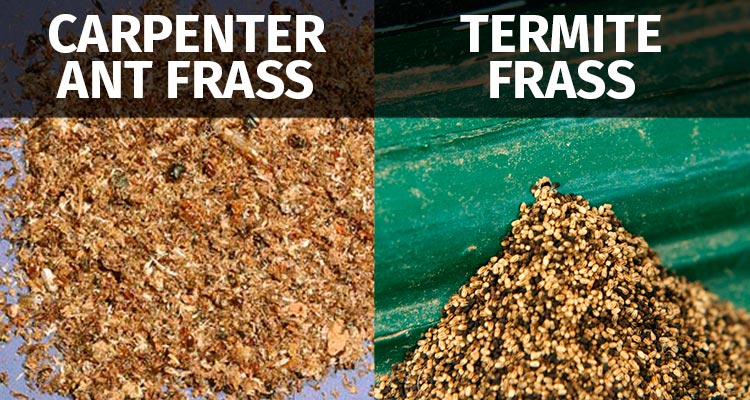
Homeowners often notice small piles of debris and assume it is just sawdust. Sometimes it is. But sometimes it is a sign of insect activity.
Carpenter ant frass usually contains wood shavings, insect parts, and debris. Drywood termite droppings are more pellet-like and uniform. Subterranean termites usually do not leave dry pellet piles because they use fecal material to build mud tubes.
If you suspect pellets or unusual debris, read: how to identify termite droppings in the house.
Ant Hills, Termite Hills, and Mounds
Outdoors, ants and termites may both create visible activity in soil, but large termite mounds are not a typical residential clue for most homeowners in the United States. In everyday home settings, people are more likely to notice termite signs in wood, around foundations, near mud tubes, or during a swarm.
Ant hills are more familiar and more common in yards. So if you spot a small mound outside, ants are often the more likely explanation. Still, outdoor insect activity should not be used as the only deciding factor when indoor termite signs are present.
When It Is Probably Termites, Not Ants
You should take the situation more seriously if you notice several of the following signs together:
- shed wings indoors that are all about the same size;
- winged insects near windows, baseboards, or wooden trim;
- soft, hollow, or damaged wood;
- mud tubes near the foundation or crawlspace;
- small pellet-like termite droppings near trim, windows, or wood;
- repeated sightings rather than a one-time outdoor swarm.
These clues do not guarantee termites, but they make termite activity much more likely than a simple ant swarm.
If you are already seeing suspicious activity in specific areas of the house, review these signs of a termite infestation and compare them with what you have found.
If It Looks Like Termites, What Should You Do Next?
The right next step depends on what you found. Do not jump straight to spraying without identifying the risk level first.
| What You Found | What It May Mean | Best Next Step |
|---|---|---|
| One outdoor swarm near lights | Seasonal swarm nearby | Monitor and check nearby wood, foundation, and windows. |
| Shed equal-sized wings indoors | Possible termite swarmers inside or near the structure | Compare termite swarmers and consider inspection. |
| Mud tubes near foundation | Possible subterranean termite activity | Read about subterranean termites and soil treatment options. |
| Pellet-like frass near wood | Possible drywood termite activity | Compare drywood termite signs, borate treatment, and inspection options. |
| Visible damage, hollow wood, or repeated indoor swarms | Higher-risk termite situation | Schedule inspection and compare treatment paths before damage spreads. |
If you only saw one outdoor swarm and no other termite signs, monitor first and inspect the area carefully. If you find equal-sized wings indoors, mud tubes, frass, hollow wood, or repeated swarmers, do not keep guessing. Identification and inspection are usually cheaper than waiting until damage becomes visible.
What to Do if You Are Not Sure
If you are unsure whether you are dealing with flying ants or termites, do not ignore it. The safest next step is to compare a specimen closely or save one for identification.
Use this simple checklist:
- Take a clear photo of the insect from above.
- Check whether the waist is pinched or straight.
- Look at the antennae: bent means ant, straight means termite.
- Compare the wings: uneven wings suggest ant, equal wings suggest termite.
- Look nearby for mud tubes, hollow wood, droppings, or discarded wings.
- If signs point to termites, schedule an inspection or choose the right treatment path.
You can also check these related guides:
- How to identify termite swarmers
- Signs of a termite infestation
- When a termite inspection makes sense
- How to get rid of termites effectively
If the infestation appears localized and accessible, review our guide to the best termite sprays and foams for spot treatment to understand what works, what does not, and when professional help is the safer choice.
When a Termite Inspection Makes Sense
If you are seeing repeated swarmers indoors, finding suspicious wings, or noticing damage in multiple spots, a professional inspection is often the smartest next step. It becomes even more important if the home has older wood framing, previous termite history, mud tubes, or unexplained soft spots around trim, floors, or window frames.
- One outdoor swarm only: monitor and check the foundation, windows, lights, and nearby wood.
- Equal-sized wings indoors: compare with termite swarmers and inspect for hidden activity.
- Repeated indoor swarms, mud tubes, frass, or damage: use the termite inspection cost guide and the DIY vs pro decision guide before choosing treatment.
FAQ
What is the easiest way to tell flying termites from flying ants?
Look at the waist, antennae, and wings. Flying ants have a narrow waist, bent antennae, and uneven wing pairs. Flying termites have a thicker body, straight antennae, and four wings that are nearly equal in size.
Do flying termites mean I have an infestation?
Flying termites can mean a mature colony is nearby. If you see them indoors, find discarded wings, or notice wood damage, take it seriously and inspect further.
Are flying ants dangerous to a house?
Most flying ants are not a serious structural threat. However, carpenter ants can damage wood by excavating galleries, so repeated indoor activity should still be checked.
Why do I find wings near windows?
Both ants and termites may swarm near light and windows. Termite swarmers often shed their wings after landing, so piles of equal-sized wings near windowsills can be a warning sign.
Should I spray flying termites?
Spraying visible swarmers may kill the insects you see, but it does not eliminate the colony. If you suspect termites, identify the species and look for the source of activity.
What should I do if I cannot tell whether it is ants or termites?
Take a clear photo, save a specimen if possible, check the wings and antennae, and look for nearby termite signs such as mud tubes or hollow wood. If the signs point to termites, schedule an inspection.
Conclusion
Flying ants and flying termites may look similar at first, but the differences become much clearer when you focus on the waist, wings, and antennae. Ants have a narrow waist, bent antennae, and uneven wing pairs. Termites have a thicker body, straighter antennae, and wings of nearly equal length.
If you are seeing repeated swarms indoors, finding equal-sized discarded wings, or noticing signs of wood damage, do not assume the insects are harmless. Correct identification is the first step toward choosing the right treatment and protecting your home before the damage gets worse.
Related Reading
- How to Identify Termite Swarmers
- Subterranean Termites: Signs, Damage, Treatment, and Cost
- Termite Mud Tubes: What They Look Like and What to Do
- Termite Droppings: What Frass Looks Like
- 10 Signs of Termite Infestation
- Best Termiticide for Soil Treatment
- Best Borate Wood Treatment for Termites
- Best Termite Bait Stations for Home Protection
- Termite Inspection Cost: What Homeowners Should Expect
- Can I Treat Termites Myself or Do I Need a Professional?


It’s really a great and helpful piece of information. I’m satisfied that you shared this helpful information with us. Please keep us informed like this. Thank you for sharing.
I am actually grateful to the owner of this site who has shared this enormous article at here.