

Of all the household pests in the United States, termites cause some of the most expensive structural damage. They can quietly damage wooden structures, foundations, and framing for years before the problem becomes obvious. Most homeowners insurance does not cover termite damage, which makes early identification especially important.
One of the clearest early warning signs is the appearance of termite swarmers. Knowing what swarmers look like, when they appear, and what to do when you see them can help you respond before the damage becomes more serious.
- Swarmers indoors near windows, lights, or walls → save a specimen, check for wings and entry points, and inspect for hidden activity
- Discarded wings indoors → compare with flying termites vs flying ants
- Mud tubes or foundation activity → compare termite bait stations and soil treatment options
- Live activity inside walls or exposed wood → review termite foams and sprays for spot treatment
- Multiple swarms, visible damage, or recurring activity → start with the termite inspection cost guide and the DIY vs pro termite treatment guide
What Are Termite Swarmers?
Termite swarmers, also called alates, are winged reproductive termites. Their role is to leave an existing colony, find a mate, and start a new colony. They are not a separate termite species. Most termite species produce swarmers when the colony is mature and conditions are right.

When you see swarmers in or around your home, it usually means a mature termite colony is nearby. If they appear indoors, the warning is stronger because the colony may be inside, under, or very close to the structure.
What Do Termite Swarmers Look Like?
Termite swarmers can be confused with flying ants, especially when they appear near windows or lights. Look closely at the wings, antennae, and body shape.
- Size: termite swarmers are often about 1/4 to 1/2 inch long, including wings, depending on species.
- Shape: they have straight, bead-like antennae and a thick, uniform body without a narrow pinched waist.
- Wings: they have four wings that are nearly equal in length and extend past the body.
- Color: color varies by species. Subterranean swarmers are often dark brown to black, drywood swarmers can be tan to brown, and Formosan swarmers are often yellowish-brown to reddish-brown.
Signs of an Active Swarmer Problem
When termites swarm indoors, they often emerge from small exit points in baseboards, door frames, window sills, posts, walls, or hidden wood. The most common signs include:
- live swarmers near windows, doors, or light fixtures;
- piles of discarded wings on windowsills, in webs, or on the floor;
- small exit holes in wooden surfaces;
- mud tubes running up the foundation or crawlspace walls;
- frass piles beneath wooden structures.
Termite swarmers are attracted to light, which is why many indoor swarms appear near windows and lamps. Discarded wings near these areas are one of the strongest signs to investigate further.
See our full guide on how to identify a termite infestation for the complete checklist.
Indoor Swarmers vs Outdoor Swarmers
| Where You See Them | What It Usually Means | What to Do |
|---|---|---|
| Indoors near windows or lights | Possible colony inside, under, or very close to the structure | Save specimens, check wings, inspect nearby wood, consider professional inspection |
| Outdoors near foundation | Colony may be in soil near the home | Check for mud tubes, moisture, wood-to-soil contact, and consider bait stations or soil treatment |
| Only outdoors away from the house | May be a nearby natural colony | Monitor, reduce moisture/wood debris, and inspect the foundation |
Why Do Termites Swarm?
Termites swarm to start new colonies. The trigger is usually a combination of three things:
- Colony maturity: the original colony is large enough to produce reproductives.
- Weather conditions: warm temperatures and high humidity, often after rain.
- Time of day: many species swarm during daylight hours, while Formosan termites often swarm at night.
When conditions align, swarmers leave the colony, fly short distances, drop their wings, and pair up. Each pair searches for a protected spot to start a new colony.
When Do Termites Swarm?
Different termite species swarm at different times of year. Knowing your local species helps you predict when to expect activity.
Subterranean Termites
Subterranean termites often swarm in early spring when temperatures rise, usually after a warm rain. They are the most common termite group in the United States and account for much of the structural damage nationwide.
Formosan Termites
Formosan termites often swarm from late spring through summer, typically on warm, humid evenings. Formosan colonies can be especially large and aggressive.
Drywood Termites
Drywood termites often swarm from late summer through fall, depending on region. They are more common in the southwestern United States, Florida, and coastal California.
Dampwood Termites
Dampwood termites often swarm in summer, especially in regions with wet wood and high moisture. They prefer damp, decaying wood and are less likely to attack sound, dry structural lumber.
How Long Do Termites Swarm?
A single swarm event often lasts less than an hour, but the full swarming season for a colony can span several days or weeks. New swarms may emerge on favorable days when temperature and humidity are right.
If you see one swarm, watch carefully over the next 1-2 weeks. This is the window when signs such as wings, exit holes, and visible swarmers are easiest to document.
Where Do Termite Swarmers Come From?
Swarmers emerge from existing colonies through specific exit points:
- cracks in foundations and walls, common for subterranean species;
- holes in soil in the yard near tree stumps or wood debris;
- mud tubes on the foundation, basement walls, or crawlspace;
- wood directly, when drywood termites cut tiny exit holes in infested furniture, framing, or walls.
If you see swarmers indoors, the colony may be inside, under, or directly next to the structure. If you see them outside near the foundation, the colony may be in the yard but close enough to justify inspection.
What to Do During a Termite Swarm
Finding swarmers is alarming, but it is also a useful moment to act. Here is the right response, in order:
- Do not panic and do not rely on household insecticide. Generic bug spray may kill the swarmers you see, but it does not eliminate the colony.
- Vacuum visible swarmers. Empty the bag outside immediately.
- Save a few specimens in a sealed container or photograph them clearly. This helps confirm the species during inspection.
- Check for entry points. Look for mud tubes, exit holes, frass, damaged wood, and discarded wings near where the swarm appeared.
- Treat the source. For active galleries inside walls, use a foam termiticide; for subterranean colonies in soil, consider bait stations or soil treatment.
- For severe or recurring activity, get a professional inspection.
Treatment Options After a Termite Swarm
- Active gallery inside a wall or baseboard → termite foam or spot treatment
- Mud tubes or soil activity near foundation → termite bait stations or soil treatment
- Exposed structural wood during repairs → borate wood treatment
- Repeated indoor swarms or visible damage → use the termite inspection cost guide and review termite damage signs before repairs
- Save a few specimens or take clear photos. This helps confirm whether they are termites or flying ants.
- Check the source area. Look for discarded wings, mud tubes, exit holes, frass, hollow wood, or moisture problems nearby.
- Choose the next step by evidence. Use the termite inspection cost guide and the DIY vs pro guide if swarms are recurring, indoors, or paired with visible damage.
Need a complete plan after identifying the swarm? Follow our step-by-step guide to getting rid of termites and preventing them from returning to compare soil treatment, bait stations, wall-void treatment, exposed-wood protection, and professional help.
Other Steps to Reduce Future Swarming
- Repair leaking pipes, broken downspouts, and dripping AC units.
- Ventilate basements and crawlspaces properly.
- Store firewood away from the house and elevated off the ground.
- Remove buried wood, stumps, and scrap lumber near the foundation.
- Apply a borate wood treatment to exposed structural wood during repairs.
- Schedule regular termite inspections if your area has termite pressure.
How Long Do Termites Live After They Swarm?
Most swarmers do not survive long after the swarm. Predators eat many of them, and many others die within a day if they fail to find a mate or a suitable nesting spot.
However, a successful pair can start a new colony. That is why indoor swarmers and discarded wings should never be dismissed as harmless.
Termite Swarmers vs Flying Ants: How to Tell Them Apart
The most common confusion in pest identification is termite swarmers versus flying ants. They look similar at a glance, but the differences are clear once you know what to look for.
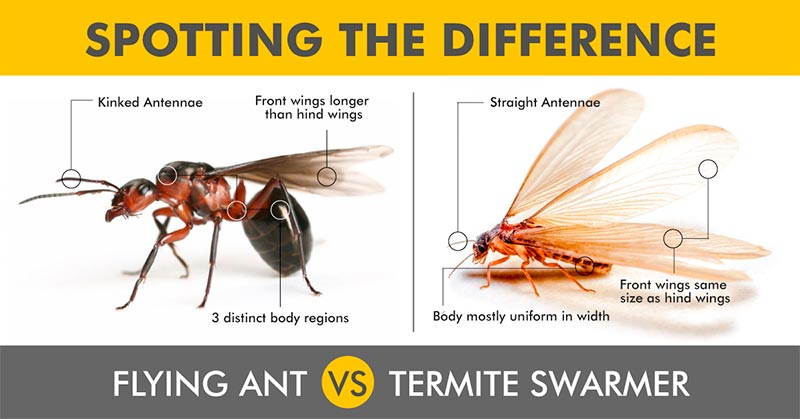
- Antennae: termite swarmers have straight, beaded antennae; flying ants have bent, elbowed antennae.
- Body shape: termites have a thick, uniform waist with no pinch; ants have a narrow pinched waist.
- Wing structure: termite wings are nearly equal in length; ant wings are different sizes, with the front pair larger than the back pair.
- Wing texture: termite wings are often translucent with a milky quality; ant wings are clearer with more visible veins.
For more detail, see our guide on flying termites vs flying ants.
FAQ
What month do termite swarmers appear?
Subterranean termites often swarm in spring. Formosan termites often swarm from late spring through summer. Drywood termites often swarm from late summer through fall. Exact timing depends on climate, species, and recent weather.
Are termite swarmers a sign of infestation?
They can be, especially when you see them indoors. Indoor swarmers may mean a mature colony is established inside, beneath, or very close to the structure. Outdoor swarms are less direct, but they still mean termite colonies are active nearby.
Do termite swarmers bite?
No. Termite swarmers do not bite or sting people. The risk is not the swarmer itself, but the colony that produced it or the new colony it may start.
How do you kill termite swarmers fast?
Vacuum visible swarmers and empty the bag outside. Avoid relying on household spray as the main solution. Killing the visible swarmers does not eliminate the colony.
Can I ignore a termite swarm if it happens outside?
You should not ignore it. Outdoor swarms mean termite colonies are active nearby. Inspect the foundation, check for mud tubes, remove wood debris, and monitor for indoor signs.
Why are there termite swarmers in my house but no other signs?
Indoor swarmers often emerge from hidden colonies inside walls, beneath floors, in crawlspaces, or near the foundation. Lack of other visible signs does not mean the colony is absent.
What kills the entire termite colony?
For subterranean termites, bait stations and liquid soil treatments are common colony-control paths. For drywood termites, localized foam treatment or professional fumigation may be needed depending on the infestation.
Conclusion
Termite swarmers do not eat your home, but they are one of the clearest warnings that a mature colony may be nearby. A swarm can be the difference between catching an infestation early and discovering hidden structural damage later.
When you see swarmers, act quickly:
- Visible indoor activity → save specimens, check for wings, and inspect the source.
- Active wall galleries → spot foam treatment.
- Colonies in soil near the foundation → bait stations or soil treatment.
- Exposed structural wood → borate treatment.
- Severe or recurring activity → start with termite inspection cost and DIY vs pro treatment guidance.
A swarm is not the end of your home. It is a warning system. Listen to it early.
Related Reading
- Flying Termites vs Flying Ants: How to Tell the Difference
- Subterranean Termites: Signs, Damage, Treatment, and Cost
- Termite Mud Tubes: What They Look Like and What to Do
- 10 Signs of Termite Infestation
- Best Termite Killer for Soil: Termidor SC vs Taurus SC
- Termite Inspection Cost: What Homeowners Should Expect
- Can I Treat Termites Myself or Do I Need a Professional?
- Termite Damage: Signs, Pictures, and What to Do


Thank you for all of this information, been dealing with this for a bit thinking it was something else, I have been bitten and stung by these pests and they really hurt, very dilabetating. Im hoping to do these methods given here in article, if it fails I will call exterminator.
I do have a question do they find humans as hosts? and do they put out an odor at all during infestation? because I have been noticing this smell only happens certain times. Smells sweet and musty all at once.
I really appreciate your list of ways to stop termites from swarming your house. I never knew that moisture from things like leaking pipes could contribute to a termite infestation, which makes sense that we’re experiencing one now after we recently had some plumbing issues. I’ll get a termite extermination professional to stop by our place and make sure we get rid of them as soon as possible.