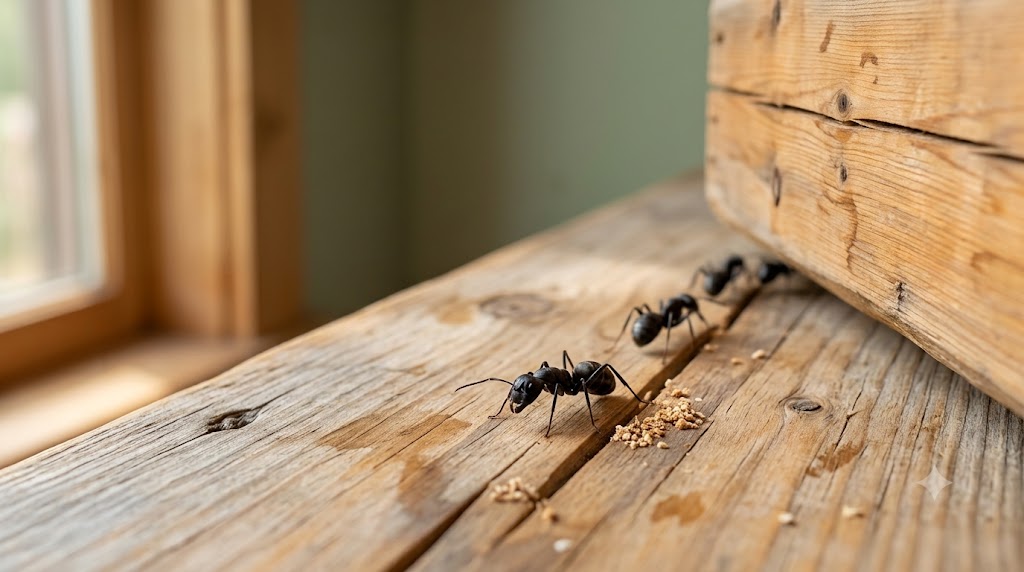
Carpenter ants are not the same problem as a small trail of kitchen ants. They do not eat wood like termites, but they can excavate galleries in damp, decaying, or previously damaged wood. A few large ants near a window may be foraging from an outdoor nest. Repeated activity around a wet wall, soft trim, deck post, bathroom, or ceiling can mean the colony is much closer.
Quick Answer: How to Get Rid of Carpenter Ants
- Confirm that the ants are carpenter ants. They are usually large, but size alone is not enough.
- Follow their route and look for moisture. Check damp wood, leaks, hollow areas, stumps, firewood, and branches touching the house.
- Use bait where workers forage. Give them time to carry it back; do not spray over an active bait route.
- Fix the condition that supports nesting. Repair leaks, dry wet materials, and replace badly damaged wood when needed.
- Use a perimeter treatment only as support. It can reduce entry from outside, but it does not replace finding a nest in a wall or wet structure.
If you are not sure whether you are seeing ants or termite swarmers, start with Flying Termites vs Flying Ants: How to Tell the Difference.
| What you find | What it may mean | Best next move |
|---|---|---|
| Large ants on an exterior wall or tree | Foraging from an outdoor nest. | Follow the route, trim access, bait the route, and inspect nearby damp wood. |
| Ants near a leak, window, bathroom, or soft trim | A satellite nest may be close to moisture-damaged wood. | Repair the moisture source and consider a professional inspection. |
| Coarse sawdust-like debris with insect parts | Possible carpenter-ant frass from an excavation site. | Save a sample or photo; inspect the area and rule out termite signs. |
| Shed equal-sized wings, mud tubes, or hollow structural wood | More consistent with a termite concern. | Use the termite guide and arrange an inspection instead of assuming ants. |
How to Identify Carpenter Ants Before You Treat
Most carpenter ants are noticeably larger than common pavement or odorous house ants, often black, reddish-black, or dark brown. But colour and size vary by species, so the setting and evidence matter just as much. Carpenter ants are especially attracted to moisture-damaged wood, though they can also nest in sound wood, foam insulation, voids, and outdoor structures.
Look for a steady route at dusk or early morning, especially near window frames, rooflines, plumbing penetrations, decks, porches, stumps, stacked firewood, and trees that touch the house. If you see winged insects, do not guess from colour. Compare the waist, antennae, and wings with our flying ants versus flying termites guide.
Carpenter Ant Frass vs Termite Droppings
Carpenter ants excavate wood and push debris out of their galleries. Their frass can look like coarse sawdust, but it may also contain bits of dead insects and insulation. Drywood termite droppings are more uniform, pellet-like, and granular. Subterranean termites usually leave mud tubes rather than a dry pile of pellets. When the material is near structural wood and you cannot tell what made it, treat it as an inspection issue rather than a cleaning job.
See how to identify termite droppings in the house and what termite damage looks like for the signs that should not be ignored.
Step 1: Find the Foraging Route and the Moisture Problem
Do not start by sealing the first crack you see. Watch the ants long enough to learn whether they are entering the building, leaving it, or travelling between outdoor food sources and a sheltered area. A carpenter-ant colony may have more than one nesting site, so the point where you see ants is not automatically the nest.
- Check under sinks, around dishwashers, tubs, roof leaks, and window flashing.
- Probe visibly soft, swollen, or water-stained trim without opening a wall unnecessarily.
- Inspect outdoor stumps, landscape timbers, firewood, mulch, deck posts, and trees near the structure.
- Trim branches and vines that give ants a direct bridge to siding, eaves, or windows.
- Mark where activity is strongest before cleaning or treating the route.
Correcting water intrusion is part of carpenter-ant control, not a cosmetic extra. A bait may reduce active foragers, but a wet void or rotted sill can remain an attractive nesting site until the building condition changes.
Step 2: Bait Active Foragers Instead of Spraying Them First
For a route that is actively carrying workers, bait is often the useful first move. The goal is not to make the surface look quiet immediately. It is to let workers take a slow-acting product back to the colony. Carpenter ants can change food preferences, so bait acceptance is a practical signal: place it along the route, protect it from rain and disturbance, and follow the label exactly.
Specialized Carpenter-Ant Bait
Advance Carpenter Ant Bait
A granular bait formulated specifically for carpenter ants. It is most useful on active outdoor routes and around the base of a structure or tree when those placements are allowed by the label. It is not a reason to skip moisture repair or an inspection of suspect structural wood.
Where Bait Belongs
- Beside a confirmed foraging route, not in the middle of a broad open area.
- Near the base of an exterior wall, tree, stump, or other route only if the label permits it.
- In a dry, protected location that is inaccessible to children and pets.
- Far enough from repellent sprays that workers are not driven away from the bait.
Do not put bait on food-preparation surfaces, mix it with another pesticide, or scatter it where it can wash into drains or water. More product is not better. The label controls the placement, rate, and reapplication timing.
Step 3: Do Not Rely on a Surface Spray to Solve a Hidden Nest
A contact spray can kill the ants you hit, but it does not tell you where the colony is. Broadly spraying a trail while you are trying to bait can make workers avoid the route or shift activity elsewhere. That makes diagnosis harder and can reduce bait acceptance.
If you need an outdoor barrier after baiting has begun to reduce repeated entry, use a perimeter product only where its label allows. Treat it as support for exclusion and source reduction, not proof that the nest is gone.
For Exterior Entry Routes
Ortho Home Defense Insect Killer
A perimeter product for ants at foundation lines, doors, and windows where the product label permits. Use it to reduce outdoor entry pressure after you have inspected the route and addressed moisture. It is not a substitute for locating a carpenter-ant nest in damaged wood.
Step 4: Repair Water Damage and Remove Access
Once activity is falling, address the conditions that made the site useful. Repair plumbing and roof leaks, correct poor drainage, dry wet cavities, and replace wood that is badly decayed. Then seal cracks around trim, pipes, utility penetrations, doors, and windows. Do not seal a suspected active nest inside a wall before you know what is happening; trapping activity behind a repair can make later diagnosis more difficult.
For the practical exclusion details, use our pest barriers for doors and windows guide. For a broader household-ant process, read How to Get Rid of Ants in the House.
When a Carpenter-Ant Problem Needs a Professional
Professional help is worthwhile when the likely nest is in a wall, ceiling, roofline, or structural wood, particularly when moisture damage is present. An inspection can distinguish ants from termites, identify the nesting area, and show whether wood repair is needed before treatment is considered complete.
- Large ants keep appearing after careful baiting and exterior source reduction.
- You find frass-like debris, a hole in trim, soft wood, or a persistent rustling sound in a wall.
- Activity is concentrated near a leak, skylight, window, shower, or roof area.
- You see winged insects indoors, equal-sized shed wings, mud tubes, or possible termite damage.
- The affected wood is structural, difficult to reach, or visibly deteriorated.
Carpenter Ants vs Termites: The Practical Difference
Carpenter ants excavate galleries for nesting. Termites consume cellulose materials. Either problem can be serious when it involves structural wood, but the evidence and treatment path are different. Do not use an ant bait as a response to possible termite activity, and do not assume every pile of debris is carpenter-ant frass. Our ant versus termite identification guide and termite damage guide can help you decide when the next step should be an inspection.
Frequently Asked Questions
Do carpenter ants eat wood?
No. They excavate wood to create galleries and nesting space. Their presence can still point to wet, decaying, or damaged material that needs repair.
Will bait get rid of carpenter ants?
Bait can reduce a colony when workers accept it and carry it back. It works best as part of a plan that also identifies the route, removes moisture, and addresses exterior nesting sites. A nest in structural wood may still require professional treatment and repair.
Should I spray carpenter ants first?
Usually no. Spraying an active route can interfere with baiting and does not locate a hidden nest. Reserve a perimeter product for the appropriate labeled exterior use after you have assessed the route and moisture issue.
How do I know if the damage is from carpenter ants or termites?
Carpenter-ant debris is often coarse and mixed with insect fragments. Drywood termite droppings are small, uniform pellets, while subterranean termites often leave mud tubes. Wing shape, antennae, and body shape also help when swarmers are present. When structural wood is involved, an inspection is the safer call.
Can carpenter ants come back after treatment?
Yes. If leaks, damp wood, firewood, tree contact, or exterior gaps remain, the property can still attract foraging ants or satellite nests. Long-term control depends on reducing those conditions as well as treating active routes.
Need to compare bait, gel, and perimeter options?
This page focuses on carpenter-ant routes and nesting conditions. For a broader comparison of household ant products, including different bait and spray formats, see our main guide.