Cockroaches in Your Home: Identification, Control & Prevention

Cockroaches in house don’t just wander in. They come because your home offers them what they need: water, food, and warmth. Kill the ones you see and more will follow — because the conditions that invited them are still there. This guide explains how to identify the species of cockroaches in house, spot the early signs, and stop them at the source, not just on the counter.

Why Cockroaches in House Appear: What They Actually Want

Every case of cockroaches in house is a supply problem. If your home wasn’t giving them something they need, they’d be somewhere else. In order of importance, roaches are looking for:

  • Water — the #1 driver. A German cockroach can survive weeks without food, but only about a week without water. Leaky pipes under sinks, condensation on cold water lines, pet water bowls left out overnight, and standing water in drain traps are all invitations.
  • Food access — crumbs behind the toaster, grease on the stovetop, pet food in an open bag, unsealed pantry items. They will eat almost anything organic, including cardboard, book bindings, and soap.
  • Shelter and warmth — cracks around baseboards, gaps behind appliances, cardboard clutter under sinks, and warm motor housings (the back of your fridge is a five-star roach hotel).

This is why kitchens and bathrooms are the two rooms where infestations start. Fix the supply problem, and the roaches lose their reason to stay. Products speed up the kill, but products alone don’t solve the reason they’re there.

Common Species in US Homes: Quick ID

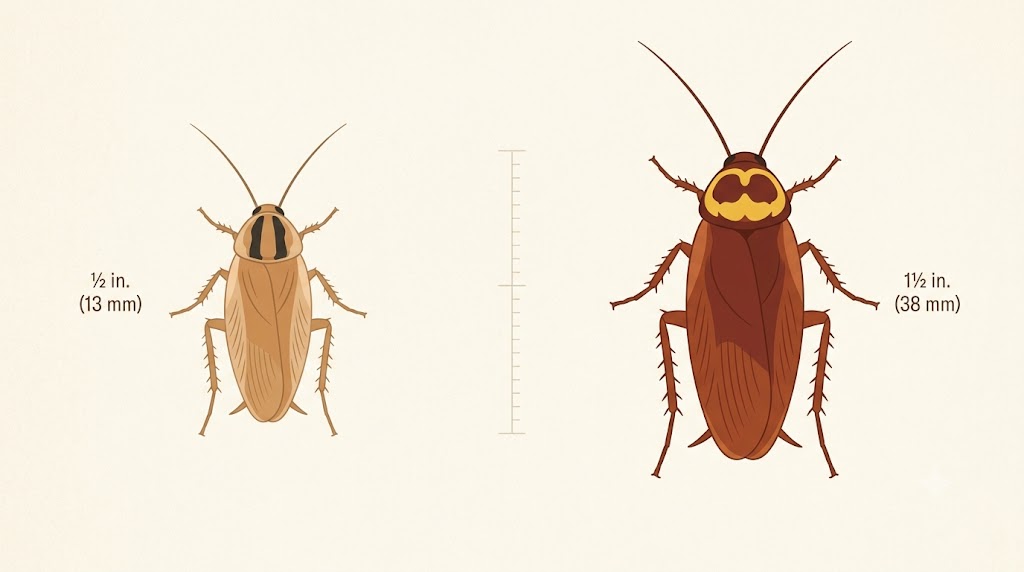
Getting the species right matters. The product that eliminates a German cockroach infestation in a kitchen will barely touch an American cockroach living in a crawlspace. Here’s what you’re likely to be dealing with:

SpeciesSizeColorWhere You’ll Find ItKey Fact
German½–⅝ inchLight brown / tan, two dark stripes on the pronotumKitchens, bathrooms — indoor onlyEgg case incubates in about 28 days; a female produces 4–8 cases of 30–40 eggs and over 300 offspring in her lifetime (University of Florida). This is the species that turns a “saw one” into an infestation fastest.
American1¼–2 inchesReddish-brown, yellowish figure-8 marking on headBasements, crawlspaces, drains, garages, mulch bedsOutdoor-origin. Comes in through drains, garage gaps, and around utility penetrations. Kitchen appearances mean an outdoor colony is thriving nearby.
Oriental1 inchVery dark, almost black, greasy sheenCool damp areas — basements, drains, under porchesSlower and less agile than others. Often the first roach spotted in older homes with humidity problems.
Brown-banded½ inchLight brown with two pale bands across wingsWarm dry areas — behind picture frames, in electronics, upper cabinetsUnlike German, prefers drier areas. Gets missed because people look under sinks instead of behind the TV.

The two you’ll actually encounter in a US home 90% of the time are German and American, and they require noticeably different strategies. We cover the difference in detail — including how to tell them apart from photos and droppings — in our guide to German vs American cockroaches.

How to Know You Have Cockroaches in House: Warning Signs

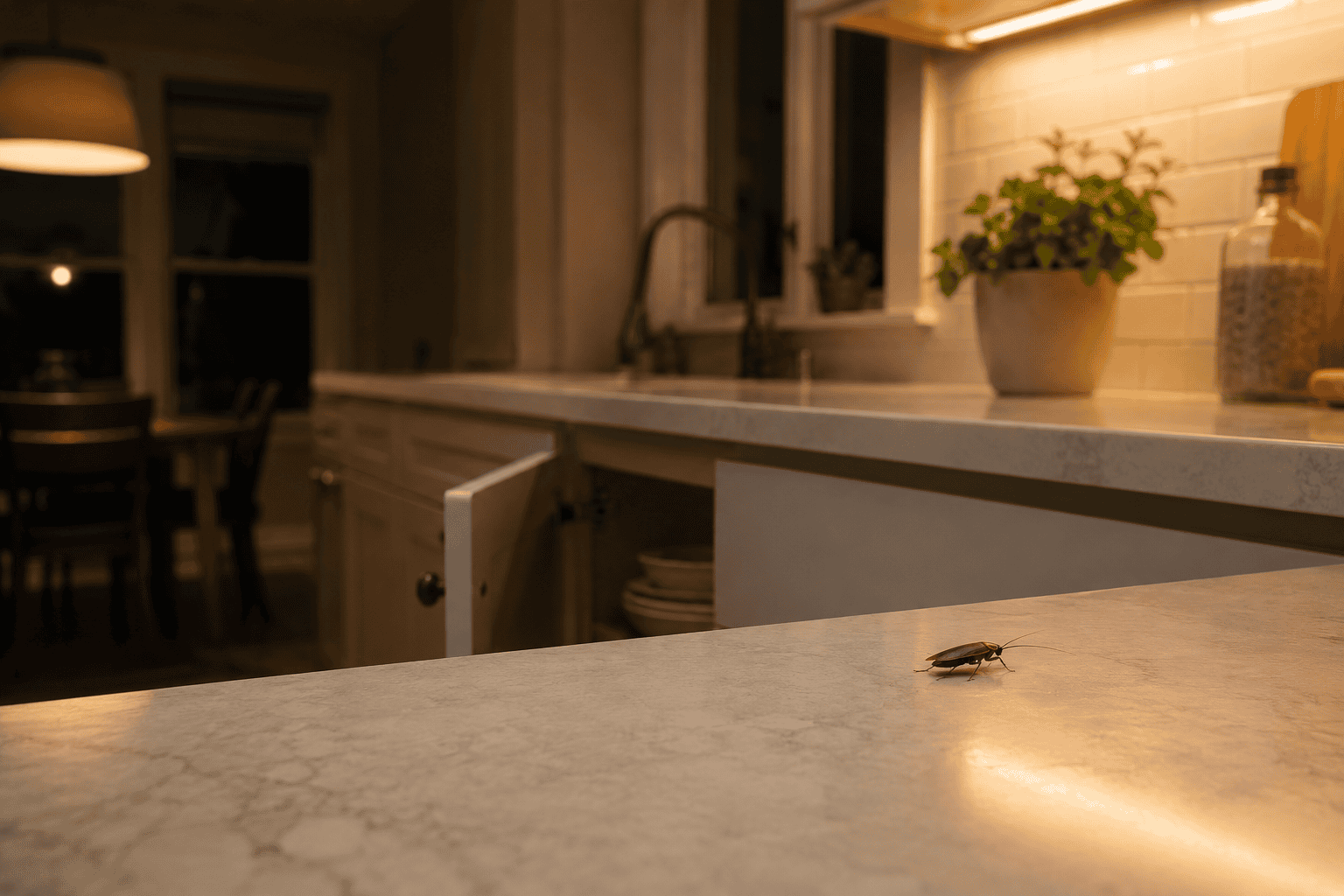
By the time you see a roach in daylight, the colony is already established. Roaches hide during the day and only push out into open space when their normal hiding spots are full — meaning the population has outgrown the space. If you’re seeing one, there are almost certainly dozens more you’re not seeing.

Earlier and more reliable warning signs:

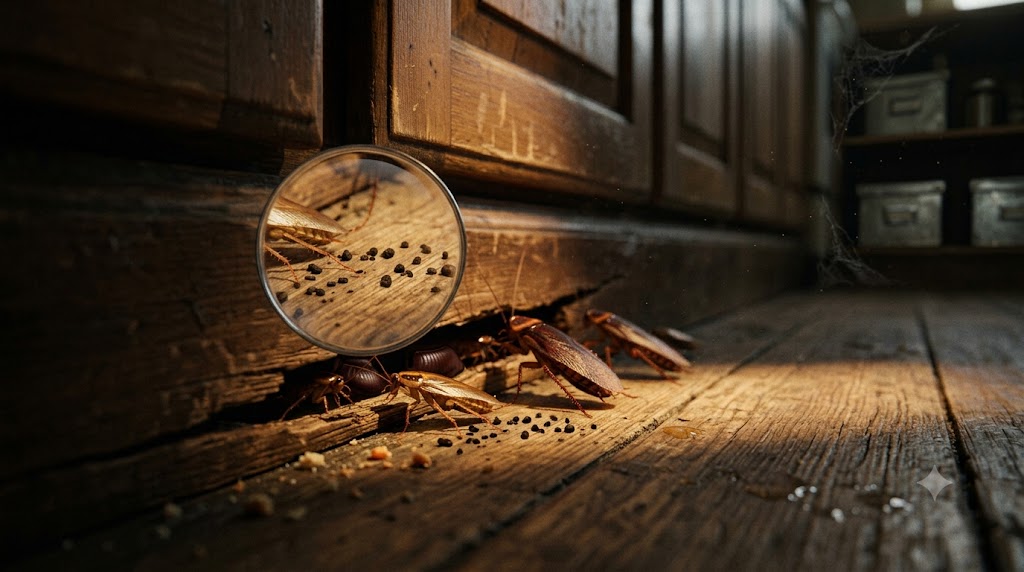
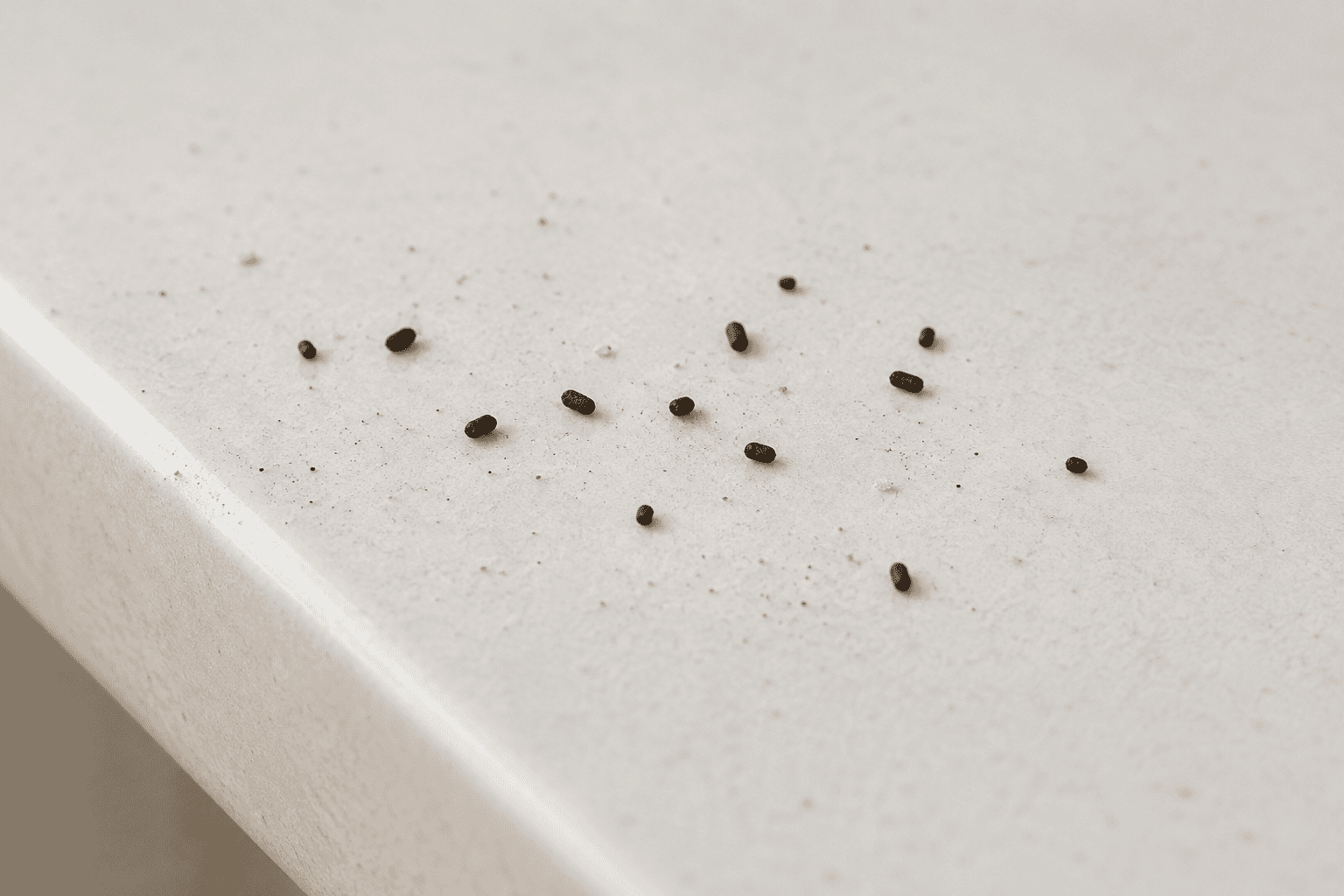
  • Droppings — small roaches leave what looks like ground coffee or black pepper along baseboards and inside cabinets. Larger roaches leave capsule-shaped droppings, roughly the size of a rice grain, often with ridges along the sides.
  • Egg cases (ootheca) — small, dark, purse-shaped capsules stuck to hidden surfaces. German roach cases stay attached to the female until hatching; American roach cases are dropped and can be found in undisturbed corners.
  • Musty, oily smell — a distinct chemical odor near an active harborage. If a room smells “wrong” and you can’t place why, and it’s stronger near cabinet bases, that’s often the signal.
  • Smear marks — dark, greasy streaks along baseboards, on wall-to-cabinet joints, and around door frames. Roaches rub against surfaces as they navigate in the dark.
  • Daytime sightings — the escalation trigger. Means the hiding population has exceeded available shelter.

If you’re not sure what you’re seeing, a monitoring trap tells you fast. Placed along baseboards under sinks and behind appliances for 3–5 nights, sticky traps confirm both presence and species. They’re a diagnostic tool, not a treatment — but they’re the cheapest way to know for sure. A pack of Catchmaster monitoring glue traps on Amazon costs less than $15.

For the full checklist and species-by-species identification photos, see our guide to the signs of a cockroach infestation.

The DIY Path That Actually Works

Most DIY roach treatments fail for one reason: they treat what’s visible instead of what’s breeding. Killing 20 adult roaches on a countertop with spray does nothing to the 200 nymphs and 30 egg cases hidden in a wall void. Two weeks later, the population is back — because the reproductive cycle was never interrupted.

A real DIY elimination is a system with four parts, and skipping any of them is why people call exterminators after a month of frustration:

  1. Remove water and food access — the environmental fix. This is the step everyone wants to skip. It’s also the step that decides whether the product step will actually stick.
  2. Deploy gel bait in cracks and crevices — the primary weapon. Non-repellent baits like Advion Cockroach Gel (0.6% indoxacarb) are the industry standard for a reason: roaches carry the active ingredient back to the harborage and spread it through feces and cannibalism. A single feeding roach can affect up to 40 others in the colony.
  3. Add an Insect Growth Regulator (IGR) — this is what separates real elimination from a temporary knockdown. IGRs like Gentrol prevent nymphs from maturing into breeding adults. Without an IGR, gel bait can drop the population 90% and it will still bounce back within a few generations.
  4. Monitor and hold the line — sticky traps in the same spots for weeks after the last sighting. The first sighting after treatment tells you where survivors are hiding.

Gel bait alone works for light infestations. Gel bait plus IGR works for real ones. Spray-and-fogger approaches almost always backfire — repellent sprays drive roaches deeper into wall voids and stop them from taking the bait, which is exactly the wrong outcome. The step-by-step DIY walkthrough for each species is coming next in this cluster.

When to Skip DIY and Call a Pro

DIY makes sense when the infestation is caught early and confined. It stops making sense in a few specific scenarios:

  • Apartment or attached housing — if neighbors have roaches, DIY on your unit alone is a losing game. Roaches will re-enter through shared walls, plumbing chases, and outlets no matter how well you treat. A building-wide treatment or a professional is often the only path.
  • Heavy infestation (daytime sightings, roaches in electronics, roaches in bedrooms) — populations this large usually mean the harborage is inside a wall void that gel bait can’t reach efficiently.
  • Immunocompromised, elderly, or asthmatic household members — roach allergens are a documented asthma trigger, and delay costs more than treatment.
  • DIY for 4+ weeks without improvement — either a diagnostic problem (wrong species, wrong product) or a structural one (colony in a place you can’t reach).

If any of these apply, jump straight to our comparison of the best pest control services instead of losing weeks to DIY.

If you’re at the point of buying, three products cover the vast majority of home cockroach situations. The full comparison with dosages, application patterns, and species matches will follow in a dedicated buyer’s guide within this cluster.

  • Advion Cockroach Gel Bait (Syngenta) — the pro-grade standard. Works against every species in the table above, including gel-bait-averse German strains. Available on Amazon (4-tube pack) for fast delivery, or on DoMyOwn (pro-grade DIY specialist) if you want the same product from a pest-control retailer with pro-grade documentation.
  • Gentrol Point Source IGR — the companion product that prevents nymphs from breeding. Not a standalone kill, but the difference between “population dropped for two months” and “population gone.” Compare current formats and pricing on DoMyOwn.
  • Catchmaster monitoring glue traps — cheap, essential for both diagnosis and post-treatment monitoring. Amazon is fine for these — they’re a commodity.

A note on natural products: essential-oil sprays and diatomaceous earth have a role in prevention and light activity — we cover natural options in our natural pest control roundup — but they’re not a match for an active roach infestation. Setting honest expectations now saves you from buying the wrong thing.

Prevention: How to Keep Them From Coming Back

Once the population is down, prevention is what makes it stay down. The same conditions that let them in the first time will let another wave in if nothing changes. Prevention isn’t a product — it’s a maintenance routine:

  • Seal entry points — caulk around pipe penetrations under sinks and behind appliances, weather-strip exterior doors, screen dryer vents and floor drains. Our guide to pest control barriers walks through exactly where to look.
  • Fix moisture problems — repair leaks the day you notice them, run a dehumidifier in damp basements, keep pet water bowls off overnight, dry the sink before bed.
  • Store food correctly — glass or hard-plastic containers with airtight lids. Cardboard cereal boxes and paper bags are not storage.
  • Remove cardboard clutter — under-sink storage of paper bags, delivery boxes, and old newspapers gives roaches ideal harborage and food at once.
  • Take out trash daily in kitchens with a history of activity, and rinse recyclables before storage.

If you’re renting and can’t do structural work, our guide on pest control for renters covers what you can do about cockroaches in house without landlord permission.

Frequently Asked Questions

Do cockroaches bite humans?

Rarely, and only in very heavy infestations where the population has exhausted food sources. It’s not a typical concern. The much bigger health risk is allergens — roach droppings, shed skins, and body parts are a well-documented asthma trigger, particularly in children.

How fast will gel bait get rid of roaches?

You should see a noticeable population drop within 3–7 days and dramatic reduction by week two. The delayed action is deliberate — a fast-kill would prevent secondary transfer to the rest of the colony. If nothing has changed after 10 days, the bait placement or species diagnosis is usually the problem.

Are roach foggers (“bug bombs”) effective?

Generally no, and often counterproductive. Foggers deposit particles on exposed surfaces, but roaches live in hidden voids the fog doesn’t reach. Worse, the pesticide acts as a repellent, driving the colony deeper into walls and away from any bait you’ve placed. Most professionals recommend against foggers for roach control.

Do ultrasonic roach repellers work?

Independent research doesn’t support the marketing claims for these devices against cockroaches. Save the money for gel bait and an IGR.

One roach or an infestation — how do I know?

A single American cockroach in a basement in summer is often a stray from outdoors. A single German cockroach in a kitchen is almost always the visible tip of a hidden population — they’re indoor-only breeders and don’t wander alone. Set monitoring traps for 3–5 nights and let the count decide.

Can I treat cockroaches naturally without pesticides?

You can suppress light activity with sanitation, diatomaceous earth in cracks, and sealing entry points. You generally can’t eliminate an established indoor breeding population that way — the reproductive rate outpaces the kill rate. If pesticide-free is a hard requirement, professional heat treatment is the realistic path.


PestsGuide gives independent DIY pest control guidance for US homeowners and renters. When you buy through links on this page we may earn a commission, at no extra cost to you. We don’t recommend products we wouldn’t use in our own homes.

RECOMMENDED