Renting comes with a uniquely frustrating pest control problem: you see the ants, you smell the mice, you hear the roaches — but you may not be able to do everything a homeowner would do. You usually cannot drill holes, alter shared structures, spray restricted pesticides, or hire your own exterminator and automatically bill the landlord. And calling the landlord too often can feel stressful when you are trying to protect your housing record.
The good news: there is a lot you can usually do on your own without damaging the unit. This guide walks through seven renter-friendly pest control products for 2026, plus a practical breakdown of documentation, landlord communication, and when to escalate. Most products here are removable and low-damage, but always check your lease and local rules before applying any pesticide, bait, sealant, or treatment.
If you rent and are not sure what pest you are seeing, start by documenting the signs and comparing them with our common household pest identification guide. This can help you describe the problem more clearly before buying products or contacting your landlord.

Quick Answer: 3 Renter-Friendly Pest Control Products to Start With
If you only have time to buy three things, start here. These cover the three pillars of renter pest control — block entry, deter what’s around, catch what’s already inside — without violating any lease clause:
Block Entry — Foundational Prevention
Holikme Door Draft Stopper
The single largest entry point for most apartment pests is the gap under your front and back doors. The Holikme draft stopper closes that gap with zero installation — just slide it under. Removable, lease-safe, and works as insulation too.
Deter What’s Around — Passive Coverage
Bell+Howell Pest Repeller Max (6-Pack)
Six ultrasonic plug-in units can be used as a low-effort support layer, with one placed in each room where you want coverage. They do not replace sanitation, sealing, traps, or landlord action for active infestations.
Catch What’s Inside — Active Capture
Catchmaster Sticky Traps
A useful monitoring trap for roaches, ants, spiders, silverfish, and other crawling pests. Place under sinks, behind the fridge, and along baseboards. For mice, use sticky traps only as monitoring evidence and escalate recurring rodent activity to the landlord.
Prices and availability change frequently — click through to Amazon for current pricing. PestsGuide.com earns from qualifying purchases (Amazon Associates).
Looking for Renter-Friendly Product Ideas?
If you need removable or low-toxicity pest control tools, start with our natural pest control product guide before buying random products.
See Natural Pest Control Products
Know Your Rights as a Renter
Before you do anything, understand the legal framework. In most US states, your landlord is obligated to provide a “habitable” living space — and that includes pest-free conditions. This is called the implied warranty of habitability, and it’s recognized in nearly every state except Arkansas.
What this means in practice: if you have a serious infestation (especially in a multi-unit building), the landlord is generally responsible for paying for professional pest control. Tenants are typically responsible for keeping the unit clean enough not to attract pests in the first place. The split depends on cause: if mice came in through a structural gap the landlord failed to seal, that’s on the landlord. If you left food out for three weeks and ants arrived, that’s likely on you.
State variation matters. California, New York, New Jersey, and Massachusetts have strong tenant protections — bed bugs in particular are almost always the landlord’s financial responsibility. Florida, Texas, and Georgia have weaker tenant pest laws, which often defaults the responsibility to whichever party caused the problem (and the burden of proof is on the tenant).
Single-family rentals versus apartment buildings also differ. In a detached rental home, the lease often places more pest responsibility on the tenant (since there are no shared walls). In multi-unit buildings, pest issues are typically structural and shared, putting responsibility on the landlord.
Always read the pest control clause in your lease. Some leases explicitly state who pays for what. Some require tenants to report infestations within a specified time window (often 24-72 hours) to preserve their legal rights. Missing this window can shift responsibility to you. If your lease is silent on pests, your state’s default tenant law applies.
This article is general information, not legal advice. For state-specific tenant rights, consult your state’s housing authority, legal aid office, or a local tenant rights organization (search “[your state] tenant rights pest infestation” for current state-specific resources, which are updated more frequently than third-party guides).
What You Can and Cannot Do Without Landlord Permission
This is the question every renter actually wants answered. Here’s the realistic breakdown for a typical US lease:
| ✓ Allowed (in most leases) | ⚠️ Gray Area (ask first) | ✗ Not Allowed Without Permission |
|---|---|---|
| Plug-in ultrasonic devices Removable door/window seals Natural sprays (peppermint, vinegar) Sticky traps and snap traps Gel baits in cracks (washes off) Liquid ant bait stations Airtight food storage Diatomaceous earth (food-grade) Cleaning, vacuuming, mopping Documenting infestations | Caulking small gaps Steel wool in pipe gaps Sealing dryer vents Window screen repair Treating outdoor patio area Cleaning shared hallways Installing door sweeps | Spraying pesticides (especially restricted-use) Foggers and bug bombs Drilling holes for fixtures Treating shared walls, HVAC, plumbing Cutting into walls or flooring Hiring an exterminator and billing landlord Tampering with shared structures Removing window screens Treating outside common areas |
The single biggest mistake renters make is using foggers (bug bombs). Almost every standard residential lease forbids them — the residue stains surfaces, the propellant is flammable, and in multi-unit buildings the chemicals can drift into neighboring units. Don’t use foggers. Ever. Use the products in this guide instead.
1. Holikme Door Draft Stopper

The first place pests enter most apartments isn’t a hole in the wall — it’s the half-inch gap under the front door. House mice can squeeze through a quarter-inch gap. Roaches, ants, and silverfish need even less. The Holikme draft stopper closes that gap completely with zero installation. You unbox it, slide it under the door, and it stays put against the threshold.
For renters this is the perfect prevention product: no adhesives, no screws, no drilling, no permanent change to the door. When you move out, it comes with you. The same model is featured in our deeper pest barriers guide, where we walk through how to combine it with window seals for full-perimeter coverage.
It also doubles as draft insulation — apartments with poor weather sealing can lose meaningful heating/cooling efficiency through door gaps. Pest prevention plus a small utility bill drop is a fair trade for the price.
- Zero installation — fully removable
- Blocks insects, mice, and drafts
- Single size fits most exterior and interior doors
- Reusable for years
- Doubles as energy-efficiency upgrade
- Addresses door gaps only — not windows, vents, or plumbing
- You’ll step over it entering the apartment
- Curious pets may move it
- Limited color/style options
2. Chef’s Path Airtight Food Storage Set

Most apartment infestations start in the pantry. Flour, sugar, cereal, pasta, pet food — anything stored in original packaging is fair game for pantry moths, weevils, ants, and rodents. Cardboard tears, plastic bags can be chewed through, and paper boxes wick moisture that attracts pests further.
The Chef’s Path airtight set replaces all of that with completely sealed BPA-free plastic containers. The locking lids create a true airtight barrier — pests can’t smell what’s inside, and even if they could, they can’t get in. The set is stackable, which matters in small apartment kitchens where shelf space is limited.
This isn’t an exciting product, but it’s quietly the highest-leverage prevention purchase a renter can make. Pair it with thorough weekly cleaning of crumbs and food residue and you eliminate the food source that draws pests in the first place. Most ant and roach problems in apartments can be reduced 60-80% by food storage hygiene alone.
- True airtight seals — no pest access
- BPA-free and food-safe
- Stackable for small kitchens
- Reusable for years
- Visible content levels help reduce food waste
- Initial cost for a full set
- Some sizes may not fit standard bag quantities
- Requires kitchen reorganization
- Dishwasher compatibility varies by size
3. Bell+Howell Pest Repeller Max (6-Pack, 2025 Edition)
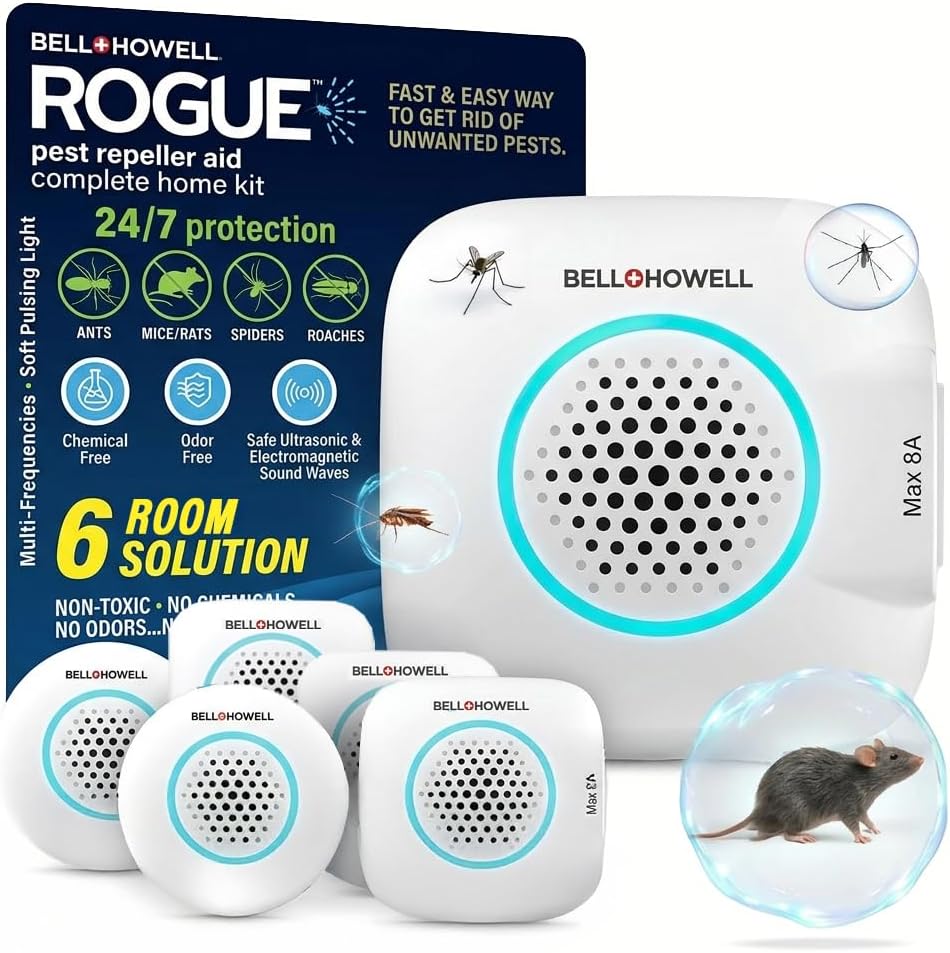
Ultrasonic pest repellers emit high-frequency sound waves that are marketed for pest deterrence. Effectiveness varies by pest, room layout, clutter, and product quality, so treat them as a support tool rather than the core plan. The Bell+Howell Pest Repeller Max comes in a six-pack, which lets you place one device in each room where you want coverage instead of expecting one plug-in to affect the whole apartment.
Ultrasonic waves do not penetrate walls well, which is the main mistake people make: buying one device and expecting it to cover three rooms. Even with several units, results can be limited if pests have food, water, nesting material, or an open entry route.
For renters, the appeal is that there is no installation, no spray residue, and no permanent change to the unit. If you move, you unplug and take them. We cover the ultrasonic category in more depth in our best ultrasonic rodent repellers guide, including where these devices fit and where they should not be relied on.
- Multiple plug-ins for room-by-room support
- Plug-in, no installation
- Silent to humans
- No chemical spray residue
- Completely removable when you move
- Effectiveness varies by pest type and apartment layout
- Results typically take 2-4 weeks to appear
- Ultrasonic waves don’t penetrate walls (need one per room)
- May affect small pets like hamsters or guinea pigs
4. Mighty Mint Peppermint Spray (16oz)
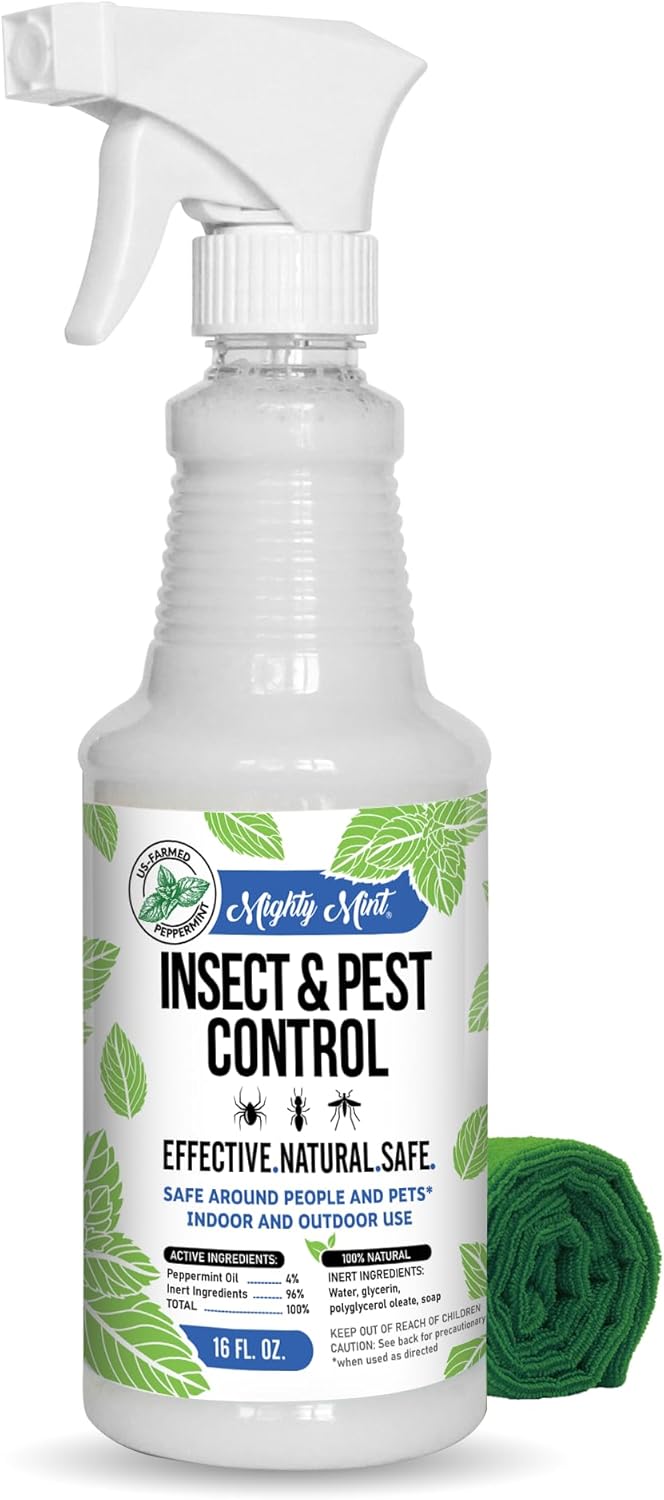
Here’s the question every renter asks: “Am I allowed to spray anything in my apartment?” The answer depends on your lease and the product label. Mighty Mint Peppermint Spray is a removable, low-residue scent deterrent, but it should still be used according to the label and kept away from sensitive pets, food-prep surfaces, and areas children touch.
Use it lightly along baseboards, cabinet corners, windows, under sinks, behind appliances, and suspected entry points if the label allows those surfaces. The strong mint scent may discourage some insects and rodents from using a route, but it does not remove an active infestation or close the gap pests are using.
It works best as a support deterrent rather than a killing product. If you already have a heavy infestation, peppermint spray alone will not solve it — pair prevention with monitoring traps, pest-specific baits, sanitation, and landlord notification when the problem is structural or recurring.
- Peppermint-based scent deterrent
- No conventional pesticide odor
- Pleasant scent (no chemical odor)
- Usually easier to remove than residual sprays
- Won’t stain or damage surfaces
- Scent fades within 24-48 hours — needs reapplication
- Deters but doesn’t kill
- Insufficient alone for established infestations
- Some pets dislike the strong scent
5. Catchmaster Sticky Traps

Catchmaster sticky traps are flat cardboard panels coated with adhesive that catch crawling pests that walk across them: cockroaches, ants, spiders, silverfish, crickets, and sometimes small rodents. No chemicals are released into the air. No bait is required. You simply place them along the natural travel routes pests use.
Best placements in an apartment: behind the refrigerator, under the kitchen sink, inside the bathroom cabinet, along baseboards in rooms where you’ve seen activity, behind the toilet, and in dark corners of closets. Inspect every 3-7 days, replace when full, and dispose in a sealed bag.
For renters, sticky traps solve a specific problem: they tell you what kind of infestation you actually have. If you find mostly cockroaches, you may need a roach bait plan. Mostly ants, use ant bait instead of spray. Spiders often point to other insects nearby. Mice should be treated as evidence of a possible structural entry point, especially in multi-unit housing.
- Pro-grade brand used by licensed exterminators
- Catches multiple pest types simultaneously
- Diagnostic value — shows what you’re dealing with
- Discreet placement (out of sight)
- No chemicals, no spraying
- Visible kills can be unpleasant
- Pets and small children may touch them — keep out of reach
- Not strong enough for larger rodents (use rat traps for those)
- Need to be checked and replaced regularly
6. Terro Liquid Ant Bait T300

The single most common renter pest complaint is ants — a line of them marching across the kitchen counter, around the sink, or into a pantry. The instinct is to spray and kill the visible ants. That’s exactly the wrong move. Killing visible workers doesn’t touch the colony. New workers replace them within hours.
Terro Liquid Ant Bait works by using a slow-acting borax-based liquid that ants carry back to the colony. For many common sugar-feeding ants, activity drops within 1-2 weeks. The first 48 hours after placement often look worse, not better — you may see a sudden surge of ants on the bait stations. This is expected because workers are feeding on the bait.
For renters this is the cleanest option available. The stations are pre-sealed, so there’s no liquid to spill on countertops or rental surfaces. They’re tiny — fit in tight corners and under appliances. Best results against sugar-loving species: Argentine ants, odorous house ants, pavement ants (the typical “small black ants in the kitchen”). Less effective against carpenter ants, which prefer protein.
- Kills the colony at its source, not just visible workers
- Pre-filled stations — no mixing, no spills
- Tiny stations fit anywhere
- No spray, no smell, no surface damage
- Amazon best-seller in ant control
- “More ants” effect for 48 hours (this means it’s working)
- Takes 1-2 weeks for full colony kill
- Less effective against carpenter ants (protein eaters)
- Toxic to pets if swallowed — place out of pet reach
7. Combat Roach Killing Gel
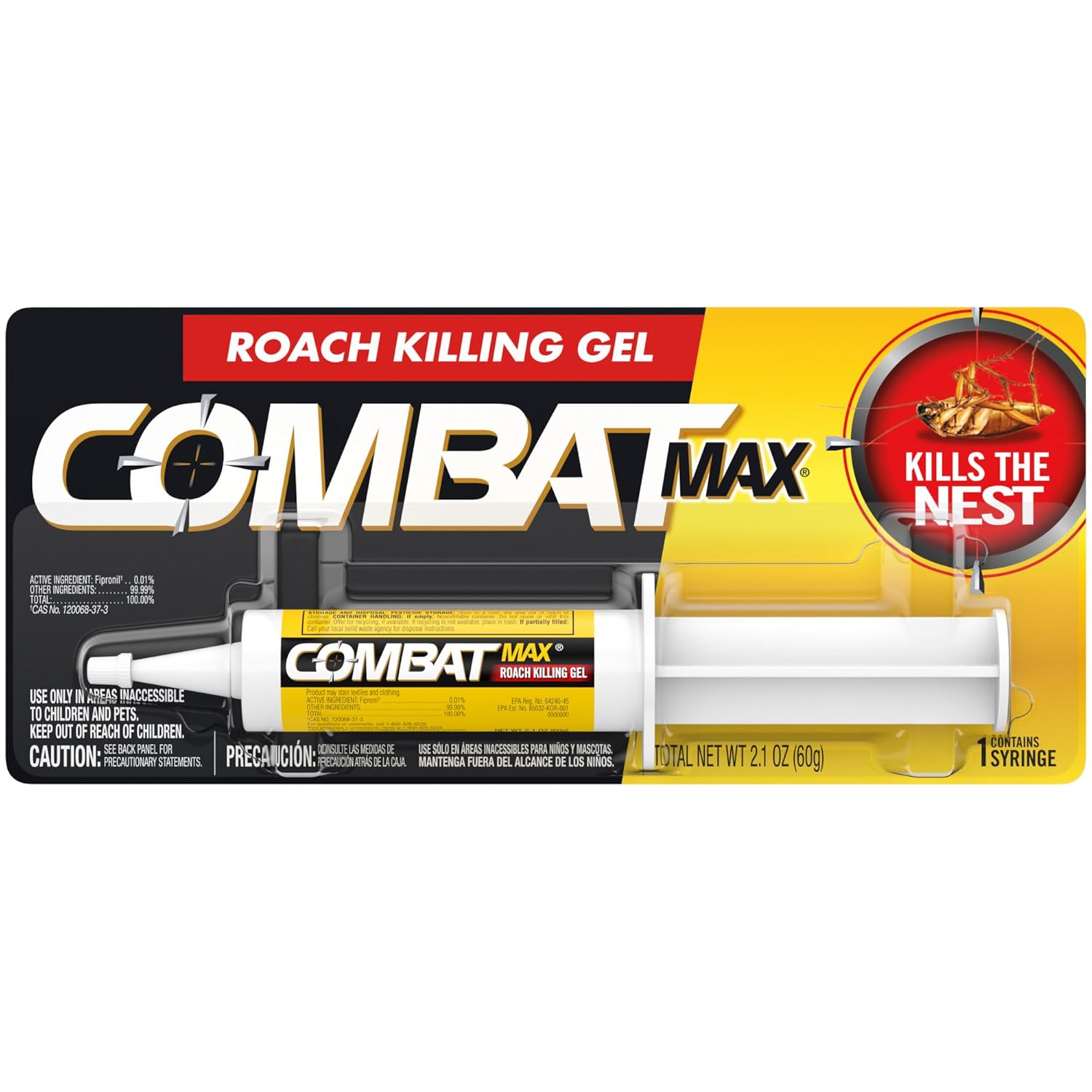
If you’re a renter, especially in a multi-unit building, cockroaches are the pest you fear most. They breed fast, they hide in shared walls and pipes, and they often migrate from neighboring units no matter how clean your own apartment is. Sprays don’t work — roaches scatter, hide, and come right back. Foggers are forbidden in most leases.
Combat Roach Killing Gel works the same way Terro does for ants: it’s a slow-acting bait the roaches eat and carry back to harborages, killing the colony at its source. You apply tiny pea-sized dabs in cracks behind the stove, under the kitchen sink, along the bathroom baseboards, behind the refrigerator, and inside cabinet corners. The gel is virtually invisible once applied and washes off with water if you ever need to remove it.
For renters, gel bait is often easier to justify than sprays or foggers because there is no fumigation, no drilling, and no broad surface residue. Read the label and your lease before applying it. Results often take 1-2 weeks, and you may see dead roaches appearing in the open as exposed roaches leave harborages. Reapply only according to the label and escalate to the landlord if activity continues in a multi-unit building.
- Kills entire roach colony, not just visible insects
- Gel applied invisibly in cracks — no spraying
- Targets German, American, and brown-banded roaches
- Small targeted placements instead of broad spraying
- One tube may cover many small placement points
- Slow — full effect in 1-2 weeks
- Needs reapplication every 3 months
- Toxic if eaten by pets — place out of reach
- Won’t kill the roaches you see immediately (they have to carry it back first)
Pest-by-Pest Action Plan for Renters
Different pests need different approaches. Here’s the renter-friendly playbook for the five most common apartment problems:
Ants
Action: place 2-3 Terro Liquid Ant Bait stations along the ant trail. Do not kill the visible workers. Wait 48 hours — you’ll see more activity on the bait (this is working). Within 1-2 weeks, the trail will stop. Spray Mighty Mint along the trail’s entry point afterward to prevent return. Escalate to landlord if ants persist 3+ weeks despite consistent baiting — that suggests a structural entry point the landlord needs to seal.
Cockroaches
Action: apply roach gel bait only where the label allows, such as cracks behind appliances and protected cabinet/baseboard areas. Use Catchmaster sticky traps along the same spots to monitor the population. Improve food storage with Chef’s Path containers. If roach activity continues at high levels after 2 weeks, escalate to landlord — in multi-unit buildings, roaches often indicate a building-wide problem that requires professional treatment.
Mice
Action: block obvious entry points with removable door seals and document gaps under sinks, behind appliances, and around utility lines. Place monitoring traps along walls and behind the refrigerator so you can show the landlord where activity is happening. For more than one mouse sighting, droppings in multiple rooms, or noises in walls, escalate to the landlord — mice often indicate a structural entry point that DIY methods alone will not solve. Start with our mice control guide or how to get rid of mice without killing them before considering rodenticides.
Fruit Flies and Gnats
Action: source-elimination first. Empty trash, clean drains with boiling water, remove overripe fruit. Place a small bowl of apple cider vinegar with a drop of dish soap as a trap — this is the most effective and lease-compliant fruit fly control. Mighty Mint sprayed around the kitchen helps prevent return. Usually solves within 5-7 days without further escalation.
Spiders
Action: in most cases, leave them alone — spiders eat other pests and are a net positive. If a spider is venomous (black widow, brown recluse, hobo) or you simply don’t want them, vacuum the spider and its web. Spray Mighty Mint in corners where webs reappear. Catchmaster sticky traps catch wandering spiders effectively. Escalation to landlord rarely needed unless you find a venomous species nest.
How to Document an Infestation and Talk to Your Landlord
If DIY methods fail or the infestation is too large to handle alone, you need to escalate — and you need to do it correctly to protect your legal position.
Step 1: Document everything. Take dated photos of pests, droppings, damage, and traps. Note the date and location of every sighting in a simple text file or notebook. Keep dead pest specimens in sealed bags if relevant (especially bed bugs — proof matters). The more documentation, the stronger your case.
Step 2: Write to your landlord in writing. Phone calls and verbal reports don’t create a legal paper trail. Email or text is acceptable in most states. Certified mail with return receipt is the gold standard for serious cases. Include: the date you first noticed the problem, what you’ve observed since (dated photos attached), what you’ve already tried, and a specific request.
A template that works in most situations:
Hi [Landlord’s name],
I’m writing to formally report a [type of pest] infestation in unit [number] at [address]. I first noticed activity on [date] and have documented [number] sightings since. I’ve attached dated photos.
I’ve taken reasonable steps on my own — [list what you’ve done: sealed door gaps, used traps, removed food sources, etc.] — but the problem persists/has worsened.
Per our lease and [state]’s implied warranty of habitability, I’m requesting professional pest control treatment at the unit. Please confirm by [reasonable date, typically 7-10 days] when treatment will be scheduled.
I’m available for unit access at [times]. Thank you.
[Your name]
[Date]
Step 3: Give the landlord a reasonable response window. Most state laws require 7-14 days for non-emergency repairs and 24-72 hours for urgent ones (severe rodent or roach infestations often qualify as urgent). If the landlord doesn’t respond, send a follow-up in writing.
Step 4: Know your escalation options. If the landlord refuses to act, your options vary by state but may include filing a complaint with the local health department, withholding rent into an escrow account (NOT just stopping payment), repair-and-deduct (in states that allow it), or breaking the lease under habitability provisions. Consult a local tenant rights organization before any of these — they have specific legal procedures that must be followed precisely.
The USA.gov tenant rights portal links to state-specific resources for next steps.
Common Mistakes Renters Make
- Using foggers or bug bombs. Forbidden in most leases. Residue stains surfaces, flammable propellants can ignite from pilot lights, and in multi-unit buildings the chemicals drift to neighbors. You’re liable for damage.
- Hiring your own exterminator and trying to bill the landlord. In nearly every state, this doesn’t work unless the lease explicitly allows it or you’ve followed strict legal repair-and-deduct procedures first. The landlord can refuse the bill.
- Hiding the infestation from the landlord. Most leases require timely reporting (often 24-72 hours). Missing the window can shift legal responsibility to you. Always document and report, even if you’re handling it yourself.
- Spraying pesticides outside what’s permitted. “Off-label” pesticide use is illegal in most states regardless of who’s spraying. Stick to OTC bait stations and gels — they’re explicitly designed for residential use.
- Withholding rent unilaterally. In most states this gets you evicted, not your problem solved. If you want to withhold rent legally, you must place it in escrow per your state’s specific procedure — and that procedure varies widely.
- Killing visible ants/roaches instead of baiting. Sprays scatter the colony and create resistance. Bait kills the source. Counterintuitive but proven.
FAQ
Who’s legally responsible for pest control in a rental?
In most US states, the landlord is responsible for keeping the unit habitable, which includes pest control — especially in multi-unit buildings where pests can be a structural/shared issue. The tenant is responsible for keeping the unit clean enough not to attract pests. Bed bugs are increasingly the landlord’s responsibility nationwide. Read your lease for specific allocation.
Can I withhold rent if my landlord ignores a pest problem?
In some states yes, but only through specific legal procedures (escrow accounts, written notice with grace period, etc.). Withholding rent without following the procedure can get you evicted. Consult a local tenant rights organization before withholding any rent.
My neighbor’s apartment is the source of the infestation — what now?
Common in multi-unit buildings. Report it in writing to the landlord with documentation. The landlord is responsible for building-wide treatment in this case. Tenant-to-tenant complaints rarely work — go straight to landlord/property management.
Am I allowed to hire my own exterminator?
In your own unit, generally yes — you’re paying. Whether you can get the landlord to reimburse depends on lease terms and state law. In most states the answer is no without explicit lease provision or repair-and-deduct procedure followed precisely.
What pesticides am I legally allowed to use as a renter?
Over-the-counter consumer products labeled for indoor residential use are often allowed in your own unit, but the product label and your lease control what you can do. Sticky traps, bait stations, and gel baits are usually lower-risk than foggers or broad sprays. Restricted-use pesticides and off-label applications are not appropriate for tenants. Always read the label and your lease.
Can I break my lease over pest infestation?
In most states yes, but only if (a) the infestation makes the unit uninhabitable, (b) you’ve given the landlord written notice and a reasonable opportunity to fix it, and (c) the landlord failed to act. This is called “constructive eviction.” Document everything; consult a local tenant rights attorney before breaking the lease.
Are ultrasonic pest repellers actually effective?
Mixed evidence. Independent studies show modest effects on some insects and rodents, but ultrasonic devices are not a standalone solution for active infestations. As ongoing background prevention they work well, especially when deployed one-per-room. Don’t expect them to solve a serious problem alone.
How quickly must my landlord respond to a pest report?
Varies by state and severity. For “uninhabitable” conditions (severe rodent infestations, major roach outbreaks), most states require 24-72 hours. For non-emergency pest issues, 7-14 days is typical. Check your state’s specific landlord-tenant laws for exact timelines.
What if I’m being retaliated against for reporting pests?
Most states explicitly forbid landlord retaliation against tenants who report habitability issues — eviction notices, rent increases, or service reductions within 6-12 months of a complaint are presumed retaliatory in many states. Document the timing, file with your state housing authority.
Can my landlord enter my unit to treat pests without notice?
In most states no — landlords must give 24-48 hours notice for non-emergency entry. Exception: actual emergencies (active flood, fire, severe infestation that threatens other units). Refusing entry for a scheduled, properly-noticed pest treatment can shift legal responsibility to you, so cooperate with reasonable requests.
Final Thoughts
Being a renter does not mean being powerless against pests — it means using tools that respect your lease, your safety, and your legal position. The seven products in this guide cover common apartment pest scenarios without permanent changes to the unit. Start with the foundational three: Holikme draft stopper to block door gaps, Catchmaster sticky traps for diagnostic monitoring, and Bell+Howell 6-pack ultrasonic only as an optional support layer.
Add pest-specific tools as needed: Terro liquid ant bait for ant trails, Combat roach gel for cockroaches, Mighty Mint peppermint spray as a removable scent deterrent, and Chef’s Path airtight containers to reduce the food sources that attract pests.
Document everything from day one. Report serious infestations to your landlord in writing with photos. Know your state’s tenant rights — they’re stronger than most renters realize. And don’t use foggers. Ever.
When DIY Methods Aren’t Enough
If your apartment has a severe, recurring infestation or structural defects that your landlord refuses to address, localized DIY solutions may provide only temporary relief. In these critical situations, professional intervention is necessary to identify shared-wall migrations and secure your legal standing as a tenant.
Before taking any severe measures, check our complete analysis of top professional extermination providers to know what protocols they should be implementing in a multi-family building.
Related Reading
- 10 DIY Methods to Keep Bugs Out Naturally (2026)
- Best Pest Barriers for Doors, Windows & Vents (2026)
- Mice Control Guide
- How to Get Rid of Mice Without Killing Them
- Best Mouse Poison (When Traps Aren’t Enough)
- Best Ultrasonic Rodent Repellers Compared
- Best Pest Control Services 2026 — Compared
- All Biological & Natural Pest Control Guides