
- 130-year-old Victor brand
- 6 units cover a 2-3 bedroom home
- Built-in nightlight indicator

- 3 selectable frequency modes
- 6-pack — whole-home coverage
- Multi-pest (rodents + insects)

- 4.2-star rating from 1,700+ reviews
- 3 operating modes
- 2-pack for two separate rooms
If mice or rats keep showing up in your kitchen, basement, or garage — and you would rather not deal with poisons, traps, or chemical sprays — an ultrasonic rodent repeller is one of the simplest preventive tools available. These plug-in devices emit high-frequency sound waves that humans usually cannot hear and that are intended to make treated areas less comfortable for rodents.
The challenge is that not all ultrasonic rodent repellers work the same way. Some are designed for small indoor rooms, others for whole-home coverage, and a few are built specifically for vehicles or outdoor use. Choosing the wrong type means weeks of plugging in a device that does nothing for your specific pest problem.
This guide compares five ultrasonic rodent repellers on Amazon in 2026 by use case, coverage area, and rodent type. It also explains where ultrasonic technology is most useful, where it falls short, and what to expect during the first few weeks of use.
Affiliate disclosure: PestsGuide may earn from qualifying purchases through Amazon Associates and other partner programs. This does not change your price or our recommendations.
For dedicated rodent control from a 130-year-old American brand, Victor PestChaser Rodent Repellent (6 Units, M756K) is the strongest rodent-specific pick in this comparison. For whole-home coverage with three selectable frequency modes, Jqely 2026 Upgraded Ultrasonic Indoor Pest Repeller (3-Mode, 6 Pack) is the best-value choice. For a two-room multi-mode setup backed by more than 1,700 Amazon reviews, REPELIX ARMOUR Ultrasonic Pest Repeller (2 Pack, 3 Modes) is the premium indoor pick. For mice in vehicles, sheds, and tight enclosed spaces, Jahy2Tech Under Hood Rodent Repeller (2 Pack) is the purpose-built option in this comparison. For a familiar consumer brand with thousands of verified reviews, Bell+Howell Ultrasonic Pest Repeller Complete Kit (6 Pack) is the trusted-brand pick.
When Ultrasonic Rodent Repellers Make Sense
Ultrasonic repellers are most useful in specific situations. They are usually worth considering when:
- You want to prevent mice or rats rather than respond to a major active infestation
- You have small children or pets and want to avoid rodenticide poisons
- You live in an apartment or rental where chemical treatments are restricted
- You want low-maintenance rodent deterrence — plug it in and forget
- You see occasional mouse droppings or hear scratching but have not had a full infestation
- You want to supplement mouse traps with passive long-term protection
When Ultrasonic Repellers Are Not Enough
Ultrasonic repellers have real limits. They are usually not the right answer when:
- You already have an active rodent infestation in walls or attics
- You need immediate results — repellers work over weeks, not days
- The structure has solid concrete walls that block sound waves
- You see multiple mice during the day (sign of a large established population)
- The infestation covers multiple rooms or spans the whole house
For active mouse infestations, ultrasonic repellers work best combined with snap traps or bait. For wall activity, start with our guide to getting mice out of walls. For chemical options, read our guide to the best mouse poison before placing bait indoors.
If you are still choosing the main control method, compare the full decision path in our mouse control guide. For fast removal, start with mouse traps or electric mouse traps, then use ultrasonic repellers as prevention after activity drops.
5 Best Ultrasonic Rodent Repellers in 2026
Each product below has been chosen for a specific use case — dedicated rodent brand, whole-home best-value, premium multi-mode, vehicle and tight-space, and trusted brand. Pick the one that matches your situation, and use traps or exclusion when activity is already established.
Victor PestChaser Rodent Repellent (6 Units, M756K) — Best for Rodents
Victor is the most established brand in American rodent control — the company has been making mouse and rat products since 1898. The PestChaser Rodent Repellent (model M756K) is their flagship ultrasonic rodent product, and it carries the trust that comes from a brand long associated with rodent-control products.
The 6-unit pack is engineered specifically for rodents: mice, rats, and other small mammals. Unlike multi-pest units that try to do everything, the PestChaser is positioned around one job: rodent deterrence. The integrated nightlight serves a dual purpose: it provides discreet room lighting and acts as a visual indicator that the unit is operating correctly.
The plug-in design installs in any standard outlet. Each unit covers a single room of typical residential size. With 6 units in the pack, a 2-3 bedroom home can be covered room by room: kitchen, basement, garage, two bedrooms, and one extra room. The Victor brand includes a verified product warranty backed by 130 years of customer service infrastructure.
Why it stands out:
Victor is one of the best-known American rodent control brands. While other brands compete on price or features, Victor competes on reputation and reliability. If you want a rodent-focused repeller from an established brand, this is the safest starting point in the group. Thousands of verified Amazon reviews provide solid social proof.
Best for:
Recurring mouse or rat pressure; homeowners who prefer trusted American brands over generic imports; long-term rodent prevention after professional treatment; properties near wooded areas, fields, or older utility gaps.
Example from real life:
You have an older home with recurring mouse problems each fall. After three seasons of fighting them with traps and store-brand repellers, you switch to Victor PestChaser. You install 6 units across the kitchen, basement, attic access, garage, and two bedrooms. Over the next few weeks, you watch for fewer droppings and combine the repellers with sealing or traps if activity continues.
- Most trusted American rodent control brand (130+ years)
- Engineered specifically for rodents — not generic multi-pest
- Integrated nightlight for visual confirmation
- 6-unit pack covers a typical 2-3 bedroom home
- Backed by Victor warranty and customer service
- Less effective for non-rodent pests (insects, spiders)
- Single-frequency design may allow rodent acclimation over time
- Sound does not pass through walls
Jqely 2026 Upgraded Ultrasonic Indoor Pest Repeller (3-Mode, 6 Pack) — Best Value
The Jqely 2026 Upgraded 6-Pack combines multi-room coverage with three selectable frequency modes. Blue mode is marketed for flying insects, yellow mode for crawling insects, and red mode for mice, rats, and larger household pests.
The six plug-in units can be distributed across a kitchen, basement, garage, bedrooms, and other enclosed areas. The listing states that each unit can cover up to 1,600 sq ft in open space, but walls and large furniture block ultrasonic waves, so one unit per room remains the more practical setup.
One important limitation is disclosed by the seller: red mode may be audible or uncomfortable and should be used only when people and pets are not in the room. Follow the product instructions rather than assuming every mode is silent.
Why it stands out:
It provides six units and three selectable modes in one purchase, making it easier to assign different settings to different rooms. The listing showed a 4.3-star rating from more than 160 reviews when checked.
Best for:
Whole-home indoor prevention; multi-room layouts where different rooms have different pest types; homeowners who want one six-pack purchase and selectable frequency modes.
Example from real life:
You hear occasional scratching in your kitchen ceiling and find spiders in the basement. You install one of these 6 units in each main room: kitchen, basement, two bedrooms, the garage, and the laundry room. Over the next few weeks, you monitor whether scratching and basement pest sightings decline, while keeping traps or sealing in the plan if signs continue.
- Three selectable frequency modes
- Whole-home 6-pack coverage in a single purchase
- Up to 1,600 sq ft of open-space coverage per unit, according to the listing
- Multi-pest targeting (rodents + insects)
- Different modes for different rooms
- Red mode may be audible or uncomfortable
- Sound does not penetrate concrete walls
- Seller advises using red mode only when people and pets are absent
REPELIX ARMOUR Ultrasonic Pest Repeller (2 Pack, 3 Modes) — Premium Pick
The REPELIX ARMOUR Ultrasonic Pest Repeller is a two-unit indoor set with three operating modes. Its Amazon listing showed a 4.2-star rating from more than 1,700 reviews when checked, giving it a longer buyer-feedback history than many newly listed generic repellers.
The listing markets the devices for mice, rats, ants, flies, cockroaches, spiders, and mosquitoes. Each unit is rated for up to 1,500 sq ft of open indoor space, but the seller still recommends one unit per room because walls interrupt ultrasonic transmission.
Modes 2 and 3 may be audible to some people or animals. The seller recommends switching to the quieter Mode 1 when the sound is noticeable, so this model is not an automatic fit for every bedroom or pet area.
Why it stands out:
The two-pack suits homeowners who need focused coverage in two separate problem rooms and want a product with a substantial number of existing Amazon reviews.
Best for:
Homeowners dealing with mice or insects in two separate rooms; apartments, basements, kitchens, or garages where a six-pack would be unnecessary.
Example from real life:
You have occasional mouse signs in the basement and insect activity in the kitchen. You install one unit in each room, select the least intrusive suitable mode, and monitor activity while continuing exclusion and trapping where needed.
- 4.2-star rating from 1,700+ Amazon reviews when checked
- Three operating modes
- Two units for two separate rooms
- Up to 1,500 sq ft of open-space coverage per device, according to the listing
- No bait or chemical cartridges
- Only two units, so it is not a whole-home pack
- Modes 2 and 3 may be audible to people or pets
- Ultrasonic waves do not pass through walls
Jahy2Tech Under Hood Rodent Repeller (2 Pack) — Best for Vehicles & Tight Spaces

The Jahy2Tech Under Hood Rodent Repeller is a two-device set designed for vehicles and other enclosed utility spaces. Its listing showed a 4.0-star rating from about 1,000 reviews when checked, making it a more established replacement than many newly listed vehicle repellers.
Each device combines variable-frequency ultrasound with flashing white lights. The listing markets the set for mice, rats, and squirrels around car and truck engine bays, RVs, garages, warehouses, attics, barns, and sheds.
The product supports three power methods: four AA batteries, a DC-to-USB cable, or connection to 12V vehicle power. Batteries are not included. The listing notes that direct vehicle installation is intended for 12V systems, so owners should confirm compatibility before wiring.
Why it stands out:
Standard indoor plug-in repellers need wall outlets. This two-pack can be powered inside a vehicle or used with batteries or USB in locations where a standard plug-in model is impractical.
Best for:
Mice or rats nesting in car or RV engine bays; vehicles parked outdoors near fields, garages, or rural areas; sheds, barns, and storage units; tractors and boats stored seasonally; homeowners who have already had rodent damage to wiring.
Example from real life:
Your truck sits in a rural driveway next to a field, and last winter mice chewed wiring insulation in the engine bay. You install the two units in separate protected positions, follow the wiring and mounting instructions, and continue checking for nesting material, chewed wires, and droppings.
- Purpose-built vehicle/tight-space option
- Two devices in the package
- Variable-frequency ultrasound plus flashing lights
- Battery, USB, or 12V vehicle power options
- Batteries are not included
- Direct vehicle installation is limited to compatible 12V systems
- Requires secure placement away from moving or hot components
Bell+Howell Ultrasonic Pest Repeller Complete Kit (6 Pack) — Trusted Brand
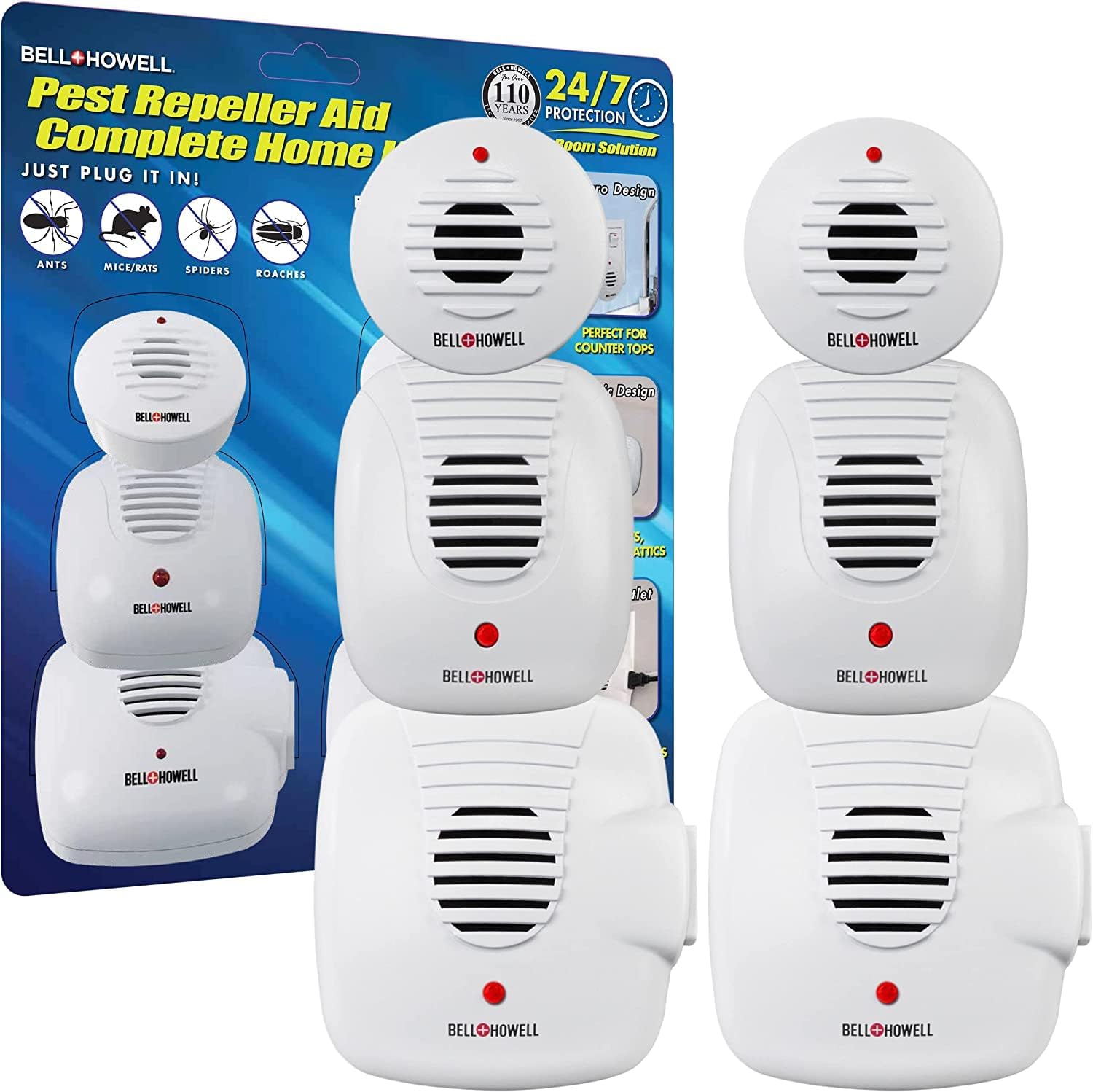
Bell+Howell is one of the most recognizable American consumer brands, with a 100+ year history in electronics and home goods. This currently available complete kit had a 3.9-star Amazon rating from more than 6,000 reviews when checked.
The six-pack includes two units in each of three sizes. The micro units suit counters and compact spaces, classic units fit hallways, basements, and attics, and the larger units include an extra electrical outlet. The listing markets the kit for mice, rats, spiders, ants, mosquitoes, and cockroaches.
The plug-in units do not require bait, cartridges, or batteries. Bell+Howell describes the system as using variable ultrasonic frequencies. As with other repellers, use one device per room and keep pet rodents away from treated areas.
Why it stands out:
This is the most familiar brand choice in the comparison, and its 6,000+ Amazon reviews provide more buyer feedback than most generic alternatives.
Best for:
Homeowners who prefer trusted American brands; households with pets and children where familiar-brand reassurance is the top priority; first-time ultrasonic users who want maximum social proof; medium-sized homes (2-3 bedroom).
Example from real life:
You see your first mouse in the kitchen and want to add prevention after placing traps. You distribute the six units across the kitchen, basement, garage, laundry room, and other problem areas, then monitor for new droppings and entry points.
- 6,000+ Amazon reviews when checked
- Trusted Bell+Howell American brand (100+ year history)
- Six units in three sizes
- Variable-frequency design
- Larger units include an extra outlet
- 3.9-star rating is lower than some newer alternatives
- Six units may still be insufficient for homes with many closed rooms
- Less specialized than rodent-only models
Ultrasonic Rodent Repeller Comparison Table
| Repeller | Pack / Format | Best For | Use With |
|---|---|---|---|
| Victor PestChaser | 6 plug-in units | Rodent-focused whole-home prevention | Mouse traps |
| Jqely 3-Mode Repeller | 6 plug-in units | Whole-home value and selectable modes | Entry barriers |
| REPELIX ARMOUR 3-Mode Repeller | 2 plug-in units | Multi-mode coverage for two rooms | Mouse control plan |
| Jahy2Tech Under Hood Repeller | 2 vehicle / tight-space units | Cars, RVs, sheds, tractors, boats | Mice in car guide |
| Bell+Howell Complete Kit | 6 plug-in units | Trusted-brand prevention for medium homes | Backup traps |
Prices, ratings, and availability change frequently. Click through to confirm current details before buying.
Which Ultrasonic Rodent Repeller Should You Choose?
Choose Victor PestChaser Rodent Repellent (6 Units, M756K) if:
- You want the most established American rodent control brand backing your purchase
- You have an active mouse or rat problem and need dedicated rodent technology
- You prefer single-purpose specialization over multi-pest devices
- Brand reputation matters more than novelty features
Choose Jqely 2026 Upgraded Ultrasonic Indoor Pest Repeller (3-Mode, 6 Pack) if:
- You want six units for whole-home coverage
- You want selectable settings for rodents, crawling insects, and flying insects
- You want different rooms targeted for different pest types
- You are protecting a 2-3 bedroom home with one purchase
Choose REPELIX ARMOUR Ultrasonic Pest Repeller (2 Pack, 3 Modes) if:
- You need focused coverage in two rooms rather than six
- You want three operating modes
- You prefer a listing with more than 1,700 Amazon reviews
- You can move to the quieter Mode 1 if another mode is audible
Choose Jahy2Tech Under Hood Rodent Repeller (2 Pack) if:
- You have mice nesting in your car, RV, boat, tractor, or shed
- You need two compact devices for engine bays or enclosed equipment
- You park outdoors near fields, garages, or rural areas
- You need battery, USB, or compatible 12V power options
Choose Bell+Howell Ultrasonic Pest Repeller Complete Kit (6 Pack) if:
- You prefer trusted American brands with extensive verified reviews
- You want six units in three different sizes
- You want a simple trusted-brand option
- You value the extra outlet included on the larger units
How Ultrasonic Rodent Repellers Are Intended to Work
Ultrasonic rodent repellers emit sound waves at frequencies above 20,000 Hz — the upper limit of human hearing. While humans (and most birds) cannot detect these frequencies, mice, rats, and other small rodents may avoid areas where the sound is strong and unobstructed.
The proposed mechanism is usually described in three ways:
1. Auditory stress. Ultrasonic frequencies in the 20-65 kHz range may create auditory stress for rodents, especially in open areas close to the device. Continuous exposure is intended to make feeding, nesting, and travel routes less comfortable.
2. Acclimation prevention. Quality repellers vary the emitted frequency over time to reduce the chance that rodents adapt. Cheaper single-frequency units often fail after 3-6 weeks because rodents simply tune out the sound. Premium units include rotating frequency patterns specifically to prevent this.
3. Electromagnetic supplementation. Some advanced units add electromagnetic wave generation that interacts with electrical wiring in the walls, extending the effective deterrent zone beyond direct line-of-sight.
A 2016 academic review of electronic pest repellents found that results vary widely based on device quality, room layout, and rodent species, with better-designed devices performing better in controlled settings. Cheap mass-produced units often fail because they emit weak, single-frequency signals that rodents quickly ignore.
What ultrasonic repellers cannot do: they will not eliminate an established colony in walls or attics, they cannot kill rodents, and they have limited effect against rats that have already established nesting sites. For active infestations, combine ultrasonic with traps and use our mice-in-walls guide if scratching or droppings suggest rodents are already inside the structure.
Tips for Better Results
- Plug at least 12 inches above the floor. Sound disperses better from elevated positions. Outlets along baseboards work fine, but avoid placing units behind furniture.
- Use one unit per room. Ultrasonic frequencies do not pass through walls or solid doors. Each separate room needs its own repeller.
- Keep doors open between connected spaces. Closed doors block sound transmission. If you want one unit to cover a hallway and adjacent room, leave the door open.
- Run continuously for at least 3-4 weeks. Many repellers take 1-3 weeks before users notice any change. Rodents may seem more active in the first 3-7 days as they search for new shelter — this is normal and expected.
- Combine with traps for active infestations. Ultrasonic alone is preventive — for visible mice or rats, pair with snap traps or bait stations.
- Avoid soft surfaces. Heavy carpets, drapes, and upholstered furniture absorb ultrasonic frequencies. Place units in areas with hard surfaces (kitchens, bathrooms, garages, basements).
Common Mistakes Homeowners Make
- Buying ultra-cheap units from unknown brands. Repellers under $10 typically emit weak, single-frequency signals that rodents adapt to within weeks. Quality matters more than quantity.
- Using ultrasonic alone against an active infestation. If you already see droppings, hear scratching in walls, or find chewed wires, ultrasonic alone is not enough. Pair with traps or call a professional.
- Expecting same-day results. Ultrasonic is a slow-acting deterrent. Plan on 1-4 weeks for visible reduction in rodent activity.
- Placing units behind furniture. Sofas, dressers, and bookshelves block sound waves. Always plug into outlets with clear line-of-sight to the room.
- Forgetting that rodents adapt to fixed frequencies. Cheap single-frequency models may lose effectiveness after 3-6 weeks. Choose multi-mode or rotating-frequency units for long-term use.
Are Ultrasonic Rodent Repellers Safe for Pets?
For dogs, cats, ferrets, and most household pets, they are generally marketed as safe when used as directed, but there are caveats.
Dogs and cats can technically hear into the lower ultrasonic range (up to ~45 kHz for dogs, ~64 kHz for cats), so cheap repellers operating in this range may cause mild irritation. However, many products are marketed as tuned to minimize overlap with common pet hearing ranges. Watch pets after installation and move the device if you notice stress, avoidance, or behavior changes.
However, ultrasonic rodent repellers are NOT safe for:
- Hamsters, gerbils, mice, rats, and other pet rodents — these are exactly the species the device is designed to repel
- Guinea pigs and rabbits — though larger, they share the same auditory sensitivity range
- Bird species with sensitive hearing — most pet birds are unaffected, but check with your vet
- Some exotic pets with high-frequency hearing
If you keep pet rodents or rabbits, install ultrasonic repellers only in rooms where these animals are never present. Sound waves do not pass through walls, so a repeller in the basement will not affect a hamster in an upstairs bedroom.
Frequently Asked Questions
Do ultrasonic rodent repellers help?
Sometimes — when the device is strong enough, placed correctly, and used for prevention or light activity. Results vary by room layout, rodent pressure, and device quality. Cheap single-frequency units under $10 are more likely to disappoint because rodents may adapt to the sound. Always combine ultrasonic with traps for active infestations.
How long until ultrasonic rodent repellers start working?
Some users notice reduced rodent activity within 1-2 weeks of continuous use. If the device helps, the clearer pattern usually appears over 3-4 weeks. During the first 3-7 days, mice may seem more active as they search for new shelter, which is normal and expected.
Will ultrasonic repellers work on rats as well as mice?
They can help in some rat situations, but rats are larger and more persistent than mice. For rat problems, you may need more units per area and longer running time. Rats also respond better when ultrasonic is combined with snap traps or bait stations.
Do ultrasonic repellers work against mice in the car or RV?
Standard plug-in indoor units do not work in vehicles — they need a constant outlet. For cars, RVs, boats, and tractors, use a battery-powered or 12V vehicle-specific unit (like the one reviewed above). These are designed to fit in engine bays and survive engine heat and vibration.
How many ultrasonic repellers do I need for my house?
Plan on one unit per room you want to protect. Sound waves do not pass through walls or solid doors. For a typical 2,000 sq ft home, that often means 4-6 units (kitchen, basement, garage, living room, bedrooms). Several repellers in this comparison are sold in 2-pack or 6-pack formats.
Will ultrasonic repellers affect Wi-Fi or other electronics?
No. Ultrasonic frequencies (20-65 kHz) are far below the radio frequencies used by Wi-Fi (2.4 GHz and 5 GHz). The two operate in entirely different frequency bands and do not interfere with each other.
Can I use ultrasonic rodent repellers in apartments?
Yes — and they are particularly well-suited to apartment use. They produce no chemicals, no smell, no residue, and no risk to neighbors. Most apartment leases allow plug-in pest deterrents without restriction. Always check your lease if unsure.
Do ultrasonic repellers work outdoors?
Standard indoor plug-in units do not work outdoors — they need outlets and shelter from weather. For outdoor rodent problems, use outdoor-rated rodent control, reduce shelter near the foundation, and seal entry points before relying on sound-based deterrents.
How much do ultrasonic rodent repellers cost?
Entry-level units start around $15-25. Mid-range pet-safe multi-packs cost $25-35 for 4-6 units. Premium models with multi-mode technology cost $30-45 per unit. Vehicle-specific units cost $20-30. Multi-packs lower the per-unit price for whole-home coverage.
Should I use ultrasonic repellers if I already have mice?
Use them as a supplementary tool, not a primary solution. For active mouse infestations, you need mouse traps or mouse poison to eliminate the existing population. Ultrasonic helps prevent re-invasion after the rodents are removed.
Final Thoughts
Ultrasonic rodent repellers are not magic. They are best treated as prevention or support alongside traps, sealing, and cleanup. The key is choosing the right product for your specific situation:
- For dedicated rodent control with a 130-year-old American brand → Victor PestChaser Rodent Repellent (6 Units, M756K)
- For whole-home coverage with three selectable modes → Jqely 2026 Upgraded Ultrasonic Indoor Pest Repeller (3-Mode, 6 Pack)
- For focused multi-mode coverage in two rooms → REPELIX ARMOUR Ultrasonic Pest Repeller (2 Pack, 3 Modes)
- For mice in vehicles, sheds, and tight enclosed spaces → Jahy2Tech Under Hood Rodent Repeller (2 Pack)
- For trusted brand reliability with thousands of reviews → Bell+Howell Ultrasonic Pest Repeller Complete Kit (6 Pack)
For severe rodent infestations that ultrasonic alone cannot solve, combine with snap traps or bait stations. For ongoing rodent pressure that returns even after DIY treatment, consider a professional inspection. Most major exterminator companies offer free inspections, which makes diagnosis simple even if you decide to handle treatment yourself.
The rule is simple: install early, place strategically, run continuously, and combine with traps when needed.
Related Reading
- How to Get Rid of Mice
- Best Mouse Traps
- Best Electric Mouse Traps
- How to Get Rid of Mice in Walls
- Best Mouse Poison
- Mice in the Attic
- Mice in the Garage
- How to Keep Mice Out of Your Car
- Best Pest Control Barriers for Doors and Windows
When repellers aren’t enough
Use ultrasonic repellers for prevention, not as the only treatment for active nesting
Ultrasonic repellers work best before a rodent population is established or after trapping has reduced activity. If mice or rats are already nesting in walls, attics, garages, or basements, sound waves alone usually will not reach every hiding place. Combine repellers with traps, entry-point sealing, and cleanup instead of relying on plug-in devices by themselves.
If you hear scratching inside walls, start with the mice-in-walls guide before buying more repellers.