If cockroaches keep showing up in your kitchen no matter how much you clean, gel bait is almost always the smartest first move. It is not a spray you blast around the room, and it is not a fogger that coats every surface. Gel bait is a small, targeted dab of food that cockroaches eat, carry back, and share – and that sharing is what can reduce the nest you never see.
The reason it works so well comes down to cockroach behavior. Cockroaches feed on each other’s droppings and on dead cockroaches, so a slow-acting bait spreads from the one cockroach that ate it to the ones hiding behind your cabinets. A good gel does the hard part for you.
This article compares the two gel baits worth buying, explains where to place them, and helps you decide which one fits your situation. If you are still confirming what you are dealing with, check our guide on the signs of a cockroach infestation first, and if you want the full treatment plan, see how to get rid of cockroaches.
PestsGuide.com may earn from qualifying purchases through affiliate links in this article.
- Best overall gel bait: Advion Cockroach Gel Bait is the strongest choice here for active indoor cockroach problems.
- Best budget / store-brand option: Combat Roach Killing Gel is an easy, affordable choice for smaller problems.
- Rotate if cockroaches stop eating: If activity does not drop after a couple of weeks, switch to the other gel. Cockroaches can develop bait aversion, and a different formula often gets them feeding again.
- Gel is not a fogger: Do not spray insecticide near your bait. Spray residue repels cockroaches and stops them eating the gel, which kills the whole strategy.
Why Gel Bait Is the Go-To for Cockroaches
Gel bait is usually the strongest DIY cockroach product for one simple reason: it uses the cockroaches against themselves. Instead of trying to spray every cockroach directly – which never works, because most of them are hidden – you place small dabs of bait where they travel, and let them do the rest.
Here is the chain reaction that makes it work:
- A cockroach finds the gel and eats it.
- It returns to the harborage before the slow-acting insecticide takes effect.
- Other cockroaches feed on its droppings and, once it dies, its body.
- The active ingredient passes through the population – this is called the secondary kill or domino effect.
That secondary kill is why a pea-sized dab of gel can affect more roaches than the one that ate it. Sprays and foggers do not do this: they kill on contact, scatter the survivors, and drive cockroaches deeper into the walls. Gel does the opposite – it pulls them to a controlled feeding point and spreads through the colony.
Gel Bait vs Bait Stations vs Spray
Gel is the best first choice for most cockroach problems, but it is not the only format. Here is how it compares.
| Format | Best for | Why |
|---|---|---|
| Gel bait | Kitchens, active infestations, precise placement in cracks | Highest kill rate; secondary kill spreads through the nest; placed exactly where cockroaches hide. |
| Bait stations (discs) | Homes with kids or pets, hands-off maintenance, prevention | Enclosed and tamper-resistant, but slower and less flexible than gel for a heavy infestation. |
| Spray / aerosol | Killing a cockroach you can see right now | Fast contact kill, but scatters the colony and repels cockroaches away from bait – use it apart from your gel, never near it. |
For most people, gel is the workhorse. If you have young children or pets and want something enclosed, bait discs are a reasonable trade-off – and we cover those separately. Just remember not to combine spray with gel in the same area.
Best Cockroach Gel Baits
Advion Cockroach Gel Bait
 Check price on Amazon
Advion Cockroach Gel Bait is the product most pest-control pros keep in their kit, and for good reason. Its active ingredient is indoxacarb, a slow-acting insecticide that is uniquely suited to the domino effect. Indoxacarb converts into its most toxic form inside the cockroach, which means a cockroach that eats the bait becomes a carrier that poisons others through droppings and cannibalism.
It is labeled for broad use across common household species – including German, American, brown-banded, and Oriental cockroaches – so you do not usually need to identify the exact species before choosing a gel. If you are not sure which one you have, our guide on the German vs American cockroach can help, but Advion is a broad starting point either way.
Why it stands out: Advion combines an attractive bait matrix with an active ingredient suited to secondary transfer. That pairing is what separates professional-grade gel from most store brands. In a heavy infestation, it is the one to reach for.
Best for: Active or heavy infestations; kitchens and bathrooms; anyone who wants a single reliable product that works on all cockroach species; treating cracks, hinges, and voids with precision.
Example from real life: You start seeing German cockroaches around the dishwasher at night. Instead of spraying the counters, you place tiny dabs of Advion under the sink, along the hinge of the cabinet, and behind the fridge. Within a few days you notice dead cockroaches in the open – a sign the bait is moving through the nest. Two weeks later the nightly sightings are gone.
- Professional-grade formula commonly used in cockroach control
- Indoxacarb drives a strong secondary (domino) kill
- Highly attractive bait – cockroaches feed readily
- Works on all common cockroach species
- A little goes a long way; one pack covers most homes
- Costs more up front than store-brand gels
- Gel can dry out if placed in hot, exposed spots
- Requires correct placement to work its best
- Cockroaches may need a rotation product over long campaigns
Combat Roach Killing Gel
 Check price on Amazon
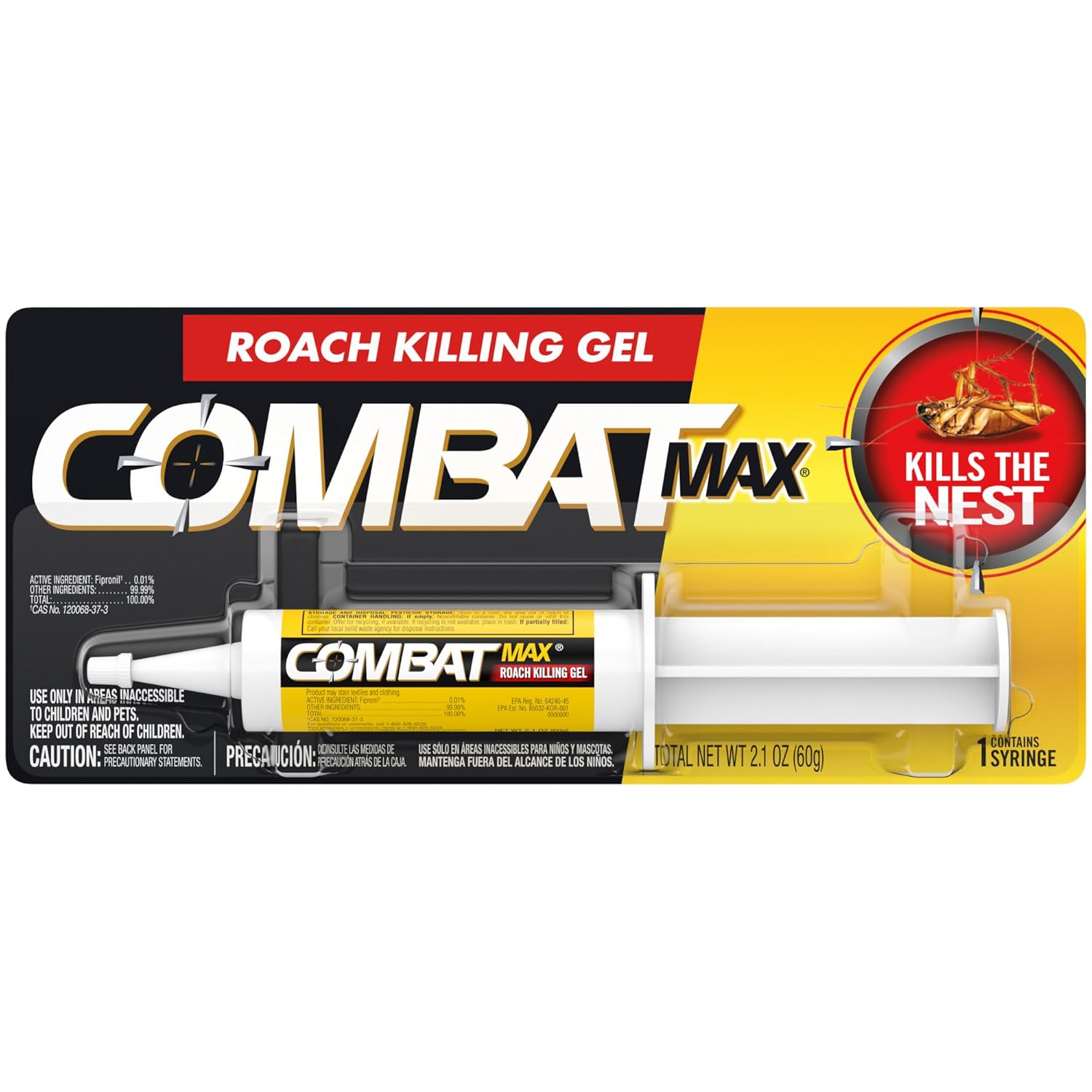
Combat Roach Killing Gel is the easy, affordable option – the one you will find on the shelf at most stores and the one many homeowners try first. It uses fipronil as its active ingredient, which also produces a secondary kill, and it comes in a simple syringe applicator that makes placement straightforward for a first-timer.
It is not quite as aggressive as Advion on a large, established infestation, but for a smaller or early-stage problem it does the job at a lower price. It also makes an excellent rotation partner: if cockroaches start avoiding one bait, switching between Combat’s fipronil and Advion’s indoxacarb keeps them feeding.
Why it stands out: Combat is the low-friction choice. It is inexpensive, widely available, and simple to apply, which makes it ideal for a light infestation or for someone treating cockroaches for the first time.
Best for: Smaller or early-stage infestations; budget-conscious buyers; first-time DIY users; rotating with Advion to beat bait aversion.
Example from real life: You spot a couple of cockroaches behind the toaster but no heavy activity yet. You run a line of Combat gel dots along the back of the counter and inside the lower cabinets. Activity drops over the next couple of weeks – and you keep the syringe on hand to reapply if they return.
- Affordable and widely available
- Fipronil delivers a genuine secondary kill
- Simple syringe applicator – beginner friendly
- Great rotation partner to prevent bait aversion
- Good value for light or early-stage problems
- Less aggressive than Advion on heavy infestations
- May need more frequent reapplication
- Bait matrix is a little less attractive to some cockroaches
- Smaller quantity per tube than professional packs
Which One Should You Choose?
Choose Advion Cockroach Gel Bait if:
- you have an active, heavy, or established infestation;
- you want the single most reliable product regardless of cockroach species;
- you want a professional-grade product for a DIY treatment plan;
- you are willing to pay a little more for the strongest option.
Check Advion Cockroach Gel Bait on Amazon
Choose Combat Roach Killing Gel if:
- the problem is small, early, or just getting started;
- you want an affordable, easy-to-find first product;
- you are treating cockroaches for the first time and want simplicity;
- you need a second formula to rotate against bait aversion.
Check Combat Roach Killing Gel on Amazon
Honestly, the best approach for a stubborn infestation is to own both and rotate them. It costs little extra and directly counters the one thing that makes gel bait fail over time – cockroaches learning to avoid a formula they have seen before.
How to Apply Gel Bait for Best Results
Placement matters more than the brand. A great gel in the wrong spot does nothing. Follow these rules:
- Use many small dabs, not a few big blobs. A dozen pea-sized dots beat three large piles. More feeding points means more cockroaches reached.
- Place bait where cockroaches live, not where you see them. Target cracks, corners, hinges, under the sink, behind and under appliances, and inside the lower cabinet seams.
- Get it into cracks and voids. Cockroaches travel along edges. A dab tucked into a crevice gets eaten far faster than one out in the open.
- Never spray insecticide near your gel. Spray residue repels cockroaches and contaminates the bait. Keep gel and spray in completely separate areas, or skip spray entirely.
- Refresh dried-out bait. Gel that has hardened or been eaten no longer works. Recheck placements every couple of weeks and reapply as needed.
- Keep it clean around the bait. Cockroaches choose your bait over crumbs only if the crumbs are gone. Sanitation and gel work together.
For the full step-by-step plan – including sanitation, sealing entry points, and follow-up – see our main guide on how to get rid of cockroaches.
Common Mistakes Homeowners Make
- Spraying near the bait. This is the number-one mistake. Repellent spray drives cockroaches away from the gel and cancels the whole strategy.
- Placing too little bait. A couple of dots for a whole kitchen will not reach the colony. Use plenty of small placements.
- Putting gel out in the open. Cockroaches feed along edges and in the dark. Bait on an open countertop mostly gets ignored.
- Giving up too early. Secondary kill takes one to two weeks to move through a nest. Seeing dead cockroaches is progress, not failure.
- Never rotating. Using the same bait for months can cause aversion. Switch active ingredients if feeding slows.
- Ignoring the source. If you never fix the moisture, crumbs, and gaps that attracted cockroaches, new ones can move in after the bait reduces the old population.
FAQ
What is the best cockroach gel bait overall?
Advion Cockroach Gel Bait is the strongest choice here for most active home infestations. Its indoxacarb formula and bait matrix are why it is so common in professional-style roach control. For smaller problems or a lower price, Combat Roach Killing Gel is a solid pick.
How long does gel bait take to work?
You may see dead cockroaches within a day or two, but the full secondary kill takes about one to two weeks to spread through the colony. Keep the bait in place and resist the urge to spray during this window.
Why are cockroaches not eating my gel bait?
The two usual causes are spray contamination nearby and competing food. If you sprayed insecticide in the area, cockroaches will avoid the bait. Clean up crumbs and grease so the gel is the most attractive food source, and if they still avoid it, rotate to a different active ingredient.
Is cockroach gel bait safe around kids and pets?
Gel should be placed in cracks, voids, and out-of-reach spots where children and pets cannot access it – that placement also happens to be where cockroaches feed. If you want a fully enclosed option, tamper-resistant bait stations are a better fit, though they work more slowly than gel.
Can I use gel bait and spray together?
Not in the same area. Spray repels cockroaches and contaminates the bait, which stops the domino effect. If you must use a spray for a visible cockroach, keep it far from every bait placement – or better, rely on gel alone.
How often should I reapply gel bait?
Check your placements every couple of weeks. Reapply wherever the gel has been eaten or has dried out. During a heavy infestation you may refresh more often at first, then taper off as activity drops.
Do I need to identify the cockroach species first?
Usually not. Both Advion and Combat are broad-use gels for common household cockroaches, so you can usually start baiting right away. If you are curious what you are dealing with, our German vs American cockroach guide breaks down the differences.
Final Thoughts
For most indoor cockroach problems, gel bait is the right first tool – and choosing between these two is simple. Use Advion Cockroach Gel Bait when you want the stronger option for a heavy infestation. Choose Combat Roach Killing Gel when the problem is small or you want an inexpensive, beginner-friendly start.
For a stubborn nest, owning both and rotating them is the smartest strategy of all. The gel does the killing – your job is to place it well, keep spray away from it, and give the domino effect time to work.
Before you place your bait
Make sure gel bait fits your situation
Gel bait works best when you place it where cockroaches actually harbor and keep all spray away from it. Confirm what you are dealing with and follow the full plan – sanitation, sealing, and follow-up – so activity does not rebound after the bait reduces it.
How to Get Rid of Cockroaches Signs of a Cockroach Infestation