Disclosure: This article contains affiliate links. If you buy a product through one of them, PestsGuide.com may earn a commission at no extra cost to you. We recommend products based on independent research, not commission rates. As an Amazon Associate we earn from qualifying purchases. See our full affiliate disclosure.
You’re relaxing at home when it starts — that rapid tap-tap-tap-tap from somewhere outside. A woodpecker has decided your siding is the perfect drum kit. Left unchecked, one bird can drill dozens of holes into fascia, trim, and shingles in a single spring, opening the way to water damage and hidden insect infestations.
The good news: you have plenty of legal, non-lethal options. This guide compares the six most effective woodpecker deterrents on the US market in 2026 — with honest pros, cons, and a proven sequence for combining them so the birds actually leave and stay gone.
Not sure why woodpeckers are pecking your house?
Before choosing a deterrent, it helps to understand whether the bird is looking for insects, drumming for territory, or excavating a nesting cavity. The right deterrent depends on which of these three drives the bird.
Quick Answer: Best Woodpecker Deterrents
There is no single product that works alone. The most effective strategy pairs two things: a long-term fix that removes what draws woodpeckers to your house, plus an immediate deterrent to protect the damage spots while the long-term fix takes effect. Our picks in each category:
Best Long-Term Fix — Removes the Root Cause
Talstar Professional Insecticide
Woodpeckers almost always come to a house because insects live in the wood. Talstar’s 7.9% bifenthrin solution eliminates those insects, so the birds have no reason to return. Odor-free after drying, lasts up to 3 months per application, legal in all US states. This is the only deterrent that solves the actual problem — everything else just moves it.
Best Immediate Deterrent — Stops Damage This Week
CLEANRTH TSBR610 Ultrasonic Bird Repeller
Motion-activated combo of ultrasonic sound, predator calls, and LED strobe flashes. Deploys in 10 minutes with no wiring. Best paired with Talstar for a full solution — sound scares birds off active damage while the insecticide removes what draws them there in the first place.
Prices and availability change frequently — click through for current pricing. PestsGuide.com earns from qualifying purchases (Amazon Associates and other affiliate programs).
How We Researched These Deterrents
We don’t run field trials on active woodpecker damage ourselves — homeowners deal with the real thing, and we don’t stage infestations. What we do is aggregate what actually works based on four sources: verified buyer reviews on Amazon and DoMyOwn (filtering for detailed, long-form reviews over one-line ratings), professional pest control forums and university extension resources, peer-reviewed research on bird deterrence (linked in the “Research Note” boxes below), and federal and state regulatory guidance on both the products and the birds themselves.
We ranked the six products below using four criteria that matter to homeowners actually dealing with damage:
- Root-cause effectiveness — does the product address why woodpeckers come to a home, or only the symptom?
- Habituation curve — how many weeks before birds figure out the deterrent is harmless and start ignoring it?
- Coverage area vs. cost — square feet or linear feet protected per dollar spent.
- Legal compliance — every product must comply with the Migratory Bird Treaty Act. No exceptions.
Where possible, we note the specific failure modes — the situations where a product doesn’t work — because a deterrent that fits 90% of homes is still useless in the 10% where you actually live.
What Are Woodpecker Deterrents?
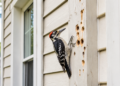
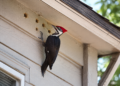
Woodpeckers peck into wood for three reasons: to look for insects, to attract a mate with loud drumming, or to excavate a nesting cavity. Wood is the most common exterior material on US homes — siding, fascia, trim, cedar shingles — so a persistent bird can drill dozens of holes in a single season, opening pathways for water damage, insect infestations, and structural problems.
To deter — to prevent or discourage someone from doing something.
— Cambridge Academic Content Dictionary
Woodpecker deterrents are tools and products that prevent birds from damaging your house, garage, shed, or outbuildings — without killing or harming the birds themselves. Federal law prohibits lethal control (more on this below), so every legal solution focuses on making your property unattractive or uncomfortable to land on.
There is no single product that repels woodpeckers with 100% accuracy. Most successful homeowners run two or three deterrents at once — typically one that removes the food source and one or two that make active damage spots physically uncomfortable.
Types of Woodpecker Deterrents Explained
Before diving into specific products, it helps to understand the main categories and how each one actually works — because the right category depends on why the bird is at your home in the first place.
Insecticides (Indirect Control)
Insecticides like Talstar don’t target the woodpecker directly. Instead, they kill the insects living inside your siding, trim, and exterior wood — the food source that brings woodpeckers to your property. Once the bugs are gone, the birds lose interest and move on to better feeding grounds. This approach is fully legal and usually the most effective long-term solution. One or two annual applications typically hold results.
Ultrasonic and Sonic Repellers
These devices emit high-pitched sounds, motion-activated alarms, or strobe lights when birds approach. Modern units combine ultrasonic frequencies with audible distress calls and LED flashes for a multi-sensory effect. The downside: birds habituate. A repeller that works brilliantly for the first 4–6 weeks may become invisible to the same birds after that. Rotation, repositioning, and combining with other methods extends effective life significantly.
Physical Barriers
Stainless steel spikes, bird netting, and hardware cloth physically prevent woodpeckers from landing on or accessing specific surfaces. These work indefinitely with no habituation problem — but they’re visible, they require installation work, and they only protect the exact spot where you install them.
Visual and Tactile Deterrents
Holographic scare tapes, optical gels, and predator-shaped decoys exploit a bird trait called neophobia — fear of new objects in their environment. They’re inexpensive and easy to install, but their standalone effectiveness fades within weeks as woodpeckers realize the new object poses no real threat. Best used as part of a layered approach.
Woodpecker Deterrents Compared at a Glance
Before the detailed reviews, here’s how the six products stack up against each other on the criteria that matter most:
| Product | Category | Best For | Duration | Habituation |
|---|---|---|---|---|
| Talstar Insecticide | Root-cause | Any home with insect activity in the siding | Up to 3 months / app | None |
| CLEANRTH TSBR610 | Ultrasonic | Immediate protection of active spots | 4–8 weeks per position | Yes, moderate |
| Bird Barrier Optical Gel | Multi-sensory | Ledges, beams, irregular surfaces | 1–2 years / dish | Minimal |
| Bird-X Steel Spikes | Physical barrier | Fascia, gutter edges, roof peaks | 20+ years | Impossible |
| Bird-X Repellent Gel | Tactile | Narrow ledges, invisible protection | 6–12 months | None (physical) |
| De-Bird Scare Tape | Visual | Cheap short-term backup | 4–8 weeks | Yes, fast |
Which Deterrent Works Best?
Honest answer: it depends on your situation. Here’s how the categories rank in practice.
Most Effective Long-Term: Insecticides
Removing the food source is the only deterrent that addresses why woodpeckers come to your property. Spikes and gels make one specific spot uncomfortable, but a hungry woodpecker will simply move three feet over. A home treated properly has nothing to offer the bird, period.
Most Effective Short-Term: Ultrasonic + Visual Combo
For active damage that you need to stop this week, motion-activated ultrasonic devices paired with holographic tape can produce immediate results. Just plan to swap or reposition them every 4–6 weeks, and use the time to set up a longer-term fix like Talstar.
Most Effective for Specific Spots: Spikes and Gels
If a woodpecker is fixated on one corner of your roof, one fascia board, or one tree, physical barriers solve that specific problem permanently. They don’t drive the bird off your property, but they make that spot unusable — often enough to send it looking for a home with easier pickings.
Regional Patterns Across the US
Woodpecker behavior and species mix vary by region, which affects which deterrents work best. A quick tour of what to expect in the four main US regions:
Southeast (FL, GA, SC, AL, MS, LA)
Peak activity: February through May. The main species causing home damage are the red-bellied woodpecker and the pileated woodpecker — the latter can excavate cavities the size of a softball. Cedar and cypress siding are highly attractive. Because insect activity in warm climates is nearly year-round, insecticide treatment is the single most important step here. Physical barriers work well on stucco and Hardie-board homes but are difficult on rustic cedar exteriors where homeowners want to preserve the look.
Northeast and Mid-Atlantic (NY, NJ, PA, MA, CT, RI, VT, NH, ME, MD, DE, VA)
Peak activity: April through June. The main problem species are the downy, hairy, and northern flicker. Drumming on metal chimney caps, gutters, and aluminum flashing is common — this is territorial, not feeding, so scare tape and ultrasonic units work well. Damage to cedar shake siding on older homes is a persistent issue; combine Talstar with spikes on fascia and roof peaks.
Midwest (OH, IN, IL, MI, WI, MN, IA, MO)
Peak activity: March through May, with a second smaller pulse in September (juvenile dispersal). Yellow-bellied sapsuckers add tree damage to the usual siding problems, and the downy woodpecker is the most common home offender. Cold winters push insects deeper into wood cavities, so Talstar applications are best timed for late April once temperatures stabilize above 55°F for the label to work effectively.
West and Southwest (CA, OR, WA, AZ, NV, UT, CO, NM, TX)
Peak activity varies. The acorn woodpecker is the West’s signature problem — it drills granary holes into wooden siding, fascia, and telephone poles to store acorns. Nothing except physical barriers and food-source removal works against it once granary sites are established. In the Southwest, the ladder-backed and Gila woodpeckers are the main offenders on stucco-and-wood homes. Acorn woodpeckers in particular are federally protected and notoriously persistent — professional consultation is often warranted.
6 Best Woodpecker Deterrents Compared
Below are the six most-purchased deterrents on Amazon and DoMyOwn for US homeowners, ranked from most to least effective in our review.
1. Talstar Professional Insecticide

The top pick for woodpecker control because it addresses the root cause. Kill the insects in your siding, trim, and exterior wood, and you eliminate the reason woodpeckers visit your home in the first place. Talstar is a 7.9% bifenthrin concentrate that mixes with water for spray application around the perimeter, on exterior wood, and at known damage sites.
Application specifics: mix 1 fl oz per gallon of water for general perimeter treatment. A single quart of concentrate makes roughly 32 gallons of finished spray — enough to treat an average home two or three times. It’s odor-free once applied, dries clear, and lasts up to three months per application. Most homeowners need two applications per year — early spring (before peak woodpecker activity) and mid-summer.
When properly diluted and applied as directed, Talstar is safe for use around homes with pets and children after drying (2–4 hours). The concentrate itself is hazardous during handling — always wear gloves, long sleeves, and eye protection while mixing.
- Targets the actual cause (insect food source), not symptoms
- Lasts up to 3 months per application
- Odor-free and clear-drying
- Widely used by pest control professionals
- Legal in all US states for residential perimeter use
- Concentrate is hazardous before dilution — requires careful mixing
- Not safe around bees or aquatic life — avoid flowering plants and water
- Requires a pump sprayer (not included)
- Won’t help if the woodpecker is drumming for territory (no insects involved)
See Talstar price at DoMyOwn →
2. CLEANRTH TSBR610 Advanced Sonic/Ultrasonic Bird Repeller

A motion-activated unit that combines three deterrent modes: ultrasonic frequencies, audible distress calls and predator sounds, and LED strobe flashes. When the infrared sensor detects a bird’s body heat within a 40-foot cone, the unit cycles through its programmed sequence to scare the bird away.
Adjustable settings let you tune the sound type and intensity for different bird species (there are separate presets for woodpeckers, sparrows, pigeons, and general songbirds). Water-resistant housing handles year-round outdoor use. Runs on either replaceable batteries (~2 months at moderate activity) or an extension cord.
The catch with any ultrasonic device is habituation — woodpeckers learn over 4–8 weeks that the noise represents no real threat. Reposition every few weeks and vary the sound settings to extend effective life. Comes with a 1-year manufacturer warranty.
- Motion-activated — only triggers when needed
- Combines ultrasonic, audible, and visual deterrents
- Adjustable presets for different bird species
- Water-resistant, battery or plug-in operation
- 1-year manufacturer warranty
- Birds habituate over 4–8 weeks — reposition regularly
- Audible clicking may bother neighbors and pets
- Batteries drain fast at high-traffic spots
- Range drops in wet or windy weather
3. Bird Barrier Optical Gel (24-Pack)

Optical gel exploits three bird senses at once: sight (the gel reflects UV light that birds perceive as fire or smoke), smell (citronella and peppermint oils that birds find offensive), and touch (a sticky surface birds dislike landing on). Pre-loaded into small dishes, the system is designed for ledges, beams, signs, rooftops, pipes, and other surfaces where birds repeatedly land.
The 24-pack covers about 20 linear feet of ledge — enough for one larger problem area or several smaller spots. Each dish lasts 1–2 years outdoors before the gel oxidizes and loses effectiveness. Peel-and-stick backing installs in seconds; no drilling or adhesive required.
The trade-off is cost and scent. Optical gel is significantly more expensive per square foot than spikes, and the peppermint-citronella scent is noticeable from a few feet away — some homeowners find it pleasant, others find it too strong.
- Multi-sensory deterrent — sight, smell, and touch
- Lasts 1–2 years per dish before reapplication
- Less visible than spikes from a distance
- Works on irregular surfaces where spikes don’t fit
- Safe for birds and pets (no toxic ingredients)
- Expensive per square foot of coverage
- Dishes visible up close
- Strong scent may bother smell-sensitive people
- May not stop heavy bird pressure or active nesting
4. Bird-X Stainless Steel Bird Spikes

The classic, permanent solution. Stainless steel spikes physically prevent woodpeckers from landing on fascia, gutter edges, roof peaks, fence tops, and ledges. Birds cannot habituate to a barrier they physically cannot stand on, which makes spikes the most reliable long-term deterrent for fixed spots.
This 6-inch-wide strip system mounts on a flexible base that adjusts to curves and irregular surfaces. Check the listing for the exact length included — Bird-X sells this line in several run lengths. Stainless steel construction handles 20+ years of outdoor exposure without rusting. Install vertically (spikes pointing up) with screws or construction adhesive — an average install takes 30–45 minutes per 10-foot section.
Caveat: spikes only protect where they’re installed. A woodpecker that can’t land on a fascia board will simply move to the next un-spiked surface. They also visually change the look of your home — some homeowners accept the trade-off for high-traffic spots, others prefer less visible solutions like optical gel.
- Permanent — no habituation, no batteries, no reapplication
- Stainless steel lasts decades outdoors
- Flexible base fits curves and corners
- Available in several run lengths
- Affordable per linear foot
- Visible — changes the look of your roofline
- Only protects the spot where installed
- Vertical installation only (spikes pointing up)
- Some birds use spikes to anchor nests in adjacent spots
5. Bird-X Bird Repellent Gel

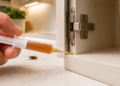
A sticky, transparent gel applied with a standard caulking gun. Unlike the Bird Barrier optical gel above, this is a continuous bead of clear adhesive that birds dislike landing on — no dishes, no scent, just a sticky surface. Best for narrow ledges, windowsills, signs, beams, and pipes where you want an invisible deterrent.
A standard tube covers about 10 linear feet of bead. The gel stays effective for 6–12 months outdoors before dust accumulation reduces stickiness. At that point, scrape off the old gel and reapply — typically an hour of work per 10 linear feet.
Critical placement rule: don’t apply where people or pets touch the surface. The gel is non-toxic but extremely sticky and difficult to clean off skin, fur, or clothing without solvents.
- Transparent — invisible from more than a few feet away
- Applies with any caulking gun (no special tools)
- Works on narrow surfaces where spikes don’t fit
- Non-toxic to birds and pets
- Affordable per linear foot
- Collects dust and debris over 6–12 months — needs reapplication
- Sticky residue is hard to remove from skin or fur
- Not suitable for surfaces touched by people or pets
- Less effective against heavy infestations
6. De-Bird Scare Tape

The cheapest deterrent on this list — and the least effective as a standalone product. Holographic mylar tape flashes in sunlight and crackles in the wind, exploiting the same neophobia that makes any new object initially scary to birds. Cut to length, tie to branches, fence posts, or under eaves where woodpeckers gather.
For a single-season problem (one woodpecker damaging one tree, for example), scare tape can buy you 4–8 weeks of relief while you decide on a longer-term solution. It’s most valuable as a layered deterrent — combining tape with a CLEANRTH unit and Talstar treatment is more effective than any single method alone.
Expect to replace tape every 2–3 months. Sun exposure dulls the holographic coating, and wind eventually shreds even the best mylar.
- Cheapest option on the list
- No installation skills required
- Useful as a layered deterrent alongside other methods
- Safe for birds, pets, and children
- Loses effectiveness in 4–8 weeks (habituation)
- Needs replacement every 2–3 months
- Visible — some homeowners find it unsightly
- Insufficient alone for severe woodpecker problems
How to Use These Deterrents Safely
The most hazardous product on this list is Talstar in concentrated form. Once diluted and applied per label directions, it’s safe around homes — but during mixing and application, follow these standard pesticide safety practices:
- Wear long sleeves, long pants, closed-toe shoes, chemical-resistant gloves, and safety goggles during mixing
- Mix outdoors or in a well-ventilated area, away from food prep surfaces
- Keep children and pets out of the treatment area until spray has fully dried (2–4 hours)
- Don’t spray on flowering plants or near water — bifenthrin is toxic to bees and aquatic life
- Choose a calm day (low wind) to prevent drift
- Wash hands, face, and exposed skin immediately after application
- Don’t store diluted solution — mix only what you’ll use that day
The non-toxic deterrents (spikes, gels, tape, ultrasonic devices) require no special safety precautions beyond common sense — wear gloves when handling spike strips, keep gels off skin, and read the product instructions.
Step-by-Step: How to Keep Woodpeckers Away From Your Home
A combined approach works far better than any single product. Here’s the proven sequence for US homeowners:
- Inspect your home. Walk the perimeter and look for woodpecker damage: round holes (feeding), irregular pecking patterns (mating drumming), or larger excavated cavities (nesting). Note which sides are affected — typically south- and east-facing walls, where insects are warmest.
- Repair existing damage. Fill holes with exterior-grade caulk, expandable foam, or wood filler. Paint over patches to match. Open holes attract more insects, which attracts more woodpeckers — closing them is essential.
- Treat the food source. Apply Talstar (or another bifenthrin-based insecticide) around the perimeter, on exterior wood, and at damage spots. This is the single most effective long-term step.
- Protect trees on your property. Wrap targeted trunks in burlap or bird netting for the active season (spring through early fall). Remove dead trees or stumps where possible — they host the insects woodpeckers seek.
- Install physical barriers at active spots. Mount stainless steel spikes on fascia, gutter edges, or fence tops. Apply optical gel or bird repellent gel to surfaces too narrow or curved for spikes.
- Add motion-activated repellers. Position one or two CLEANRTH units to cover the most-affected sides. Reposition every 4–6 weeks to prevent habituation.
- Use scare tape as short-term backup. Hang holographic tape near current damage spots. Replace every 2–3 months.
Steps 1–3 are the foundation. Skip them and everything else buys you weeks, not years.
Seasonal Woodpecker Control Calendar
Timing matters. Applying deterrents in the right season doubles their effectiveness. Here’s a US homeowner’s calendar:
| Season | What’s Happening | Priority Actions |
|---|---|---|
| Late winter (Feb) | Territorial drumming begins in South | Inspect siding for last year’s damage. Repair holes. Order Talstar and equipment. |
| Early spring (Mar–Apr) | Mating and nesting activity peaks | First Talstar application. Install spikes and optical gel at active spots. |
| Late spring (May) | Nesting cavities completed; young hatch | Deploy ultrasonic units. Do NOT disturb active nests (federal law). |
| Summer (Jun–Aug) | Feeding activity high; juveniles fledge | Second Talstar application. Reposition ultrasonic units. |
| Fall (Sep–Oct) | Juveniles disperse; scout for winter | Refresh scare tape. Inspect and repair fresh damage. |
| Winter (Nov–Jan) | Reduced activity, especially in North | Plan for next year. Consider structural insect treatment. |
Frequently Asked Questions
Why is a woodpecker drumming on my house?
Three reasons, usually. First, it’s hunting for insects living inside the siding, trim, or fascia — the most common cause of persistent damage. Second, it’s drumming to attract a mate or mark territory, which is loudest in spring (March through May) and typically stops within 4–6 weeks. Third, it’s excavating a nesting cavity, which causes the largest holes and requires the most urgent response. Metal surfaces like chimney caps and gutters amplify drumming and are almost always territorial, not feeding-related.
Is it legal to kill a woodpecker in the US?
No. Woodpeckers are protected under the Migratory Bird Treaty Act of 1918 — a federal law that makes killing, capturing, possessing, or harming them illegal without a permit. This includes destroying nests or eggs. Permits are issued only in extreme cases where non-lethal methods have documented failure, and they’re issued by the U.S. Fish and Wildlife Service, not state agencies. Penalties can reach $15,000 per bird under the enhanced enforcement provisions. Use only deterrents that comply with the law.
What time of year are woodpeckers most active?
Spring (March through May) is peak season across most of the US — that’s when mating drumming and nest excavation occur. In the Southeast, activity begins in February. Late summer (August–September) brings juvenile birds exploring new territory, sometimes causing a second damage pulse. Winter activity is lower everywhere but not zero, especially during mild winters or in southern states where insects remain active in the wood year-round.
Will woodpeckers come back next year?
If your home still has the conditions that attracted them — insects in the siding, exposed wood, or familiar drumming surfaces — yes, and often the exact same birds return. Woodpeckers have strong site fidelity and can live 4–10 years in the wild. This is why treating the food source (step 3 in our guide) matters more than chasing individual birds away. A house with no insects offers nothing to come back to.
Do plastic owl or hawk decoys work?
Only briefly. Woodpeckers habituate to stationary decoys within 1–2 weeks — they simply learn the “predator” never moves and never attacks. Decoys that move (wind-driven or motorized) extend effectiveness to 4–6 weeks, sometimes longer if repositioned. As a standalone deterrent, decoys are weak. As part of a layered approach combined with sound, tape, and insecticide treatment, they add measurable value and are worth the low cost.
Can I just patch the holes and hope they leave?
No. Patching is essential (step 2 in our guide), but without addressing the insect food source the birds will create new holes within days or weeks. Fresh holes also attract additional insects, which attracts additional woodpeckers — a feedback loop. The minimum effective combination is patch plus insecticide. Anything less than that just delays damage; it doesn’t prevent it.
How much does professional woodpecker control cost?
A one-time assessment from a licensed pest and wildlife control operator typically runs $150–$400 in the US, depending on region and home size. Full treatment plans (including insecticide application, structural repair, and deterrent installation) range $500–$2,500. Federally permitted interventions (rare, for cases where non-lethal methods have failed) are handled through the US Fish and Wildlife Service and add additional cost. DIY treatment with the products in this guide runs $150–$350 total for materials.
Do woodpeckers damage brick, stucco, or vinyl homes?
Brick and stucco homes are much less attractive to woodpeckers, though not immune — birds sometimes drum on metal flashing, chimney caps, or wooden trim on otherwise masonry homes. Vinyl siding is attractive when insects colonize the wood substrate underneath; the birds can punch through vinyl surprisingly easily. Cedar, redwood, and pine siding are the most vulnerable materials. If you’re planning a re-side, fiber cement (like HardiePlank) resists both insects and pecking damage significantly better than wood.
What if nothing on this list works?
Severe cases — multiple woodpeckers, persistent damage despite a combined approach, or federally protected acorn woodpeckers with established granary sites — often require professional intervention. Licensed wildlife control operators have access to methods and permits that homeowners cannot legally use. They can also identify uncommon causes: specific insect infestations, structural moisture problems attracting bugs, or species-specific behavior that DIY methods can’t address.
Final Thoughts
The most successful woodpecker control combines three things: kill the insect food source with Talstar, repair existing damage, and add physical barriers like stainless steel spikes or optical gel at high-traffic spots. Motion-activated repellers like CLEANRTH and visual deterrents like scare tape add useful short-term pressure but won’t solve the problem alone.
Always work within federal law. The Migratory Bird Treaty Act makes lethal control illegal without a permit, and there are no shortcuts — every product on this list is non-lethal by design.
If damage is severe or DIY methods aren’t working after 6+ weeks, the problem may need professional assessment — sometimes woodpecker damage points to a hidden insect infestation in the structure, or a federally permitted intervention is needed. See our comparison of licensed pest and wildlife control services to find a provider that handles migratory bird issues in your state.