If you have ants in your home, you already know the frustration: you wipe down the counter, spray the trail, and two hours later they’re back. The problem often isn’t just the ants you see — it’s the colony behind the wall, under the floor, or nesting outside near your foundation.
This guide compares six ant control products for common home situations, from fast contact sprays to slow-acting baits that ants carry back to the colony. The right choice depends on where the ants are active, what species you may be dealing with, and whether you need bait, a perimeter product, a crack-and-crevice gel, or a lower-toxicity spray option.

Quick Answer: Best Ant Killers for Home (2026)
Four picks cover the most common situations: indoor baiting, perimeter protection, a peppermint-based repellent spray, and a plant-based aerosol for kitchen surfaces.
Best Overall — Indoor Ant Bait
TERRO T300B Liquid Ant Bait Stations (12-Pack)
A borax-based liquid bait that worker ants carry back to the colony. Best for many common sweet-feeding household ants when you want a bait-first approach instead of spraying trails.
Best Perimeter Spray
Ortho Home Defense Insect Killer (Gallon + Wand)
A perimeter spray for foundations, window frames, door thresholds, and common entry points. Best used after indoor baiting or as prevention before ants start entering heavily.
Best Peppermint-Based Repellent Spray
Mighty Mint Ant Killer and Repellent Spray
A peppermint-oil pump spray for visible ants, kitchen edges, pantry-adjacent areas, and entry points. It works as a contact and repellent spray, not as a colony bait.
Best Plant-Based Aerosol for Kitchen Surfaces
Wondercide Ant & Roach Home + Kitchen (Essential Oils)
A plant-powered aerosol formulated with essential oils, labeled for ants, roaches, spiders, silverfish, and other common crawlers. Designed for targeted spray on visible activity in kitchens, around trash bins, and along baseboards — not as a broad-spectrum fogger. Keep people and pets away from treated areas until dry, and follow the product label carefully.
Prices and availability change frequently — click through to Amazon or the listed retailer for current pricing. PestsGuide.com earns from qualifying purchases as an Amazon Associate and from other affiliate partners.
When DIY Ant Control Is Enough
Most common household ant problems can be handled without professional help when the activity is limited and you use the right method for the situation.
DIY ant control usually makes sense when:
- You see ant trails in one or two areas, such as the kitchen, bathroom, or entry points.
- The problem started recently and has not spread through multiple rooms.
- You are dealing with common household ants such as odorous house ants, pavement ants, sugar-feeding ants, or similar small indoor ants.
- There are no signs of structural wood damage, moisture-damaged framing, or carpenter ant galleries.
The key is using the right product in the right order. A contact spray only controls the ants you see. A bait gives worker ants time to carry the active ingredient back to the colony. Many homeowners struggle because they spray the trail first, which can repel ants away from bait stations and make the bait less effective. If ants are entering through door gaps, windows, vents, or foundation openings, pair baiting with our pest control barriers guide.
When to Call a Professional
Some ant situations go beyond simple bait-and-spray treatment:
- Carpenter ants: if you see large black ants near wood, moisture damage, sawdust-like debris, or hear faint rustling in walls, there may be hidden nesting activity in damaged wood.
- Fire ants: outdoor mounds that keep returning may require a treatment plan designed specifically for fire ant colonies. See our fire ant yard treatment guide for broadcast bait, mound treatments, safety steps, and prevention.
- Pharaoh ants: tiny yellow ants can scatter and create satellite colonies when disturbed by the wrong sprays.
- Recurring or widespread activity: if ants appear in multiple rooms or return every few days despite consistent baiting, there may be more than one colony or an unresolved exterior entry point.
For those situations, DIY products can still help reduce activity, but identification and treatment strategy become more important.
6 Best Ant Killers Compared
1. TERRO T300B Liquid Ant Bait Stations (12-Pack)

TERRO T300B is one of the most widely used liquid ant baits for indoor household ants. The active ingredient is borax, which works slowly enough that worker ants can feed on the liquid and carry it back toward the colony before the bait takes effect.
The 12-station pack is useful for an active indoor problem because you can place stations along baseboards, under sinks, behind appliances, near entry points, and anywhere you have seen ant trails. You may see more ants around the stations during the first 24–48 hours. That usually means the bait is being discovered and shared.
For best results, do not spray near bait stations. Sprays can repel foraging ants and interrupt the baiting process. Leave the stations undisturbed and allow several days for activity to decline.
- Slow-acting liquid bait designed for colony-level control
- 12 stations give better placement coverage around the home
- Ready to use with no mixing or setup
- Good first choice for many sweet-feeding indoor ants
- Closed station design helps limit direct access to the liquid bait
- You may see more ants at first as they gather around the bait.
- Results take days, not minutes.
- Less useful for ants that are not attracted to sweet liquid bait.
2. Raid Ant Killer Baits (8-Count, Child-Resistant)
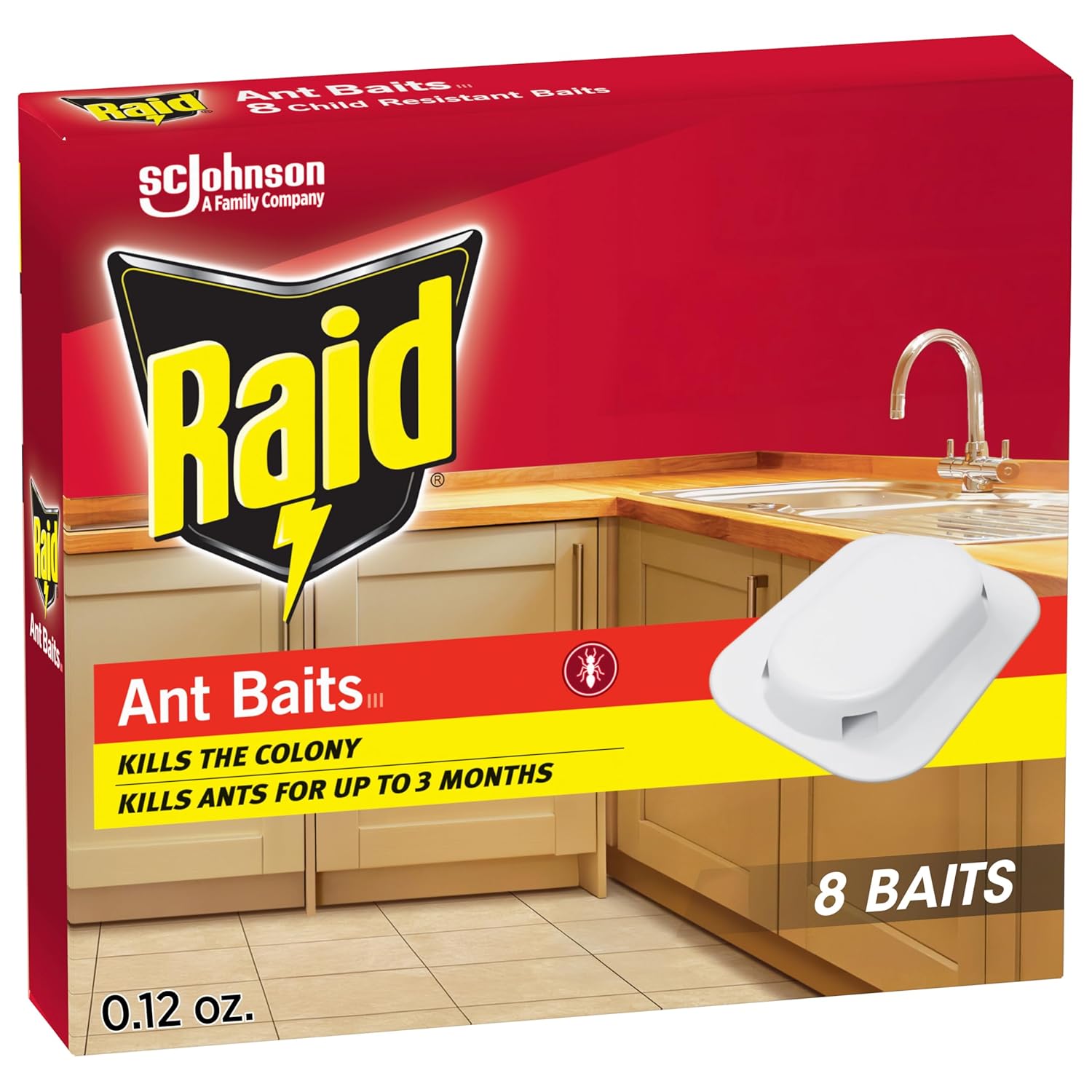
Raid Ant Killer Baits are a budget-friendly bait station option for small indoor trails and light ant activity. The enclosed casing makes placement simple, and the stations can be used in kitchens, bathrooms, laundry rooms, or near entry points where ants are traveling.
The active ingredient differs from borax-based liquid baits, so these stations may appeal to ants in situations where a liquid bait is not getting enough interest. They are best for small to moderate problems, maintenance placements, or as extra coverage in areas where you do not want to spend more on larger bait packs.
For a larger active infestation, TERRO-style liquid bait may be a stronger first choice. Raid baits are most useful when you want inexpensive coverage in several spots.
- Budget-friendly bait station option
- Child-resistant station design
- Can be placed flat or upright
- Useful for small trails and extra coverage zones
- May be less effective for large, established infestations.
- Smaller stations may need replacement sooner in active areas.
- Attraction depends on what the ants are feeding on at the time.
3. Ortho Home Defense Insect Killer (Gallon + Wand)

Ortho Home Defense is not a bait. It is a perimeter and indoor crack-and-crevice spray designed to help stop ants and other crawling insects from entering or moving through treated areas. It works best around foundations, door thresholds, window frames, utility penetrations, and other entry points.
The included wand makes it easier to apply a controlled line along baseboards, cracks, and perimeter zones. Once the treatment has dried, it can provide residual control on treated surfaces according to the product label.
The important limitation: this product does not solve the colony by itself. If ants are actively feeding indoors, place bait first and avoid spraying near the bait trail. Once bait activity declines, perimeter treatment can help reduce new entry from outside.
- Good for perimeter and entry-point treatment
- Works on many crawling insects, not just ants
- Wand applicator helps with precise placement
- Useful after indoor baiting to reduce re-entry
- Does not directly resolve the colony source.
- Can interfere with baiting if sprayed too close to bait stations.
- Exterior surfaces may need reapplication depending on weather and label directions.
4. Combat Max Ant Killing Gel

Combat Max gel is useful for hard-to-reach places where plastic bait stations do not fit: cabinet hinges, pipe gaps under the sink, window tracks, cracks behind trim, and tight ant pathways near appliances. The syringe applicator lets you apply small bait placements exactly where ants are traveling.
Gel bait can be a strong companion to station baits. Stations cover open areas, while gel covers cracks and hidden travel routes. Like other baits, it works best when ants are allowed to feed without nearby spray interference.
The main drawback is drying. Gel placements may dry faster than enclosed bait stations, especially in warm, dry, or dusty areas, so active spots may need to be checked and refreshed.
- Syringe applicator reaches cracks, hinges, gaps, and hidden pathways
- Useful companion to bait stations
- Good for targeted placement in tight spaces
- Can help when ants ignore open-area stations but travel through specific cracks
- Gel can dry out faster than enclosed stations.
- May need reapplication in active areas.
- Less convenient as a whole-home standalone solution.
5. Mighty Mint Ant Killer and Repellent Spray

Mighty Mint is a plant-based ant spray that uses peppermint oil as the active ingredient. It is best for visible ants, pantry-adjacent areas, kitchen edges, windowsills, door thresholds, and other spots where you want a lower-toxicity contact and repellent spray option.
This is not a colony bait. It can help knock down visible ants and discourage movement through treated areas, but it will not be carried back to the queen the way bait is. For an active indoor trail, use bait to address the colony and reserve Mighty Mint for open areas where a standard synthetic spray is not your first choice.
The peppermint scent is strong. In small rooms, apply lightly, ventilate the area, and always follow the product label. Keep sprays away from food, dishes, pet bowls, and surfaces where children or pets may contact wet residue.
- Plant-based contact and repellent spray option
- Useful around entry points, windowsills, and pantry-adjacent areas
- No mixing required
- Good companion to bait stations when used away from bait trails
- Does not address the colony source.
- Strong peppermint scent can be overwhelming in small rooms.
- Should not be sprayed on food-contact surfaces, dishes, pet bowls, or wet-access areas.
6. Raid Ant & Roach Killer Spray (Fragrance-Free)

Raid Ant & Roach Killer is a classic contact spray for visible ants and other crawling insects. It is useful when you need to clear ants from a surface quickly, especially in a sudden trail or visible group.
The limitation is the same as with most contact sprays: it controls the ants you spray, not the colony behind them. Spraying an active trail can also interfere with baiting by disrupting the foragers you want to carry bait back to the nest.
The best use case is tactical: use contact spray only where needed, away from bait stations, and follow up with bait if the ants are returning from a hidden colony.
- Fast contact control for visible ants
- Fragrance-free version is more practical for indoor use
- Also labeled for roaches and other crawling insects
- Useful for sudden visible activity when baiting alone is too slow
- Does not address the colony source.
- Can interfere with baiting if used near bait stations or trails.
- Should not be used on food preparation surfaces.
Which Ant Killer Should You Use? A Decision Guide
Ants in the kitchen or bathroom → Start with TERRO T300B
Sweet-feeding ants, including many common household ants, are often attracted to liquid bait. Place TERRO stations along baseboards, under the sink, behind appliances, and near trails. Do not spray anything near the stations. Give the bait several days to work.
You want to prevent ants before they appear → Use Ortho Home Defense
Apply a perimeter product in spring or before ant season starts. Focus on the foundation, window frames, door thresholds, utility openings, and the lower perimeter of the home. Use it as prevention or after indoor baiting, not directly on top of active bait trails.
Ants are moving through cracks, hinges, or tight spaces → Use Combat Max Gel
Where a bait station will not fit, a gel syringe can reach. Use small placements behind outlets, inside cabinet door hinges, along window tracks, and around pipe penetrations under sinks.
You prefer a plant-based spray for open areas → Use Mighty Mint away from bait
Mighty Mint is most useful for visible ants and entry points where you want a peppermint-oil contact and repellent spray. Use it away from bait stations so you do not disrupt the ants you want carrying bait back to the colony.
You want a plant-powered aerosol for kitchen and pantry surfaces → Consider Wondercide Ant & Roach
For a household that prefers an essential-oil aerosol instead of a synthetic contact spray, Wondercide Ant & Roach is a targeted option labeled for ants, roaches, spiders, and other common crawlers. Use it as a spot treatment on visible activity — not as a broad room spray — and keep it away from bait stations for the same reason as Mighty Mint.
You need fast contact control → Use Raid Spray carefully
For a sudden visible trail or group of ants, Raid spray can control what you see quickly. Use it as a tactical tool, not as the main colony strategy, and avoid spraying near bait stations.
How Ant Baits Work and Why Sprays Can Make Results Worse
Understanding this saves most homeowners frustration.
An ant colony can have thousands of workers depending on the species. The worker ants you see foraging in your kitchen are only a portion of the total colony. If you spray the visible trail, you may remove those foragers, but the colony can keep sending more.
Bait works differently. A slow-acting active ingredient is designed to give foraging ants time to consume the bait and return to the nest. Through normal ant feeding behavior, the bait can be shared with other colony members. Over several days, this can reduce colony activity more effectively than repeated contact spraying.
This is why the first rule of baiting is: if you’re using bait, do not spray near it. Spraying near bait stations can repel foragers, interrupt the trail, and prevent ants from carrying bait back to the nest.
Tips for Better Results
- Place enough stations. A common mistake is placing only one or two stations for an active trail. Use multiple placements near trails, entry points, under sinks, and behind appliances.
- Do not clean up the active bait trail too early. Ants follow pheromone trails to food. If you erase the trail immediately after placing bait, you may disrupt the process. Wait until activity declines before deep cleaning the trail area.
- Remove competing food sources. Store open food in sealed containers, wipe greasy surfaces, rinse sticky residue, and empty trash regularly. If ants have better food options than the bait, they may ignore the station.
- Be patient. Bait working as intended can look like more ants in the first 24–48 hours. Many homeowners panic and spray at this point, which can ruin the baiting process.
- Treat entry points after baiting. Most ant colonies live outdoors and enter to forage. After indoor activity drops, use sealing and perimeter treatment to reduce new entry.
Common Mistakes
- Spraying before placing bait. Contact sprays can repel ants away from bait stations. If you spray first, your bait may sit untouched while ants use a different route.
- Using too few bait placements. One or two stations may not be enough for active trails. More placements give foragers more chances to find the bait.
- Removing stations too early. Bait needs time to be carried and shared. Pulling stations after a couple of days can restart the process.
- Mixing sprays and baits in the same area. Sprays near bait stations can cancel out the baiting strategy. Choose one approach for that zone and give it time.
- Ignoring entry points. Once indoor activity drops, seal cracks and treat the exterior perimeter if ants are entering from outside.
FAQ
How long does it take for TERRO to work?
Many homeowners see reduced ant activity within several days, but larger or more established colonies can take longer. During the first 24–48 hours, you may see more ants around the bait. That usually means the bait has been found. Do not remove the stations or spray near them during this period.
Why do I see more ants after placing bait stations?
This is common. The bait attracts foragers, so more ants may gather at the stations before activity drops. The goal is to let foraging ants feed and carry bait back toward the colony. Spraying during this stage can interrupt the process.
What’s the difference between ant bait and ant spray?
Spray controls ants on contact but does not usually reach the colony source. Bait is carried by foraging ants and can reduce colony activity over time. For most indoor ant trails, bait is the better primary method. Spray is useful for immediate visible activity, but it should not be used near bait stations.
Do ant killers work on all species?
No single product works equally well on every ant species. Sweet liquid baits often work well on many common household ants, but some ants prefer protein or grease-based foods at certain times. Fire ants, carpenter ants, and pharaoh ants may need more specific treatment strategies.
Is TERRO safe around pets and children?
TERRO bait stations are enclosed, but they should still be placed where pets and children cannot access them. Use all ant products only according to the label, and keep bait stations, gels, and sprays away from food, dishes, toys, and pet bowls.
Can I use ant killer in the kitchen?
Bait stations can usually be placed near appliances, under sinks, or along baseboards, away from direct food-contact surfaces. Avoid spraying standard insecticides on counters, cutting boards, dishes, or food preparation areas. Always follow the product label for indoor use.
Why do ants keep coming back after treatment?
Two common reasons are an incomplete baiting period or new entry from outside. Continue baiting long enough for activity to decline, then seal cracks, reduce moisture, remove food sources, and treat entry points if ants are coming in from outdoors.
What attracts ants into the house?
Food debris, sticky residue, crumbs, open containers, moisture, leaky pipes, and warm indoor shelter can all attract ants. The most reliable long-term prevention is sealing entry points and reducing food and moisture sources inside the home.
Final Thoughts
For most homeowners with an active indoor ant trail, a bait-first approach is the best starting point. Place TERRO T300B stations near trails and entry points, leave them undisturbed, and avoid spraying nearby while ants are feeding.
If ants are entering from outside, follow indoor baiting with entry-point work: seal gaps, remove debris near the foundation, and consider a perimeter product like Ortho Home Defense where the label allows.
For open areas where you prefer a plant-based contact spray, Mighty Mint can help with visible ants and entry points, but it should not replace baiting when a hidden colony is feeding indoors. For an essential-oil aerosol alternative, Wondercide Ant & Roach targets the same category with a plant-powered formula.
For cracks, hinges, pipe gaps, and tight routes where stations do not fit, Combat Max gel is a useful targeted bait option. For budget-friendly extra coverage, Raid Ant Killer Baits can help cover additional areas.
When DIY Ant Control May Not Be Enough
If ant treatments have not reduced activity after 2–3 weeks of consistent baiting and prevention, reassess the problem before adding more sprays. You may be dealing with carpenter ants, pharaoh ants, fire ants, multiple colonies, or an unresolved moisture or entry-point issue.
Start by identifying the ant type and where activity is coming from. If you see large ants near moisture-damaged wood, sawdust-like debris, wall activity, or recurring ants in several rooms, use our carpenter-ant control guide to check the likely routes, nesting conditions, and baiting options. A professional inspection may be the safer next step when structural wood or hidden moisture is involved.