
Mole crickets can turn a healthy lawn into a patchy, loose, and uneven mess. Unlike regular crickets that usually bother homeowners indoors, mole crickets live underground. They tunnel through soil, disturb grass roots, and can leave brown or thinning patches that look like drought, fungus, grub damage, or irrigation stress.If you are trying to figure out how to get rid of mole crickets, the first step is not spraying the entire yard. The smart approach is to confirm the problem, treat at the right time, and then help the lawn recover so the same weak spots do not keep coming back.
Quick Answer: Best Products for Mole Cricket Control
Confirmed mole crickets in your lawn? These options cover the most common homeowner situations — simple granules, large-yard concentrates, professional-grade bifenthrin, biological control, and lawn recovery support.
Best for First-Time Treatment
Ortho BugClear Lawn Insect Killer Granules
A simple granular treatment for homeowners who want to spread, water in, and be done. Best first choice for average lawns and confirmed surface activity.
Best for Large Yards
Spectracide Triazicide Insect Killer Concentrate
A liquid concentrate for bigger lawns or recurring annual pressure. Better fit when you need to treat more ground than a small bag of granules can reasonably cover.
Best for Severe or Recurring Infestations
Atticus Talak 7.9% Bifenthrin Concentrate
Professional-strength bifenthrin concentrate for serious or returning lawn insect pressure. Requires careful mixing and label-following, but gives stronger residual control than simple one-off products.
Best Chemical-Free Option
NaturesGoodGuys Beneficial Nematodes
A biological soil treatment for young mole cricket nymphs. Slower than chemical products, but a strong fit for pet-heavy yards and low-toxicity lawn care.
Best After-Control Lawn Recovery Step
Repair Thin Turf After Activity Drops
After mole cricket pressure is reduced, focus on recovery: rake loose debris, improve irrigation consistency, fill bare patches, and avoid reseeding while insects are still actively feeding underground.
Prices and availability change frequently. PestsGuide.com earns from qualifying purchases and affiliate referrals.
Summary: The best way to get rid of mole crickets is to confirm them with a simple soapy-water test, treat when young mole crickets are active near the surface, and then repair the lawn so damage does not keep spreading. Heavy or recurring damage usually needs a diagnostic re-check rather than more product.
Dealing With More Than One Type of Cricket?
If you also see crickets in your garage, basement, crawl space, or around entry points, check our product guide for indoor and outdoor cricket control options.
What Are Mole Crickets?
Mole crickets are soil-dwelling insects with strong front legs made for digging. Their bodies look somewhat like regular crickets, but their front legs resemble small shovels. This makes them excellent tunnelers.
Most homeowners do not notice the insect first. They notice the lawn damage: soft turf, raised tunnels, thinning grass, brown spots, or areas where the grass pulls up too easily.
Mole crickets are especially common in warm regions where turfgrass stays active for much of the year. They are mostly an outdoor lawn pest, not a typical indoor cricket problem.
Signs of Mole Cricket Damage
Mole cricket damage can look similar to other lawn problems, so it is important to look for several signs together.
- Brown or yellow patches in the lawn
- Thin or weak turf
- Small raised tunnels near the soil surface
- Loose grass that pulls up easily
- Soft or spongy areas underfoot
- Bare patches that slowly expand
- Birds, raccoons, or armadillos digging in the lawn
- More visible damage after rain or irrigation
If animals are digging up your lawn, they may be searching for mole crickets or other soil insects. In many cases, the digging is a symptom of an insect problem already happening below the surface.
Mole Crickets vs Regular Crickets
Mole crickets need a different control strategy than house crickets, camel crickets, or field crickets. Sticky traps and indoor sprays may help with crickets inside the home, but they will not solve an underground mole cricket problem in the lawn.
| Cricket type | Main problem | Where you usually find them | Best control focus |
|---|---|---|---|
| House crickets | Chirping and indoor nuisance | Basements, garages, warm indoor areas | Traps, sealing gaps, reducing moisture |
| Camel crickets | Damp indoor areas | Crawl spaces, basements, garages | Moisture control and sticky traps |
| Field crickets | Outdoor and entry-point nuisance | Yards, patios, foundations | Outdoor cleanup and exclusion |
| Mole crickets | Lawn and root damage | Soil, turfgrass, garden beds | Lawn monitoring and soil-level treatment |
How to Confirm Mole Crickets With a Soapy Water Test
Before treating your lawn, confirm that mole crickets are actually present. A simple soapy-water flush can bring mole crickets to the surface.
How to do the test
- Choose a damaged or suspicious area of lawn.
- Mix 1 to 2 tablespoons of liquid dish soap with 1 to 2 gallons of water.
- Slowly pour the mixture over a small section of turf.
- Watch the area for several minutes.
- Look for mole crickets or other insects coming to the surface.
If mole crickets appear, you have a stronger reason to treat that area. If nothing comes up, test another damaged spot. Lawn damage can have several causes, including drought, grubs, disease, poor drainage, or soil compaction.
Best Time to Treat Mole Crickets
Timing is one of the most important parts of mole cricket control. Treatments usually work better when mole crickets are young, small, and active close to the soil surface.
Adult mole crickets are harder to manage because they can move deeper into the soil. Young nymphs are usually more vulnerable, especially when they are feeding near the surface.
| Season | What to do |
|---|---|
| Early spring | Watch for fresh tunneling, adult activity, and recurring problem areas. |
| Late spring to early summer | Run soapy-water tests in damaged or suspicious lawn sections. |
| Early to mid-summer | Target young mole crickets if activity is confirmed. |
| Late summer | Monitor for visible turf damage and spreading brown patches. |
| Fall | Repair damaged turf and improve lawn health before the next season. |
5 Best Products for Mole Cricket Control
Not every lawn insect product is designed for mole crickets. The five options below fit different situations: fast-acting granules, larger-yard concentrate, professional-grade bifenthrin, biological control, and targeted perimeter treatment.
1. Ortho BugClear Lawn Insect Killer Granules

Ortho BugClear granules are one of the simplest mole cricket products for first-time DIY users. The granular format is straightforward: spread with a broadcast spreader, water in lightly, and the product moves into the soil zone where mole crickets are active.
The formula also targets grubs, ants, spiders, ticks, and other lawn insects. One bag treats up to 10,000 sq ft, which makes it practical for average suburban lawns.
- Granular format — no mixing or sprayer required
- Kills multiple lawn pests including mole crickets and grubs
- Covers up to 10,000 sq ft per bag
- Good first-time homeowner option
- Widely available and affordable
- Requires watering in after application
- Not labeled for organic or pesticide-free lawns
- Keep pets and children off treated area until dry
Best for: Homeowners treating an active mole cricket infestation for the first time.
2. Spectracide Triazicide Insect Killer Concentrate

Spectracide Triazicide in concentrate form is designed for larger yards or recurring annual insect pressure. It mixes with water and applies with a hose-end sprayer or tank sprayer, so it is better suited to broad coverage than a small spot treatment.
The liquid format can penetrate soil faster than granules when watered in correctly. That matters when the lawn is already under stress and mole crickets are feeding near the surface.
- Better fit for larger lawn areas
- Liquid format can move into the soil quickly
- Targets mole crickets, grubs, chinch bugs, and other lawn insects
- Good for recurring seasonal pressure
- Requires a sprayer
- Less convenient than granules
- Pets and children should stay off the lawn until dry
Best for: Larger yards, recurring annual mole cricket problems, or homeowners who already own a sprayer.
3. Atticus Talak 7.9% Bifenthrin Concentrate

Atticus Talak contains 7.9% bifenthrin, a professional-strength active ingredient used for many lawn and perimeter insect problems. It is a stronger fit for severe or recurring mole cricket pressure than a basic grab-and-go product.
Bifenthrin has residual activity, meaning it continues working after application when used according to the label. It also requires more care: measure correctly, wear protective gear, avoid runoff, and keep people and pets off the treated lawn until dry.
- Professional-strength bifenthrin concentrate
- Good residual control when applied correctly
- Useful for severe or recurring infestations
- Can treat broader lawn and perimeter pest pressure
- Requires careful measuring and mixing
- Requires a tank sprayer
- Toxic to aquatic life and pollinators during application
- Not a casual product for careless use
Best for: Severe or recurring infestations, larger turf areas, and homeowners comfortable following a pesticide label carefully.
4. NaturesGoodGuys Beneficial Nematodes Triple Blend
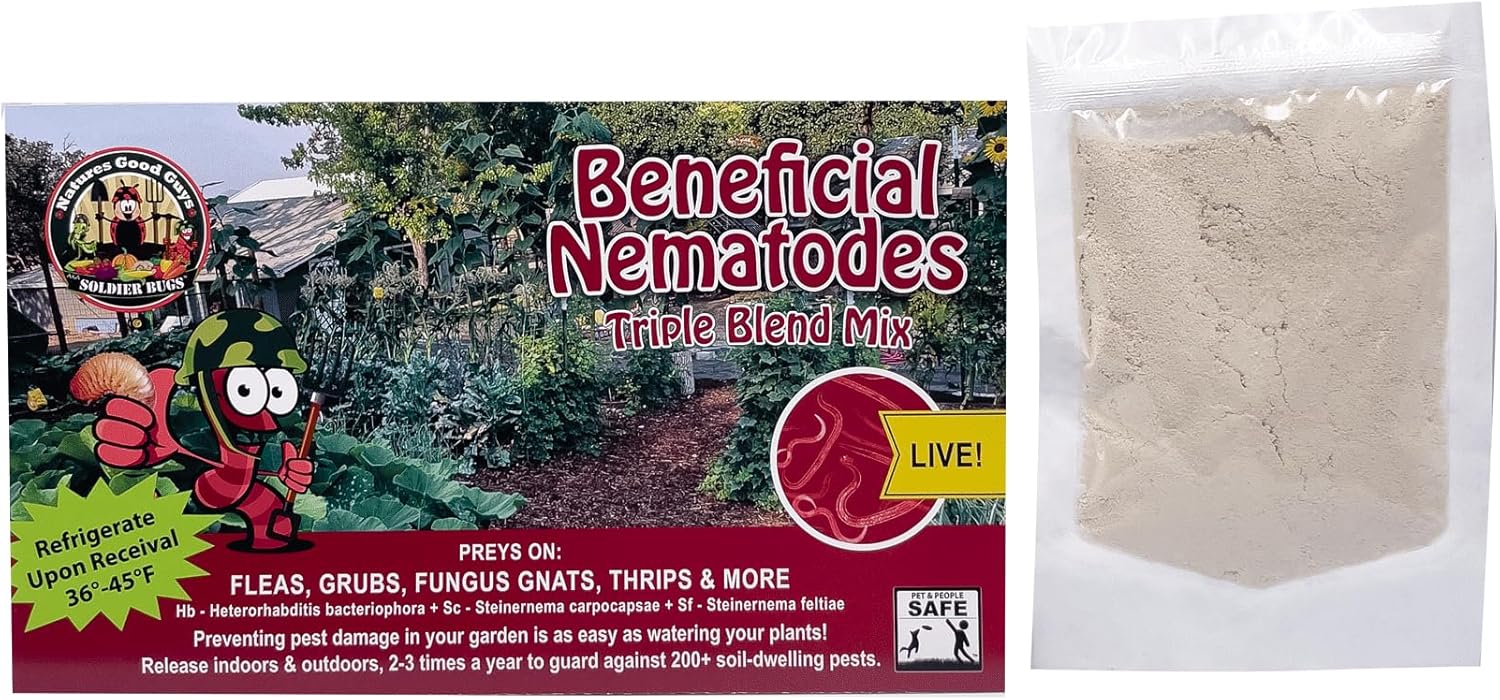
Beneficial nematodes are microscopic organisms that live in soil and parasitize certain insect larvae and nymphs. They are a non-chemical option for homeowners who want a biological approach to mole cricket pressure.
The key is timing and moisture. Nematodes work best when mole crickets are young, soil is moist, and the application is done in the evening or on a cloudy day. Results are slower than chemical treatments, usually taking 2-4 weeks.
- Chemical-free biological option
- Safe fit for pet-heavy and child-heavy yards
- Works underground where mole crickets live
- Useful as part of an integrated lawn plan
- Slower results than chemical products
- Needs moist soil
- Less effective in dry or compacted soil
- Timing matters a lot
Best for: Low-toxicity lawn care, households with pets and children, and early-season nymph control.
5. Sevin Garden Perimeter Insect Granules

Sevin perimeter granules are better for targeted border and transition zones than for whole-lawn mole cricket treatment. Use them around garden edges, foundation zones, and specific areas where tunneling or movement is concentrated.
This is not the first product I would choose for a large mole cricket infestation, but it can be useful for spot treatment and perimeter pressure.
- Affordable for small areas
- Easy granular format
- Useful around borders and transition zones
- Can support a broader lawn treatment plan
- Not ideal for whole-lawn broadcast
- Must be watered in
- Harmful to bees — avoid flowering areas
- Less suitable for severe lawn-wide infestations
Best for: Perimeter treatment, borders, and small confirmed problem spots.
Which Product Should You Choose?
| Your situation | Best pick |
|---|---|
| First-time treatment, average yard, want something simple | Ortho BugClear Granules |
| Large yard or recurring annual problem | Spectracide Triazicide Concentrate |
| Severe infestation, want professional-grade residual control | Atticus Talak 7.9% Bifenthrin |
| Pets, children, or low-toxicity lawn care preference | NaturesGoodGuys Beneficial Nematodes |
| Spot treating borders or perimeter areas | Sevin Perimeter Granules |
| Lawn recovery after treatment or recurring weak turf | Repair bare patches after activity drops; fix watering, drainage, and mowing stress |
How to Get Rid of Mole Crickets Step by Step
1. Confirm the Problem First
Do the soapy-water test before treating. Mole cricket damage can look like drought, grubs, fungus, or irrigation stress. If no mole crickets come up, test another damaged area before spending money.
2. Improve Lawn Health Before and After Treatment
A dense, healthy lawn can tolerate some insect activity better than weak or stressed turf. Mole cricket damage often looks worse when grass is already thin, overwatered, cut too short, or growing in poor soil.
- Mow at the recommended height for your grass type.
- Avoid scalping the lawn.
- Water deeply, but not too often.
- Fix drainage problems and low wet spots.
- Reduce excessive thatch if needed.
- Repair bare patches after active mole cricket pressure is reduced.
Lawn Recovery Support
Repair the lawn after active pressure drops
Mole cricket products reduce insect pressure, but they do not automatically rebuild damaged turf. After activity is under control, rake loose grass, improve irrigation consistency, correct compacted soil where needed, and patch bare areas at the right time for your grass type.
3. Reduce Excess Moisture
Mole crickets often do well in moist soil. You do not need to dry out your lawn completely, but constant moisture can make the area more inviting.
Check for sprinklers running too often, downspouts draining into the same lawn area, low spots that hold water, heavy shade with poor airflow, and overwatering after fertilizing.
4. Apply Your Chosen Product at the Right Time
Timing matters more than product choice. Apply in early to mid-summer when nymphs are young and feeding close to the surface. Water the lawn lightly beforehand to bring insects up. Apply in the late afternoon or evening when mole crickets are most active.
For granular products, spread evenly with a broadcast spreader and water in lightly. For liquid concentrates, mix to label rate, apply by sprayer, and water in afterward if the label calls for it.
5. Repair Lawn Damage After Control
After mole cricket activity is reduced, the lawn still needs time and care to recover. If roots were damaged, grass may not fill in on its own.
- Rake out loose or dead grass.
- Level small tunnel areas.
- Add topsoil to bare patches.
- Reseed or patch with sod where needed.
- Adjust irrigation to avoid overwatering.
- Feed the lawn according to your grass type.
Do not reseed too early if mole cricket activity is still high. New grass can be damaged quickly if the insects are still feeding underground.
Natural Ways to Reduce Mole Cricket Activity
Natural methods can help reduce pressure, especially when activity is light or you are using them as part of a prevention plan. They are usually not enough for a severe infestation, but they can support healthier lawn management.
- Keep the lawn dense and properly mowed.
- Avoid overwatering.
- Improve drainage in wet areas.
- Use beneficial nematodes where appropriate.
- Monitor problem areas with soapy-water tests.
- Repair bare patches before weeds take over.
- Reduce unnecessary outdoor lighting near problem areas.
Some homeowners try vinegar, essential oils, or homemade sprays. These may disturb insects in tiny spots, but they are not reliable enough for serious mole cricket damage across a lawn.
When DIY Treatments Are Not Working
If DIY treatments are not improving the lawn after several weeks of correct application and timing, the most common issue is not product strength — it is diagnosis. Grubs, drought stress, fungal disease, irrigation problems, and soil compaction can all mimic mole cricket damage.
- Brown patches are spreading quickly.
- You confirm mole crickets in several lawn areas.
- The same damage returns every year.
- Animals are digging up large sections of turf.
- DIY treatments are not working.
- You are unsure whether the problem is mole crickets, grubs, fungus, or irrigation stress.
If lawn damage keeps spreading
Rethink the diagnosis before spending more
If granules or concentrate have not worked after several weeks of correct timing, the problem may not be mole crickets at all. Re-run the soapy-water test in a fresh damaged area. If nothing surfaces, the cause is more likely grubs, fungal disease, drought, or irrigation stress — a different treatment path than lawn insect control.
Natural Pest Control Options Compare Cricket Killer Products
How to Prevent Mole Crickets From Coming Back
Once mole crickets have damaged a lawn, the same areas may be vulnerable again. Prevention is mostly about early monitoring and keeping the lawn healthy enough to recover.
- Check old problem areas in spring.
- Use a soapy-water test before major damage appears.
- Avoid keeping the soil constantly wet.
- Mow at the right height for your grass type.
- Keep turf dense and healthy.
- Repair bare spots quickly.
- Use targeted treatment only when activity is confirmed.
- Keep notes on when and where damage appears.
FAQ About Mole Crickets
Are mole crickets dangerous to humans?
Mole crickets are not considered dangerous to humans. They may look intimidating because of their large digging legs, but the main problem is lawn and root damage.
Do mole crickets bite?
Mole crickets are not aggressive toward people. They may pinch or scratch if handled, but they are not a biting pest like mosquitoes, fleas, or bed bugs.
What attracts mole crickets to a lawn?
Mole crickets are attracted to suitable soil, turfgrass roots, moisture, and areas where they can tunnel easily. Warm climates and irrigated lawns may support more activity.
Will regular cricket traps work for mole crickets?
Usually no. Sticky traps can help with crickets inside the house, but mole crickets live underground. Lawn monitoring and soil-level treatment are more relevant.
Can mole crickets destroy a lawn?
Heavy mole cricket activity can cause serious thinning, brown patches, and bare areas. Damage may become worse when birds or other animals dig up the lawn while searching for insects.
What is the fastest way to check for mole crickets?
The fastest DIY test is a soapy-water flush. Pour a mild soap-and-water mixture over a small damaged area and watch for mole crickets coming to the surface.
Should I treat the whole lawn?
Not always. If activity is limited, spot treatment may be enough. If mole crickets appear in several areas or return every year, a broader lawn plan or a diagnostic re-check may be needed.
Which option is lower-toxicity around pets and children?
Beneficial nematodes are a lower-toxicity, non-chemical option. For chemical products, follow the label and wait until the treated area is fully dry before allowing pets or children back on the lawn.
When is the best time of year to treat for mole crickets?
Early to mid-summer is usually best, when young nymphs are active close to the soil surface. This is when granules, concentrates, and nematodes are most likely to work well.
Final Thoughts
Mole crickets are different from ordinary crickets because the main damage happens underground. If your lawn has brown patches, loose turf, small tunnels, or repeated animal digging, confirm the problem first with a simple soapy-water test before buying any product.
Once confirmed, match the treatment to your situation. For most homeowners treating an active infestation for the first time, Ortho BugClear granules are the simplest starting point. For larger yards or recurring annual problems, Atticus Talak bifenthrin concentrate gives stronger residual control. For households that prefer a non-chemical lawn approach, beneficial nematodes are the lower-toxicity option.
After the active pest pressure is under control, the lawn still needs recovery. If your turf is thin, stressed, or slow to fill back in, focus on irrigation consistency, soil health, reseeding or patch repair at the right season, and fixing the underlying stress that made damage spread.