Crickets are more than just an annoying chirping sound at night. They can damage fabric, paper, wallpaper, stored boxes, and sometimes pantry goods. Cave crickets, also called camel crickets or sprickets, often show up in damp basements and crawl spaces, while house crickets usually enter through garages, door gaps, bathrooms, and foundation openings.
The right product depends on where the crickets are active. Indoor traps are the best first step for basement, garage, and bathroom activity. Sprays are better as support around entry points and foundation edges. If the damage is in the lawn, you may be dealing with mole crickets and need a different treatment path.
Quick Answer: Best Cricket Killer Products in 2026
Choose the product based on where the crickets are active: inside rooms, basement or crawl space, outdoor perimeter, or lawn pressure.
Best Overall Indoor Trap
Cricket Traps Indoor 12 Pack
Best first purchase for most indoor cricket problems. Pre-baited glue traps work in basements, garages, laundry rooms, bathrooms, and along walls where crickets travel.
Best Value Trap
Extra Large Cricket Traps 8 Pack
A strong value choice for apartments, smaller homes, and mixed cricket/spider activity. Larger glue surface gives more catching area per trap.
Best for Cave / Camel Crickets
Cricket XL Giant Glue Boards
Use this if you have large, long-legged cave crickets in a basement, crawl space, garage, or shed. Standard traps can be too small for bigger crickets.
Best Cricket-Specific Spray
Cricket Canceller Spray
Best when you want a spray to combine with traps around basement edges, garage corners, entry points, and outdoor foundation zones.
Best Outdoor Perimeter Support
Spectracide Terminate Multi-Pest Spray
Use this when cricket pressure starts outdoors around the foundation, patio, garage edge, or other entry zones, especially if you also see ants, spiders, or other crawling pests.
Prices and availability change frequently. PestsGuide.com earns from qualifying purchases and affiliate referrals.
When DIY Cricket Control Is Enough
DIY cricket control can work for many home situations, especially when the problem is still limited and you can reach the active areas.
- You hear chirping from 1-3 areas of the home.
- You see fewer than 20 crickets per week.
- The problem started recently.
- You can identify entry points near doors, foundations, vents, or garage gaps.
- The activity is mostly in a basement, garage, bathroom, laundry room, or crawl space access area.
When Crickets Need Professional Help
Cricket problems may need more than product replacement when they are tied to damp crawl spaces, wall voids, recurring outdoor pressure, or multiple pest issues at once.
- You hear constant chirping from several wall sections at night.
- You find crickets in 4 or more rooms.
- Cave crickets are nesting in crawl spaces or basements.
- Crickets keep returning after every DIY treatment.
- You also see spiders, silverfish, roaches, ants, or moisture damage.
For severe or recurring infestations, focus first on moisture, crawl space access, and hidden entry points. Repeat spraying without addressing the source rarely fixes the problem long-term. Our full cricket control guide covers the moisture-first approach in more detail.
Best Cricket Killer and Trap Products
1. Cricket Traps Indoor 12 Pack — Best Overall Indoor Trap

The Cricket Traps Indoor 12-pack is the best starting point for most indoor cricket problems. The traps are pre-baited and easy to place along walls, baseboards, basement edges, garage corners, and laundry rooms.
The 12-pack matters because crickets usually do not move through only one spot. They enter from several zones and travel along walls. A larger pack lets you cover multiple rooms at once instead of guessing where the problem is.
- Pre-baited scent attracts crickets
- 12 traps allow whole-home coverage
- Pesticide-free adhesive design
- Good for basements, garages, and bathrooms
- Also catches some other crawling insects
- Requires disposal after catching crickets
- Less effective on dusty floors
- Not reusable
- Very large cave crickets may need XL traps
Best for: first-time indoor cricket problems, whole-home trap placement, basements, garages, bathrooms, and laundry rooms.
2. Extra Large Cricket Traps 8 Pack — Best Value
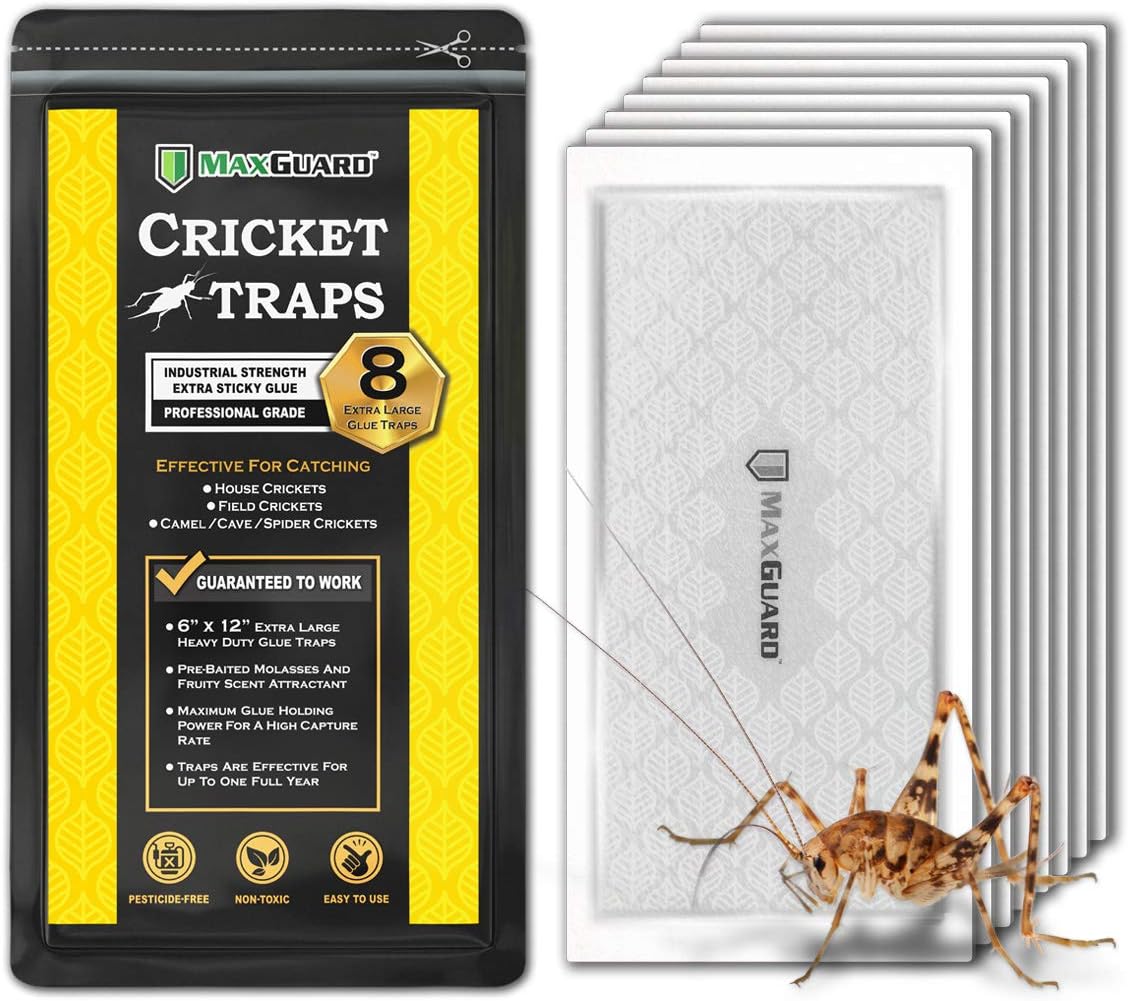
The Extra Large Cricket Traps 8-pack is a good value pick for apartments, smaller homes, and rooms where you also see spiders or other crawling insects. The larger surface area gives each trap more catching space than a small generic glue board.
This is the product I would choose when the problem is real but not whole-house severe. Eight traps are enough for a bathroom, kitchen, laundry room, basement corner, and garage entry.
- Large trap surface
- Good value for apartments and smaller homes
- Works for crickets, spiders, and crawling bugs
- Pesticide-free adhesive format
- Useful for monitoring as well as catching
- 8 traps may not cover a larger home
- Still requires manual disposal
- Dust and moisture reduce stickiness
- Not enough for heavy cave cricket pressure
Best for: apartments, smaller homes, mixed cricket/spider activity, and value-focused buyers.
3. Cricket XL Giant Glue Boards — Best for Cave and Camel Crickets

If you have large, long-legged cave crickets or camel crickets in a basement or crawl space, standard glue traps may be too small. XL glue boards give larger crickets more adhesive surface, which makes escape less likely.
Use these in damp basements, crawl space access points, garages, sheds, and unfinished storage areas where larger crickets appear at night.
- Better fit for cave and camel crickets
- Larger adhesive area
- Good for basements and crawl spaces
- Useful for larger long-legged crickets
- Can also catch spiders and other crawlers
- Only 6 traps per pack
- Takes more floor space
- More expensive per trap than small boards
- Overkill for small house crickets
Best for: cave crickets, camel crickets, sprickets, basements, crawl spaces, garages, and sheds.
4. Cricket Canceller Spray — Best Cricket-Specific Spray

Cricket Canceller Spray is useful when traps alone are not enough, especially around basement wall edges, garage corners, entry points, and exterior foundation zones. It is best used as a support product alongside glue traps.
Sprays work differently from traps: they treat surfaces and entry zones, while traps remove the crickets already moving inside. For better results, use both.
- Cricket-specific spray option
- Useful indoors and outdoors where label allows
- Good for entry points and wall edges
- Combines well with glue traps
- Helpful for garage and basement treatment
- Needs reapplication
- More expensive than traps
- Spray alone will not stop new entry
- Outdoor residue can be reduced by rain
Best for: foundation edges, garage corners, basement wall edges, and combination treatment with traps.
5. Spectracide Terminate Multi-Pest Spray — Best for Mixed Perimeter Pressure

Sometimes crickets are not the only problem. If you also see ants, carpenter ants, spiders, or other crawling insects around the foundation, a multi-pest perimeter spray may make more sense than a cricket-only product.
Use this kind of product for outdoor perimeter treatment around foundations, door thresholds, garage edges, and known entry zones. Always check the current product label before applying it indoors or near pets, children, vegetable gardens, water, or pollinator areas.
- Useful for mixed crawling pest pressure
- Large bottle for perimeter treatment
- Included sprayer simplifies application
- Good for foundation and garage entry zones
- Can reduce multiple pests using one product
- Not cricket-specific
- Chemical formula
- Mostly an outdoor/perimeter product
- Requires careful label-following
Best for: crickets plus ants, spiders, or other crawling pests around the home perimeter.
Outdoor Cricket Pressure: Natural Lawn and Perimeter Support
If crickets keep coming from the yard, foundation edge, patio, mulch beds, or damp lawn areas, indoor traps will only catch part of the problem. You also need to reduce outdoor pressure.
- Trim grass and vegetation near the foundation.
- Move mulch and leaf piles away from exterior walls.
- Reduce outdoor lighting or switch to warmer bug-reducing bulbs.
- Fix drainage and damp soil near the house.
- Use perimeter support around lawn and foundation areas.
Outdoor Perimeter Support
Use perimeter spray only when the source is outside
If crickets are entering from foundation gaps, garage edges, patio areas, or damp perimeter zones, combine trapping with moisture reduction, cleanup, sealing, and a labeled outdoor perimeter product.
Cricket Killer Comparison Table
| Product | Type | Best For | Primary Use |
|---|---|---|---|
| Cricket Traps Indoor 12 Pack | Glue trap | Best overall indoor trap | Basements, garages, bathrooms, laundry rooms |
| Extra Large Cricket Traps 8 Pack | Glue trap | Best value | Apartments, small homes, mixed cricket/spider activity |
| Cricket XL Giant Glue Boards | XL glue board | Cave and camel crickets | Basements, crawl spaces, garages |
| Cricket Canceller Spray | Spray | Cricket-specific spray support | Entry points, wall edges, basement/garage areas |
| Spectracide Terminate | Multi-pest spray | Mixed perimeter pest pressure | Foundation and outdoor entry zones |
Which Cricket Killer Should You Choose?
- Standard house crickets indoors: start with Cricket Traps Indoor 12 Pack.
- Apartment or small home: choose Extra Large Cricket Traps 8 Pack.
- Cave crickets or camel crickets: use Cricket XL Giant Glue Boards.
- Basement wall edges or entry points: combine traps with Cricket Canceller Spray.
- Crickets plus ants/spiders around the foundation: consider Spectracide Terminate.
- Outdoor yard/perimeter pressure: reduce moisture, seal entry points, and use Spectracide Terminate when a labeled outdoor perimeter spray fits the situation.
How to Use Cricket Traps Correctly
The success of cricket trapping depends on placement. Most DIY cricket failures happen because traps are placed in the middle of rooms instead of along cricket travel paths.
Placement Tips
- Place traps along walls. Crickets travel along edges and baseboards.
- Target damp areas first. Basements, bathrooms, laundry rooms, crawl space doors, and garage corners are high-value zones.
- Place traps near entry points. Door gaps, vents, foundation cracks, pipe penetrations, and garage doors matter.
- Use enough traps. A typical home may need 8-12 traps across several zones.
- Replace full or dusty traps. Dust and dead insects reduce stickiness.
Combine Traps With Prevention
- Seal door gaps and foundation cracks.
- Run a dehumidifier in damp basements.
- Move mulch and leaf litter away from the foundation.
- Reduce outdoor lighting at night.
- Use outdoor perimeter treatment when crickets keep coming from outside.
For physical exclusion, see our guide to pest control barriers for doors, windows, and vents.
Cricket Control Cost Breakdown
DIY cricket control is usually inexpensive compared with professional pest service.
Typical DIY costs:
- Glue traps: usually the lowest-cost starting point
- XL glue boards: slightly higher cost, better for cave crickets
- Cricket spray: higher upfront cost, useful around entry points
- Outdoor perimeter spray: useful when crickets come from outside
- Natural outdoor support: useful for yard/perimeter pressure
Professional treatment costs:
- Initial inspection: often free to $150
- Single cricket/pest treatment: often $150-350
- Recurring quarterly service: often $300-600+ per year
For most home cricket problems, DIY traps and prevention are the right first step. If crickets keep recurring after correct trap placement, sealing, and moisture control, the source is often a hidden entry point, damp crawl space, or outdoor pressure rather than a lack of spraying.
Frequently Asked Questions
What is the best cricket killer?
For most homes, the best first product is a pre-baited glue trap such as Cricket Traps Indoor 12 Pack. Traps catch active crickets and help show where the problem is strongest. For cave crickets, use Cricket XL Giant Glue Boards.
Do crickets bite?
Most crickets do not bite people. Some species may pinch if handled, but cricket bites are rare and usually harmless. For more detail, see our guide: Do crickets bite humans?
How do you get rid of crickets fast?
Use enough traps, place them along walls in active zones, reduce moisture, seal entry points, and treat outdoor perimeter areas if crickets are entering from outside. Most moderate problems need repeated monitoring rather than one trap or one spray.
Where do crickets come from in my house?
Crickets enter through gaps near doors, windows, foundations, vents, garage doors, and utility penetrations. They are attracted to moisture, warmth, shelter, and outdoor lighting.
How to use cricket traps around pets
Cricket glue traps use adhesive rather than pesticides, but pets should not be able to step on them or chew them. Place traps behind appliances, under furniture, along basement walls, and in areas pets cannot reach.
Do ultrasonic repellers work on crickets?
They are not a reliable primary cricket control method. Traps, moisture reduction, sealing, and perimeter treatment are more dependable.
How long does it take to get rid of crickets?
Moderate cricket problems often improve within 2-4 weeks when traps are placed correctly and entry points are addressed. Cave cricket problems in damp crawl spaces may take longer.
What attracts crickets indoors?
Moisture, warmth, food crumbs, shelter, and light attract crickets. Damp basements, crawl spaces, garages, bathrooms, and outdoor lights near entry points are common causes.
Do crickets damage my home?
Crickets can damage fabrics, paper, wallpaper, books, stored boxes, and some pantry items. The damage is usually less severe than termites or rodents, but long-term infestations can still become expensive and unpleasant.
When DIY Is Not Enough
If crickets keep returning after traps, sealing, moisture control, and perimeter treatment, the problem is usually not lack of product. It is a hidden source — a wet crawl space that keeps drawing camel crickets, a foundation or utility gap letting new crickets in, or damaged turf that points to mole crickets rather than a house issue.
If crickets keep coming back
Fix the source, not the symptom
Before buying more spray or another trap pack, check whether the source is outside the box you are treating. Damp crawl spaces, unsealed foundation gaps, and mole cricket lawn damage all require a different approach than indoor trapping.
Final Thoughts
Crickets are usually manageable when you match the product to the situation. For standard indoor problems, start with Cricket Traps Indoor 12 Pack. For large cave or camel crickets, use Cricket XL Giant Glue Boards. For entry points and basement edges, add Cricket Canceller Spray.
If cricket pressure starts outside around the lawn, patio, or foundation, traps alone will not solve the source. Reduce moisture, clean up vegetation, seal entry points, and use a labeled outdoor perimeter product only where the label allows. For mixed crawling pest pressure around the foundation, Spectracide Terminate is the more direct product path already covered in this guide.