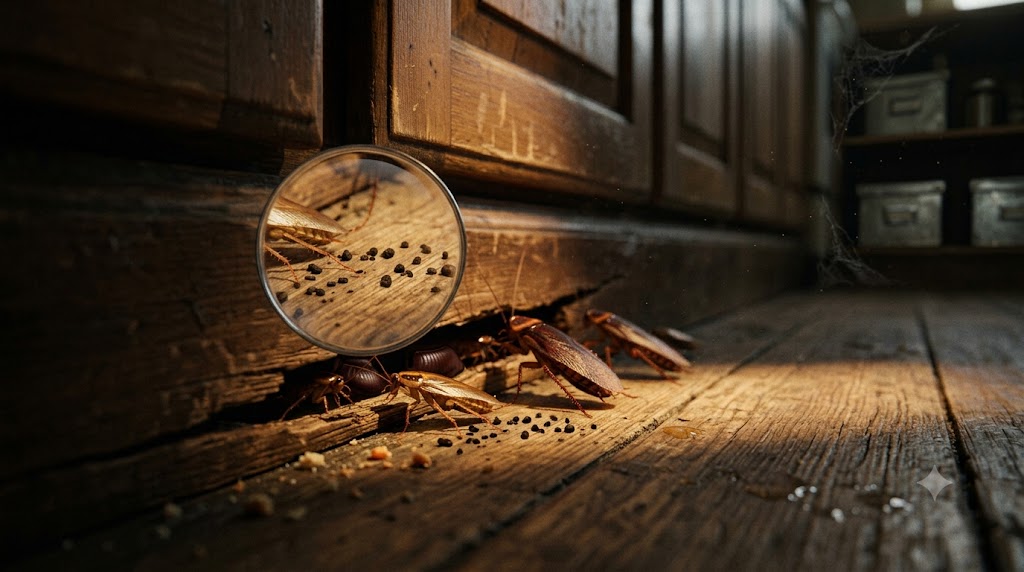
The signs of cockroach infestation appear long before you see a live roach. Cockroaches are one of the best-hidden household pests in the US, and by the time you spot one in the open, the colony has usually been established for weeks. This guide walks through the five earliest and most reliable signs of cockroach infestation — most of them visible before you ever see a live roach — and what each one tells you about the scale of the problem.
The Top Five Signs of Cockroach Infestation
- Droppings — coffee-ground or capsule-shaped, along baseboards and inside cabinets
- Egg cases (ootheca) — small dark purse-shaped capsules stuck in hidden corners
- Musty, oily smell — a distinct chemical odor near an active harborage
- Smear marks — dark, greasy streaks along baseboards and wall-cabinet joints
- Live sightings in daylight — the escalation trigger; means the hidden population has outgrown available shelter
If you’re seeing any two of these five, treat immediately — you have an established infestation, not a stray roach. Below is how to identify each sign, what it means, and what to do next.
Sign 1: Droppings
Droppings are the most common early sign — often visible before you ever spot a live roach — and the size tells you what species you’re dealing with.
What they look like
- Small roaches (German, Brown-banded): droppings resemble ground coffee, black pepper, or fine grains of dark sand. Individual pieces are smaller than 1 millimeter. Often scattered rather than clustered.
- Large roaches (American, Oriental, Smokybrown): capsule-shaped droppings roughly the size of a grain of rice, with visible ridges running down the sides. Sometimes mistaken for mouse droppings, but rodent droppings taper to a point at one end — cockroach droppings are blunt at both ends.
Where to look
- Inside kitchen and bathroom cabinets, along back and side walls
- Under and behind the refrigerator, oven, and dishwasher
- Along baseboards, especially in corners
- Inside drawer runners
- Behind toilets and under bathroom sinks
- Inside pantry shelves, particularly if cereal or dry goods are stored open
- Around utility openings (plumbing penetrations, dryer vents from inside)
What droppings tell you
Fresh droppings are the earliest visible signs of cockroach infestation. Dark and slightly moist when new, they dry out, fade, and can smear when disturbed as they age. A concentration of fresh droppings in one location marks a nearby harborage — that’s where the population is living and where treatment should be focused. Scattered old droppings without new ones may indicate a resolved infestation, or a colony that has moved to a different location.
Sign 2: Egg Cases (Ootheca)
Cockroaches don’t lay individual eggs — they produce a hardened capsule called an ootheca that contains anywhere from 12 to 40 eggs. Finding one confirms breeding activity, not just occasional visitors.
What they look like
- German cockroach ootheca: light brown to tan, roughly 6–9 mm long, with visible segmentation along the length. The female carries it protruding from her abdomen until just before hatching, so you’ll often find them near active harborage rather than scattered.
- American cockroach ootheca: dark reddish-brown to nearly black, 8–10 mm long, with a distinctive ridge along the top. The female drops them and often glues them to surfaces near food and moisture.
- Brown-banded ootheca: yellowish-brown, smaller than German, often glued to underside surfaces in unexpected locations (furniture undersides, upper cabinet interiors, behind picture frames).
Where to look
- Undersides of drawers and shelves
- Inside the motor housing of appliances (fridge, dishwasher)
- Deep corners of kitchen cabinets
- Behind bathroom vanities
- Underside of the toilet tank cover (rare but happens)
- In the folds and creases of cardboard boxes
- Behind picture frames and along the tops of door frames (for Brown-banded specifically)
What egg cases tell you
Among the signs of cockroach infestation, an egg case is the most decisive. Adult roaches can wander in occasionally without a breeding population being present — but egg cases don’t. They confirm that female roaches are breeding inside your home, and that a next generation is on its way if untreated. A single German ootheca will hatch 30–40 nymphs in 4–6 weeks; a female produces 4–8 of them in her lifetime.
If you find egg cases and they still appear intact (unhatched), collect and dispose of them — this is a small but real reduction in future population. If they appear hatched (open at one end, empty), the nymphs are already active somewhere in the home.
Sign 3: A Musty, Oily Smell
Cockroaches produce a chemical called cuticular hydrocarbon that gives established colonies a distinctive smell. Small infestations are usually undetectable to humans. Larger infestations produce an odor most people describe as “musty” or “oily” — sometimes compared to old grease or damp cardboard.
Where the smell is strongest
The smell tends to concentrate near active harborage. If a kitchen or bathroom smells “wrong” and you can’t identify a specific cause — no obvious rotten food, no plumbing issues, no mildew — and the smell is stronger near cabinet bases or behind appliances, that’s often the signal. Move a stove or fridge away from the wall and take a careful breath in the space behind; a strong musty smell there is diagnostic.
What the smell tells you
If you can smell a cockroach colony as a homeowner, the population is substantial — usually hundreds of individuals at minimum. This isn’t an early sign; it’s a mid-to-late sign. When you smell it, treatment should start the same week. A gel bait like Advion Cockroach Gel Bait on Amazon, or the same product from DoMyOwn, is the correct starting point.
Sign 4: Smear Marks
Cockroaches leave behind greasy streaks as they navigate in the dark. Their bodies pick up oil and moisture, and repeated travel along the same route deposits visible marks.
What they look like
Dark brown to nearly black streaks, roughly the width of a pencil line, running along surfaces where roaches travel repeatedly. Fresh marks smear when wiped with a damp cloth; older marks become more embedded.
Where to look
- Along the top edges of baseboards where they meet the wall
- Around door frames, especially near the bottom
- Along the joint between the wall and lower cabinets
- Under sinks along pipe surfaces
- Along the edges of shelves inside kitchen cabinets
- Around water heaters and behind furniture that hasn’t been moved in months
What smear marks tell you
Smear marks develop over time — they indicate that a colony has been established long enough for repeated travel patterns to form. In practical terms: if you’re finding fresh smear marks, you’ve had roaches for weeks at minimum, likely longer. Combined with droppings or an odor, smear marks tell you this is not an early-stage problem.
Sign 5: Live Sightings, Especially in Daylight
Cockroaches are strongly nocturnal. They hide during the day in dark voids and only emerge in the open at night when their surroundings are quiet. Seeing one in daylight — particularly a German cockroach on a kitchen surface at midday — is a serious signal.
What it means
Daytime sightings usually happen for one of two reasons:
- The hidden population has outgrown available shelter. When harborage is fully occupied, subordinate individuals are pushed out into open space to look for new hiding spots and food. Daytime sightings are how a large colony visually reveals itself.
- The population is stressed for food or water. Aggressive foraging during daylight hours suggests the colony has depleted local food sources and is expanding its search radius.
Either way, a daytime German cockroach sighting typically means at least several dozen additional roaches are hidden nearby, and often hundreds. Daytime American cockroach sightings are somewhat less alarming (they’re larger, slower, and can wander in from outside), but still warrant investigation.
Confirming the Signs of Cockroach Infestation with Monitoring Traps
If you’re seeing one or two of the signs above but aren’t sure whether you actually have a live population, monitoring traps are the fastest way to know for certain. These are sticky glue boards — pesticide-free, non-toxic, safe around pets and children — that catch any roach that walks across them.
Deploy them for 3–5 nights and check each morning. What you catch tells you:
- Nothing caught after 5 nights: most likely no active population, or the signs you saw were leftover from a previous problem. Continue monitoring for another week to be sure.
- One or two roaches caught, same species: low-level activity or occasional visitors from outside. Manageable with basic sanitation and sealing entry points.
- Multiple roaches caught, especially nymphs or Germans: established breeding population. Treatment should start immediately.
- Different species on different traps: more than one population, requiring parallel treatment strategies (see our German vs American cockroach identification guide).
A pack of Catchmaster monitoring glue traps on Amazon costs about $15 for 36 traps. That’s more than enough for a full home diagnostic. Place them along baseboards under sinks, behind the refrigerator, inside pantry corners, under bathroom vanities, and near any drain that could be an entry point.
Do not put bait on monitoring traps. Roaches will find them without it, and adding bait can actually reduce catch rates.
What to Do Next
Once you’ve confirmed an active infestation, the next steps depend on the scale and your living situation.
Light activity (1–2 roaches on traps, few droppings, no odor)
DIY treatment usually works. Start with gel bait placement plus an insect growth regulator, tighten up sanitation, and seal obvious entry points. Give it 2–3 weeks and monitor with traps. Our cockroach control hub walks through the environment-first approach in detail.
Moderate activity (multiple roaches on traps, visible droppings, some smear marks)
Still DIY-treatable, but you need to be thorough. Every kitchen cabinet, every appliance void, every bathroom cabinet. Gel bait plus IGR is not optional at this scale — it’s required. Expect 3–4 weeks to see the population decisively drop.
Heavy activity (daytime sightings, musty smell, roaches in bedrooms or electronics, apartment building)
This is where DIY starts to struggle. Populations this large usually have harborage inside wall voids that gel bait can’t fully reach, and in apartment buildings, roaches will re-enter from neighboring units no matter how well you treat. Consider calling a professional — start with our comparison of the best pest control services. If you’re renting, our guide for renters covers what you can do without landlord permission.
Frequently Asked Questions
How long does it take from first sign to visible infestation?
For German cockroaches, roughly 6–10 weeks from the first breeding female entering the home to a population large enough to produce daytime sightings and detectable odor. American cockroaches move slower — often 3–6 months from initial entry to noticeable interior activity, because their breeding cycle is longer and their primary population lives outside.
Can cockroach droppings look like mouse droppings?
Large cockroach droppings (from American or Oriental species) are similar in size to mouse droppings and can be confused. The reliable difference: mouse droppings taper to a point at one or both ends; cockroach droppings are blunt at both ends and often show visible ridges along the sides. If unsure, monitoring traps will confirm what’s actually active.
Do dead cockroaches on the floor mean the infestation is dying?
Not necessarily — and often, no. If you haven’t treated recently, finding dead roaches usually indicates a normal die-off from an active population, not a shrinking one. Older cockroaches die of natural causes constantly in an established colony. Only after you’ve applied bait and given it 5–10 days do dead roaches meaningfully suggest treatment progress.
Do cockroach allergens really affect asthma?
Yes — this is well documented. Roach droppings, shed exoskeletons, saliva, and body fragments become airborne as fine particles and trigger allergic and asthmatic responses. Cockroach allergens are one of the most significant indoor asthma triggers in urban environments, particularly for children. If someone in the household has asthma, treat the infestation aggressively and consider consulting a physician about allergen mitigation.
I’ve cleaned everything and still see droppings — why?
Cleaning removes food sources and existing droppings, but doesn’t kill the population producing them. New droppings will keep appearing as long as roaches are active. The correct sequence is: sanitation first (removes what’s attracting them), then targeted treatment with gel bait and IGR (kills the colony), then continued sanitation and monitoring. Cleaning alone is a maintenance strategy, not an elimination strategy.
PestsGuide gives independent DIY pest control guidance for US homeowners and renters. When you buy through links on this page we may earn a commission, at no extra cost to you.