Bed bugs are hard to eliminate because they do not stay in one obvious place. They hide in mattress seams, bed frames, headboards, baseboards, furniture joints, cracks, outlets, luggage, and nearby fabrics. One spray or one cleaning session is rarely enough.
If you want to know how to get rid of bed bugs at home, the real answer is a repeatable process: confirm the infestation, remove heat-treatable fabrics, vacuum the bed area, isolate the mattress, treat cracks and seams, and monitor for new activity. A small, early infestation may be manageable without an exterminator, but bed bugs in multiple rooms, shared walls, or recurring bites usually need professional help.
- Start with confirmation – check mattress seams, the bed frame, headboard cracks, baseboards, and nearby furniture before treating.
- Small early infestation – wash and heat-dry fabrics, vacuum, install a bed bug mattress encasement, and treat cracks with a labeled bed bug spray.
- Bed bugs around mattress seams or bed frame – use a targeted spray such as EcoRaider Bed Bug Killer Spray only where the label allows.
- Cracks, wall voids, and dry hiding places – consider a dust product such as HARRIS Bed Bug Powder, applied lightly and carefully.
- Need a full shopping list? Compare sprays, powders, encasements, and monitors in our best bed bug treatment products guide.
- Multiple rooms, repeated bites, or heavy activity – stop guessing with random products and use a structured treatment plan or a licensed bed bug professional.
Best First Move by Situation
Use the table below to choose the next step before buying more products. Bed bug treatment fails most often when the product does not match where the bugs are hiding.
| What you found | Best first move | Product type that fits |
|---|---|---|
| A few signs near one bed | Inspect, wash, heat-dry, vacuum, and isolate the mattress | Mattress encasement plus targeted crack treatment |
| Activity in seams, frame joints, or baseboards | Treat the hiding places directly and repeat monitoring | Labeled bed bug spray or dust, depending on the surface |
| You are not sure what to buy | Match products to the job before adding more treatment | Compare bed bug treatment products |
| Multiple rooms, shared building, or repeated bites | Get professional quotes before spending more on trial-and-error DIY | Inspection and whole-room treatment plan |
Step 1: Confirm That You Actually Have Bed Bugs
Before treating the room, make sure the problem is bed bugs and not fleas, carpet beetles, mites, or another biting insect. Bed bugs are small, flat, oval insects that hide during the day and feed at night.
Look for these signs:
- live bed bugs in mattress seams, bed frame cracks, or headboard joints;
- dark brown or black stains on sheets, mattress edges, or nearby furniture;
- tiny pale eggs or shed skins near hiding places;
- clusters of bites that appear after sleeping;
- new activity after travel, used furniture, guests, or apartment turnover.
If you are not sure, compare what you found with our guide to signs of bed bugs.
Step 2: Strip, Wash, and Heat-Dry Fabrics
Heat is one of the most useful tools against bed bugs when it reaches the right temperature for long enough. Start with bedding and washable fabrics before spraying anything.
- Remove sheets, pillowcases, blankets, mattress covers, and nearby washable fabrics.
- Bag them before carrying them through the house.
- Wash on hot settings when the fabric allows it.
- Dry on high heat for at least 30 minutes after the items are fully dry.
- Keep cleaned items sealed until the room is treated.
Do not carry loose bedding through other rooms. That can spread bugs or eggs to new areas.
Step 3: Vacuum the Bed Area Carefully
Vacuuming will not eliminate a full infestation by itself, but it removes visible bugs, eggs, shed skins, and debris before treatment. This helps sprays and powders reach the places that matter.
Focus on:
- mattress seams and labels;
- box spring corners;
- bed frame joints;
- headboard cracks;
- baseboards behind and beside the bed;
- nearby nightstands and furniture seams.
After vacuuming, empty the vacuum contents into a sealed bag and remove it from the home immediately.
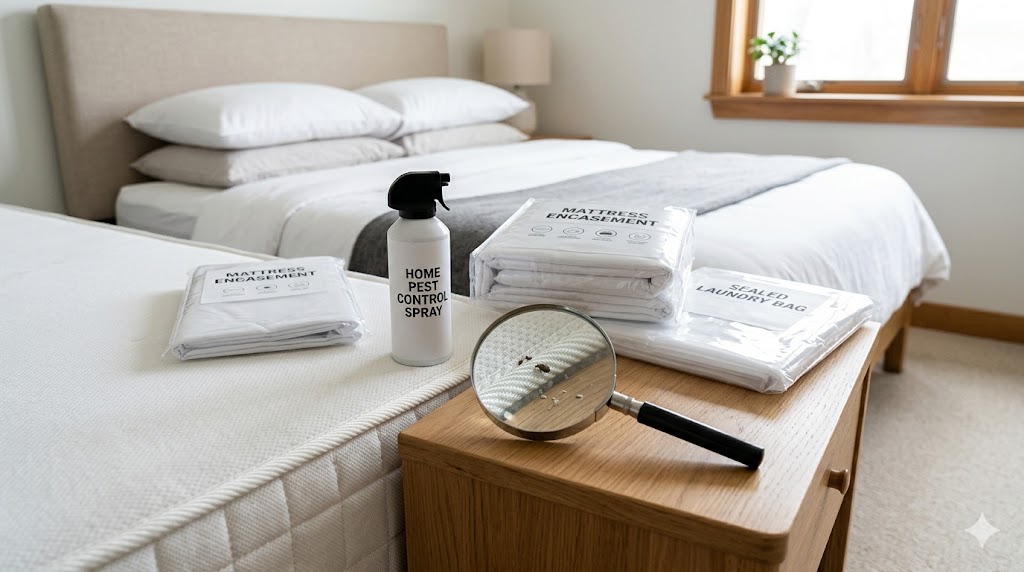
Step 4: Install a Bed Bug Mattress Encasement
A mattress encasement is not optional if the mattress may be involved. Bed bugs love mattress seams, labels, and box spring folds because those areas are close to the host and hard to inspect.
Best for Mattress Protection
SafeRest Bed Bug Mattress Encasement
A full mattress encasement helps trap bugs already inside the mattress and prevents new bugs from hiding in seams. It works best when combined with cleaning, crack treatment, and monitoring.
Keep the encasement on for at least a year. Do not remove it after a few weeks just because bites slow down.
Step 5: Treat Mattress Seams, Bed Frames, and Cracks
Bed bugs hide in tight spaces, so treatment has to target the cracks and seams where they actually rest. Do not spray the open middle of the room and expect results.
For mattress seams, bed frames, baseboards, and furniture joints, use a product labeled for bed bugs and follow the label exactly.
Best for Targeted Crack and Seam Treatment
EcoRaider Bed Bug Killer Spray
A practical DIY spray option for bed frames, seams, baseboards, and other labeled treatment areas. This plant-based formula is designed for use around the sleeping area, and works best after cleaning and before installing or resealing the mattress.
For dry cracks, crevices, and hidden voids where liquid spray is not ideal, a bed bug powder can help as part of a broader treatment plan.
Best for Dry Cracks and Hidden Harborage Areas
HARRIS Bed Bug Powder
Useful for cracks, crevices, wall gaps, and dry hiding places where bed bugs may travel. Apply lightly and only according to the label. More powder is not better.
Never spray bedding, pillows, clothing, pets, or skin unless the product label specifically allows that use. Do not mix pesticides. Do not overapply powder in visible piles. Bed bug products work best when used exactly as directed.
Step 6: Reduce Hiding Places Around the Bed
Clutter makes bed bug treatment harder. The goal is not to throw everything away, but to reduce the number of hiding places near the sleeping area.
- Move the bed slightly away from the wall.
- Remove items stored under the bed.
- Seal or treat cracks in the bed frame and nearby furniture.
- Keep clean bedding from touching the floor.
- Place questionable items in sealed bags until they can be inspected or heat-treated.
Do not move infested furniture into another room. That often spreads the problem.
Step 7: Monitor for New Activity
Bed bug treatment usually takes repeated work. Even after a good first treatment, eggs may hatch later and hidden bugs may move from nearby cracks.
For the next 2 to 4 weeks, check for:
- new bites after sleeping;
- live bugs near the bed;
- dark spots on sheets or mattress seams;
- shed skins;
- activity in nearby furniture or baseboards.
If signs continue, repeat cleaning and targeted treatment according to product labels. If the problem is spreading, move to professional help quickly.
DIY Bed Bug Treatment vs Professional Treatment Cost
DIY can be worth trying when the infestation is small and limited to one room. Professional treatment becomes more reasonable when bed bugs are in multiple rooms, apartments, wall voids, or when bites continue after repeated DIY work.
| Situation | Typical DIY Cost | Typical Pro Cost | Best First Move |
|---|---|---|---|
| One bed, early signs | $40-120 for encasement, spray, and basic supplies | $300-700+ | DIY first, monitor closely |
| Bed frame and nearby baseboards | $60-180 for spray, powder, encasement, and laundering | $500-1,200+ | DIY possible if activity is limited |
| Multiple rooms | $150-300+, with higher failure risk | $800-2,500+ | Get professional quotes |
| Apartment or recurring infestation | DIY often fails if neighboring units are involved | Varies by building and treatment plan | Professional inspection |
If you caught the problem early and it appears limited to one bed area, start with cleaning, heat, a mattress encasement, and targeted products. If bites continue after 2 treatment cycles or activity appears in multiple rooms, stop spending on random products and get professional quotes.
When to Call a Professional
DIY treatment is most realistic when the infestation is new, small, and easy to inspect. Professional treatment is the better choice when bed bugs are spreading or when you cannot find the source.
Call a professional if:
- you keep getting bites after repeated treatment;
- bed bugs appear in more than one room;
- you live in an apartment or shared building;
- you see many live bugs, eggs, or shed skins;
- you have already spent money on several products without results;
- someone in the home is elderly, medically vulnerable, or unable to help with preparation.
When DIY is not enough
Do not let a spreading bed bug problem turn into a house-wide infestation
If bed bugs are spreading across rooms, bites continue after repeated treatment, or you are not sure where they are hiding, pause before buying more random products. Recheck the mattress, box spring, bed frame, headboard, baseboards, nearby furniture, luggage, and shared-wall areas. If activity is still moving, a licensed bed bug professional is usually safer than repeated trial-and-error treatment.
For DIY cases that are still small and contained, focus on the core tools above: heat, vacuuming, a mattress encasement, targeted crack-and-seam treatment, and follow-up monitoring.
Common Mistakes That Make Bed Bugs Worse
- Throwing away the mattress too early. Carrying it through the home can spread bugs. An encasement is often the better first step.
- Spraying randomly. Bed bugs hide in seams, cracks, and joints. Treating open floor space does not solve the problem.
- Using too much powder. Heavy piles are messy, unsafe, and easier for insects to avoid.
- Moving to another room to sleep. Bed bugs may follow you and spread to the new room.
- Stopping after one quiet week. Eggs can hatch later. Keep monitoring for several weeks.
Frequently Asked Questions
Can I get rid of bed bugs myself?
Yes, but only if the infestation is small, early, and limited to an area you can inspect and treat thoroughly. DIY treatment works best when you combine heat, cleaning, encasement, targeted spray or powder, and repeat monitoring.
What kills bed bugs fastest?
Heat can kill bed bugs quickly when it reaches the right temperature for long enough. Labeled sprays can kill bugs on contact or through residual exposure, depending on the product. The problem is not killing one visible bug – it is reaching the hidden bugs and eggs.
Do mattress encasements kill bed bugs?
A mattress encasement can trap bugs already inside the mattress and prevent new bugs from hiding in mattress seams. It does not treat bed frames, baseboards, furniture, or nearby cracks, so it should be part of a broader plan.
How long does it take to get rid of bed bugs?
A small infestation may improve within a few weeks if treated correctly. Larger infestations can take multiple treatments over several weeks or more. Continued bites after repeated treatment usually mean hidden activity remains.
Should I throw away my mattress?
Usually not as the first step. Throwing away a mattress can spread bed bugs through the house or building. In many cases, a proper encasement plus treatment is more practical.
When should I stop DIY treatment and call a pro?
Call a professional if bed bugs appear in multiple rooms, bites continue after repeated treatment, or you cannot locate the hiding places. At that point, the cost of guessing with more products can exceed the value of a professional inspection.
Final Thoughts
Getting rid of bed bugs at home requires patience and a complete plan. Start by confirming the infestation, heat-treating fabrics, vacuuming carefully, protecting the mattress, and treating cracks and seams with labeled products.
If the problem is small, DIY can save money. If bed bugs are spreading, returning, or showing up in multiple rooms, professional treatment is usually the smarter next step.
Related Reading
Prices and availability change frequently. PestsGuide.com earns from qualifying purchases as an Amazon Associate and may earn commissions from partner programs.