


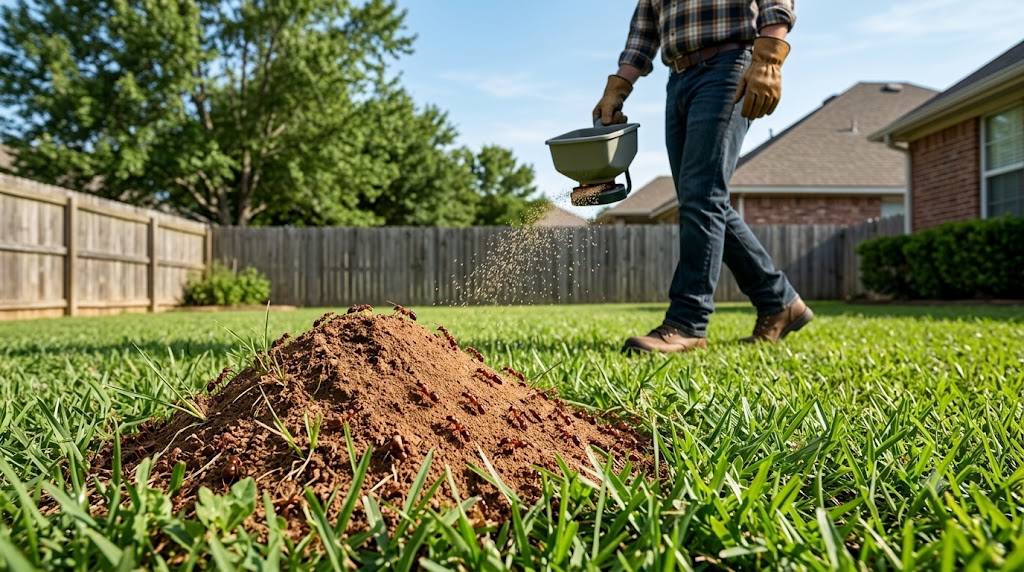
This guide explains how to get rid of fire ants in your yard with a practical two-step treatment plan. Fire ants are not just another lawn nuisance: when a mound is disturbed, many workers can rush out and sting repeatedly. Killing the ants on top of one mound may make the yard look better for a few days, but it can miss hidden colonies and new queens establishing nests elsewhere. The most reliable DIY strategy is usually to apply fire-ant bait across the infested lawn, then spot-treat the active mounds that remain.
How to Get Rid of Fire Ants in Your Yard: Quick Answer
- Confirm that the mound is active. Place a small food sample beside it and watch from a safe distance rather than kicking or opening the mound.
- Choose a product labeled for fire ants and your treatment site. Indoor ant stations and general household sprays are not substitutes for lawn treatment.
- Broadcast bait over the infested yard. Apply only at the label rate when ants are actively foraging and the weather meets label directions.
- Treat persistent mounds individually. Use a labeled mound bait, drench, dust, or granule according to its directions.
- Recheck the lawn instead of assuming every mound is dead. Mark treated areas, watch for activity, and repeat only as the label allows.
Safety first: keep children and pets away during application and for as long as the product label requires. Do not treat near water, edible gardens, or animal areas unless that exact site is listed on the label.
| Situation | Best starting method | What to expect |
|---|---|---|
| Several mounds or activity across the lawn | Broadcast fire-ant bait | Workers carry bait into visible and hidden colonies; results are not instant. |
| One or two active mounds | Labeled individual mound treatment | Faster control of a known mound, but it does not protect the rest of the yard. |
| Mounds beside a play area, pet run, or doorway | Restrict access, then use the appropriate labeled treatment | High-risk locations may justify professional treatment when access cannot be controlled. |
| Repeated mounds after DIY treatment | Recheck identification, application conditions, and neighboring pressure | A lawn-wide plan usually works better than repeatedly chasing individual mounds. |
If you are deciding how to get rid of fire ants in your yard when more than one mound is active, start with lawn-wide colony control rather than repeatedly spraying only the ants you can see.
Which Fire-Ant Product Should You Choose?
You do not need to buy every product on this page. For a lawn-wide treatment, choose one broadcast bait: Advion or Maxforce. Use Amdro as a targeted follow-up for individual mounds that remain active. Wondercide fills a different role as an optional plant-based contact spray; it is not a replacement for colony bait.
| Your situation | Best fit | Role in the plan |
|---|---|---|
| Multiple fire-ant colonies across the lawn | Advion Fire Ant Bait | Specialized broadcast bait that can also be used for labeled mound applications. |
| Fire ants plus other outdoor ant species | Maxforce Complete | Alternative broadcast bait for imported and native fire ants and other listed ants. |
| One persistent or high-risk mound | Amdro Fire Ant Bait | Targeted mound bait used after or alongside an appropriate lawn-wide strategy. |
| Plant-based contact treatment is the priority | Wondercide Outdoor Spray | Optional contact and repellent treatment, not hidden-colony bait. |
| DIY treatments failed or access cannot be controlled | Professional treatment | Inspection, treatment planning, and follow-up for severe or high-risk infestations. |
For a broader comparison of household baits, gels, sprays, and outdoor ant products, see Best Ant Killer for Home: 6 Products Compared.
Make Sure They Are Fire Ants Before Treating the Lawn
Imported fire ants are reddish-brown to dark reddish-black ants that build soil nests outdoors. A mature mound may be dome-shaped, but shape alone is unreliable: mounds can be flat in sandy soil, may have grass growing through them, and often lack an obvious opening at the top. Workers vary in size within the same colony.
The most important behavioral clue is a rapid, aggressive response when the nest is disturbed. Do not use your foot, hand, rake, or mower to test this. Instead, place a small piece of oily food near the mound during warm, dry conditions and observe from a safe distance. Fire ants usually recruit quickly when they are actively foraging.
Small pavement ants, field ants, and other lawn species can also move soil. If the ants do not match fire-ant behavior or you live outside their established range, photograph a worker and mound and ask your county Extension office for identification before applying a specialized pesticide. For other ant problems, begin with our ant identification and control hub.
Why Treating One Mound Is Often Not Enough
A visible mound is only the part of the colony you can see. Small or newly established colonies may have little surface soil, and established infestations can include many colonies across one property. A contact product may kill exposed workers without reaching the queen. Flooding or disturbing a mound can also cause ants to move or split activity into harder-to-find locations.
This is why Extension programs commonly describe a two-step approach. A broadcast bait targets colonies throughout the treatment area, including those without obvious mounds. Individual mound treatments then address colonies that remain active or create an immediate sting hazard.
Step 1: Apply Fire-Ant Bait Across the Infested Yard
For homeowners researching how to get rid of fire ants in your yard, broadcast bait is usually the foundation of the plan. Fire-ant bait combines food with a slow-acting active ingredient. Foraging workers collect the granules and carry them into the colony. That delay is useful: the goal is for the bait to move through the colony rather than kill only the workers that touch it outdoors.
Use a Quick Foraging Test
Bait works only when ants find and collect it. Before treating a large lawn, place a small piece of greasy snack food near an active mound without touching the mound itself. Check it after about 15 to 30 minutes. If fire ants are feeding, conditions are likely suitable for bait collection. If they ignore it, wait for a better time rather than wasting the product.
Choose the Right Weather Window
- Apply when the ground is dry and ants are actively foraging.
- Avoid application immediately before rain, irrigation, or heavy dew if the label requires a dry interval.
- Do not broadcast lightweight bait in strong wind.
- Follow the product’s temperature, season, and reapplication directions; they differ by active ingredient.
- Do not water bait into the soil unless the label specifically instructs you to do so.
Fire-Ant Bait for Lawn or Mound Use
Syngenta Advion Fire Ant Bait
An indoxacarb bait labeled for imported fire ants on residential lawns and landscaped areas. The current manufacturer label allows broadcast and individual mound applications. Use only where the label permits, measure the treatment area, and follow the listed rate and weather directions.
Alternative Granular Fire-Ant Bait
Maxforce Complete Granular Insect Bait
A 1% hydramethylnon granular bait labeled for imported and native fire ants as well as several other outdoor ant species. It can be used for broadcast or individual mound applications where the current label permits. Keep it away from sprays that could reduce bait acceptance, and follow the label for rate, weather, and site restrictions.
Do not estimate application rates by eye. Measure the lawn area, subtract surfaces that should not be treated, and use a spreader setting or hand application method allowed by the label. More bait does not mean faster control. Overapplication can increase exposure and cost without improving colony uptake.
Step 2: Spot-Treat Mounds That Remain Active
After the broadcast treatment has had the time stated on its label, recheck marked mounds. Treat those that remain active with a product specifically labeled for individual fire-ant mounds. Depending on the product, this may be a mound bait, liquid drench, dust, or contact granule.
Mound Bait
Mound bait is placed around or over the mound exactly as directed so foragers can collect it. Do not mix it into the mound, and do not disturb the nest before application unless the label says otherwise. Bait is a good fit when colony control matters more than an immediate cosmetic result.
For Individual Fire-Ant Mounds
Amdro Fire Ant Bait Granules, 6 oz
A granular bait intended for targeted treatment around individual fire-ant mounds. Foraging workers carry the bait into the colony, so do not disturb the mound or mix the granules into the soil. This 6 oz product is different from Amdro’s larger lawn-wide Yard Treatment bag; follow the package label for mound rate, dry-weather timing, and reapplication.
Liquid Drench
A drench uses a labeled insecticide solution and enough finished liquid to penetrate the mound according to the product directions. Correct volume and placement matter. Too little liquid may affect only the upper nest, while runoff can move pesticide away from the target. Never pour gasoline, bleach, boiling water, drain cleaner, or other household chemicals into a mound.
Dust or Contact Granules
Some products are designed for direct mound treatment and can reduce activity faster than slow bait. They are useful when a mound creates an immediate hazard, but they still treat only known colonies. Confirm whether the granules must be watered in; bait granules and contact granules are not applied the same way.
What Not to Do to a Fire-Ant Mound
- Do not kick, dig, or mow over an active mound. Disturbance can trigger mass stinging and may cause the colony to relocate.
- Do not combine products unless both labels allow it. Repellent sprays may interfere with bait collection.
- Do not treat every outdoor ant as a fire ant. Many native ants are not aggressive lawn pests and can be useful predators.
- Do not apply bait to wet ground or before rain contrary to the label. Oil-based bait can become unattractive after moisture exposure.
- Do not use an indoor ant bait station on a lawn mound. The placement, formulation, and labeled use are different.
- Do not seal or cover the mound. This does not eliminate the underground colony.
Optional: Plant-Based Contact Treatment for the Yard
A hose-end contact spray can be useful when a homeowner wants a plant-based treatment for broad outdoor pest pressure. This is a different role from colony bait: it targets ants contacted during application and may help repel activity, but it should not be presented as a substitute for bait transfer to a hidden queen or colony.
Do not spray directly over bait or across the same active foraging route while relying on workers to collect bait. Keep contact or repellent treatments separate from bait placements, and follow both product labels.
Plant-Based Contact Option
Wondercide Ready-to-Use Outdoor Pest Control Spray
A hose-end yard spray made with cedarwood oil, sesame oil, and sodium lauryl sulfate. Wondercide lists fire ants among the pests killed by the ready-to-use application and states coverage up to 5,000 square feet for this use. It kills by contact and repels; it is not a slow-acting colony bait. Do not apply to food-use sites, and follow the temperature and application directions to reduce the risk of plant damage.
How Long Does Fire-Ant Bait Take to Work?
Fire-ant baits are intentionally slower than contact treatments, and timing varies by active ingredient and product. Some baits may visibly reduce a colony within days; insect growth regulator baits can take several weeks. Weather, bait freshness, foraging activity, colony size, and whether the label rate was applied all affect the result.
Understanding how to get rid of fire ants in your yard also means allowing enough time for workers to distribute the bait through the colony. A quiet mound the next day is not the only measure of success, and visible activity shortly after treatment does not automatically mean the bait failed.
Do not judge bait failure the next morning. Record the application date and inspect from a safe distance after the label’s expected control period. A mound can remain visible after the colony is inactive, so look for ant activity rather than flattening it as a test.
Fire-Ant Treatment Around Children, Pets, Gardens, and Water
A product being sold for residential lawns does not mean it belongs everywhere in a yard. Read the full label before purchase and again before application. Pay particular attention to treatment sites, protective equipment, re-entry directions, rain restrictions, storage, and disposal.
- Remove children, pets, toys, bowls, and movable play equipment before application.
- Keep people and animals out for the period stated on the label.
- Do not place loose bait where children, pets, poultry, or wildlife can readily access it.
- Prevent granules and spray from reaching ponds, storm drains, gutters, pools, wells, or surface water.
- Do not apply to vegetable beds, edible crops, grazing areas, or animal enclosures unless those sites are expressly listed.
- Store the pesticide in its original labeled container, closed and out of reach.
For general pesticide precautions, review the EPA pesticide safety guidance. The product label remains the controlling instruction for the product in your hand.
What to Do After a Fire-Ant Sting
Move away from the mound immediately and brush or pull the ants off. Wash the skin with soap and water. A localized burning sensation, redness, swelling, and an itchy blister or pustule can occur. Avoid scratching or breaking the blister because damaged skin can become infected.
Call emergency services immediately for difficulty breathing, throat or tongue swelling, dizziness, faintness, widespread hives, vomiting, or other signs of a serious allergic reaction. People who have been prescribed epinephrine should follow their emergency plan. Multiple stings, a sting to a very young child, or a rapidly worsening reaction also warrants prompt medical advice. The American College of Allergy, Asthma and Immunology explains normal and allergic sting reactions in more detail.
How to Keep Fire Ants From Taking Over the Yard Again
No outdoor treatment can permanently exclude new fire-ant queens from an open property. The realistic goal is ongoing suppression and early treatment of new colonies. Keep a simple yard record with application dates, products, weather conditions, and mound locations. Reinspect high-use areas before parties, sports, mowing, or gardening.
- Monitor sunny lawn edges, utility boxes, driveways, sidewalks, fence lines, and disturbed soil.
- Coordinate treatment with adjacent property owners when colonies repeatedly move across boundaries.
- Use preventive broadcast applications only at intervals allowed by the label.
- Repair irrigation leaks and drainage problems that keep sections of the lawn persistently wet.
- Check new sod, potted plants, soil, hay, and landscaping materials when moving them from infested areas.
When to Call a Professional
Professional fire-ant control makes sense when the infestation is extensive, treatments repeatedly fail, or a mound is in a location where a homeowner cannot treat without exposing people, animals, food, or water. Consider professional help for schools, day-care areas, playgrounds, community lawns, rental properties, wells, pond edges, electrical equipment, or homes where someone has a history of a severe sting allergy.
Ask which active ingredient will be used, whether the plan is broadcast treatment, mound treatment, or both, how long people and pets must remain away, and what follow-up is included. A responsible service should identify the treatment area and provide the product label or application record.
Need help with a recurring or high-risk infestation?
Compare professional pest control providers, service coverage, treatment questions, and situations where hiring a technician makes more sense than repeating DIY applications.
Frequently Asked Questions
Should I treat the mound or the whole yard first?
If fire ants are spread across the lawn, a broadcast bait is usually the foundation of control because it can reach visible and hidden colonies. Persistent or high-risk mounds can then receive an individual treatment. Follow the sequence and timing on the selected product labels.
Should I disturb a fire-ant mound before using bait?
No. Disturbance can trigger stinging, interrupt normal foraging, and cause ants to move. Apply the bait around or across the treatment area exactly as its label directs.
Why are fire ants still active after baiting?
Bait is not an instant contact treatment. Workers must find it and carry it into the colony. Give the product its labeled control period, then reassess weather, bait freshness, application rate, and whether ants were foraging at the time of treatment.
Will vinegar, boiling water, or gasoline kill a fire-ant mound?
Household liquids are unreliable colony treatments and can injure people, damage grass, contaminate soil, or create fire and runoff hazards. Use only a pesticide labeled for fire ants and the specific site, or hire a licensed professional.
Can fire ants come inside the house?
Fire ants primarily nest outdoors, but workers may forage indoors, especially near moisture, food, or utility entry points. Treat the outdoor colony and correct the entry condition. For indoor trails from other species, use our guide to getting rid of ants in the house.
What is the best fire-ant killer for a yard?
The practical answer to how to get rid of fire ants in your yard depends on whether you need lawn-wide colony control or fast treatment of one dangerous mound. A labeled broadcast bait is usually the better starting point for multiple colonies; a labeled mound treatment is more targeted. Compare active ingredients, treatment sites, speed, and safety directions rather than choosing only by the word “killer” on the package.
Need a broader ant-product comparison?
This guide focuses on fire-ant colonies in lawns. For household bait stations, gels, sprays, and perimeter products, see our main comparison page.
Sources and Further Reading
- Mississippi State University Extension: Fire Ants
- Texas A&M AgriLife Extension: Fire Ant Control and the Two-Step Method
- Syngenta: Current Advion Fire Ant Bait Label
- Envu: Current Maxforce Complete Granular Bait Label
- Amdro: Fire Ant Bait for Individual Mounds
- Wondercide: Ready-to-Use Outdoor Pest Control Spray
- US EPA: Pesticide Safety Tips