


If mosquitoes have taken over your backyard, body sprays and citronella candles usually are not enough — you need to treat the yard itself. The best mosquito killer for a yard or backyard depends on the problem you are trying to solve: adult mosquitoes hiding in foliage, larvae in standing water, a small patio, a larger lawn, or a one-night outdoor event. This guide compares seven practical mosquito lawn treatment and yard repellent options for US homeowners in 2026, across five product categories — from professional liquid concentrates to garlic-based and Bti options.
Affiliate and referral disclosure: PestsGuide may earn a commission from qualifying purchases or referrals through Amazon Associates, DoMyOwn, and other affiliate programs. This does not change your price or our editorial recommendations.
Quick Answer: Best Mosquito Killer for Yard and Backyard
Start with the yard problem you actually have: adult mosquitoes resting in foliage, larvae in standing water, a small patio, a larger lawn, or a one-night event.
Best Fit for Larger Yards — Liquid Concentrate
Atticus Talak 7.9% Bifenthrin Concentrate (96 oz)
Bifenthrin concentrate for larger yards or recurring mosquito pressure. One bottle makes 32-96 finished gallons depending on dilution, and the label allows broad lawn and perimeter use when applied correctly.
Best Granular — No Mixing Required
Control Solutions Bifen LP Granules (25 lb)
Sand-core bifenthrin granules that broadcast over lawns and activate with rain or watering. A better fit when you want a spreader application instead of mixing liquid concentrate.
Best Ready-to-Spray — Hose-End
Cutter Backyard Bug Control Spray Concentrate (32 oz, 3-Pack)
No mixing or measuring — attach the sprayer to a garden hose and treat a small yard or patio perimeter. Best for homeowners who want simple application over professional-style measuring.
Best Natural — Garlic-Based
Mosquito Barrier Liquid Garlic Concentrate (1 Gallon)
Garlic juice concentrate for yards where the goal is mosquito pressure reduction without synthetic pyrethroids. It fits best as part of a routine paired with larval control in standing water.
Best for Standing Water — Larvicide
Summit Mosquito Dunks (20-Count)
Floating Bti tablets that target mosquito larvae in standing water — rain barrels, ponds, birdbaths, clogged gutters, and tree holes. A strong add-on to any adult mosquito yard treatment.
Best Fogger — Pre-Event Knockdown
Black Flag 190095 Propane Insect Fogger
Propane-powered thermal fogger for short-term mosquito reduction before an outdoor event. Useful for temporary relief, but not a replacement for residual yard treatment or standing-water control.
Best Pro-Grade Alternative — Microencapsulated
Syngenta Demand CS Insecticide (8 oz)
Professional-grade lambda-cyhalothrin concentrate with microencapsulated technology. Best reserved for experienced DIY users who already understand mixing, label rates, and perimeter applications.
Plant-Based Ready-to-Use Option
Wondercide Outdoor Pest Control Spray
A ready-to-use cedar oil yard spray instead of a synthetic pyrethroid concentrate. It fits homeowners who want a simpler plant-based option and are willing to reapply more often.
Prices and availability change frequently — click through for current pricing. PestsGuide.com earns from qualifying purchases and referrals through Amazon Associates, DoMyOwn, and other affiliate programs.
When DIY Yard Treatment Makes Sense — and When You Need a Pro
DIY mosquito yard treatments work best in three situations: small to mid-sized properties (under 1 acre), moderate mosquito pressure, and homeowners willing to treat the yard every 4-8 weeks during the season. With consistent application, the products in this guide can meaningfully reduce backyard mosquito pressure, especially when you combine adult mosquito control with larval control in standing water.
DIY treatment is the wrong choice in several scenarios. If your property is larger than 2 acres, the amount of product and labor required quickly exceeds the cost of professional service. If you live near a wetland, swamp, retention pond, or any large body of standing water you don’t control, mosquitoes will keep flying in from outside no matter how much you spray. If local health officials report mosquito-borne disease activity in your area (West Nile, EEE, or imported cases of Zika), contact your local mosquito control program or a licensed pest professional instead of relying only on DIY treatment. If anyone in your household has allergies or asthma triggered by pyrethroids, even careful DIY application carries risk.
The general rule: try DIY first. If you’ve applied a yard killer correctly for a full season (3-4 applications) and mosquitoes still dominate your yard, professional treatment may be worth considering. For most homeowners, though, the better next step is to check whether the product was applied to shaded resting areas, standing water was treated with Bti, and applications were repeated on schedule.
The 5 Types of Yard Mosquito Killers — What Each One Does
Yard mosquito products fall into five categories, and most successful homeowners use two or three of them in combination. Buying only one type is the most common mistake — each category solves a different part of the problem.
Liquid Concentrates
Professional-grade pesticide concentrates contain a synthetic pyrethroid (most commonly bifenthrin or lambda-cyhalothrin) at 7-10% strength. You mix a small amount with water in a pump or hose-end sprayer, following the product label for the pest and treatment area, then apply to grass, foliage, eaves, fences, and shaded resting areas where adult mosquitoes hide during the day. Coverage is excellent, residual activity can last for weeks when applied correctly, and per-application cost is low. The downside: you need a separate sprayer, and you have to mix the solution yourself. Best for serious DIY users and larger properties.
Granular Insecticides
Same active ingredients as liquid concentrates (bifenthrin), but in a sand-core granular form. You broadcast the granules with a standard lawn spreader, then water them in (or wait for rain). The granules dissolve gradually, releasing the active ingredient into the soil and lower vegetation where mosquitoes rest. Granules require no mixing and no sprayer, but you still need to follow the label for gloves, clothing, watering-in, and reentry timing. They also penetrate mulch and dense ground cover better than liquid sprays. Residual timing depends on rate, weather, irrigation, and label directions. Best for homeowners who already own a fertilizer spreader.
Ready-to-Spray (Hose-End) Concentrates
The mass-market option. The bottle screws directly onto your garden hose, and a built-in venturi system mixes the concentrate with water as you spray. No measuring, no separate sprayer. Coverage is lower than professional concentrates (typically 5,000 sq ft per 32 oz bottle), and per-application cost is higher, but the convenience is unmatched. Best for first-time DIY users and small yards.
Larvicides (Bti)
The only product type that targets larvae instead of adult mosquitoes. The active ingredient is Bacillus thuringiensis israelensis — a naturally occurring bacterium used in mosquito control programs. Larvicides come as floating tablets (dunks), granules (bits), or liquid suspensions, and they go directly into standing water — rain barrels, decorative ponds, clogged gutters, low spots, tree holes. Each dunk typically lasts 30 days according to the product label. Bti products are registered for mosquito larval control and are widely used by mosquito abatement districts across the United States.
Foggers
Thermal foggers create a dense cloud of insecticide that drifts through dense foliage and reduces adult mosquito activity for a short window. The effect is temporary, so foggers are best used as pre-event treatment — fog the backyard 30-60 minutes before a barbecue, wedding, or pool party. Foggers work best in calm conditions (low wind, at dusk or dawn) and are not a substitute for residual yard treatments.
7 Best Mosquito Killers for Yard and Backyard — Detailed Reviews
1. Atticus Talak 7.9% Bifenthrin Concentrate — Best Overall


Atticus Talak is a professional-grade liquid insecticide containing 7.9% bifenthrin — the exact same active ingredient and concentration as the better-known Talstar Pro brand, at a lower price point. Bifenthrin has been the workhorse of US perimeter pest control for over 35 years, registered for residential, commercial, and food-handling area use. One 96 oz bottle makes 32 to 96 finished gallons of spray, depending on dilution rate, easily covering a half-acre property through an entire mosquito season.
The product label gives dilution ranges by pest and treatment area, so do not guess or exceed the labeled rate. For yard mosquito control, mix only what you need in a pump or backpack sprayer, apply to shaded resting sites, and repeat on the schedule allowed by the label. A higher labeled rate may make sense for the first application of the season, while maintenance treatments should stay within the product’s mosquito-control directions.
Application is straightforward: spray foliage, shaded resting areas (under decks, behind sheds, dense shrubs), the lower 6 feet of fence lines, and around the perimeter of patios and seating areas. Avoid open lawn unless you have a specific lawn pest problem — mosquitoes don’t rest on open grass.
- Same chemistry as professional Talstar Pro, lower price
- Label-dependent residual control when applied correctly
- Controls 75+ pest species — works as multi-purpose yard treatment
- Water-based, no offensive odor once diluted
- Dries clear, no staining on patio furniture or siding
- Strong Amazon track record (4.6⭐, 1,150+ ratings)
- Concentrate is hazardous before dilution — careful mixing required
- Requires separate pump or backpack sprayer (not included)
- Toxic to bees and aquatic life — avoid spraying flowering plants or near water
- Atticus is less recognized than Talstar brand
2. Control Solutions Bifen LP Granules — Best Granular Option
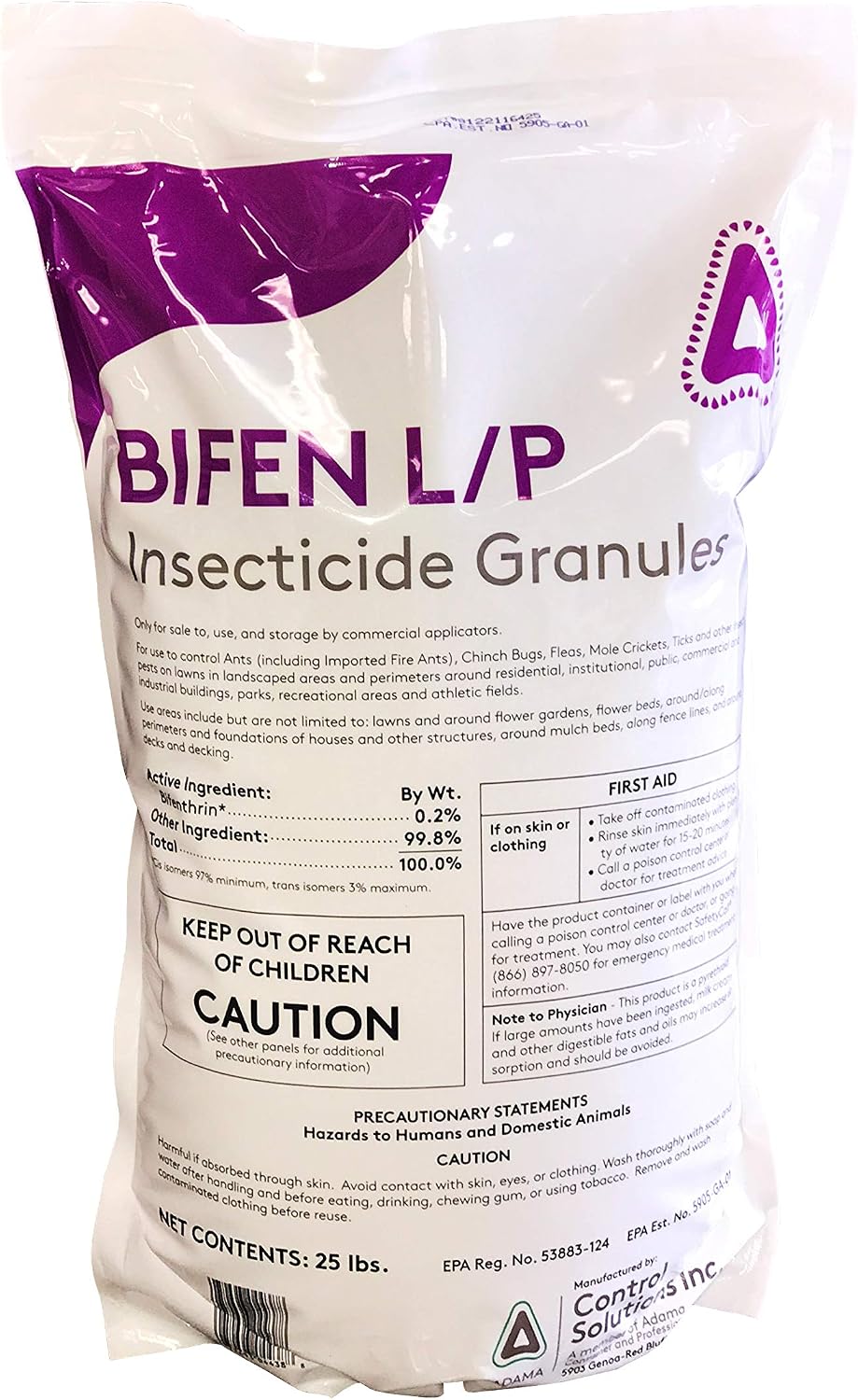

Bifen LP Granules deliver the same active ingredient (bifenthrin) as Atticus Talak, but in a granular form that requires no mixing and no sprayer. The “LP” stands for Lawn and Perimeter — the granules are formulated with a heavy sand core that resists wind drift and penetrates mulch and grass thatch where mosquitoes rest during the day.
Application is straightforward with any standard lawn spreader. One 25 lb bag covers different areas depending on the labeled rate and target pest. For yard mosquito control, set the spreader according to the label, water in as directed after broadcasting, and repeat only on the schedule allowed by the product. Weather, irrigation, mowing, and mosquito pressure all affect how long one application performs.
Bifen LP is the same product professional pest control operators use on residential accounts. It’s identical chemistry to Talstar PL Granules from FMC — Control Solutions is a major US insecticide manufacturer producing equivalent products at lower retail price.
The main advantage over liquid concentrates: no chemical handling beyond the spreader, no protective gear required beyond gloves, and the granules continue working through rain (in fact, rain activates them). The disadvantage: less precise targeting — you treat the whole yard, not just shaded mosquito-resting zones.
- No mixing, no separate sprayer required
- Sand-core formulation resists wind drift
- Longer residual window than many hose-end sprays when used according to the label
- Penetrates mulch and thatch where mosquitoes hide
- Identical chemistry to professional Talstar PL Granules
- Compatible with many pet yards once watered in and dried according to the label
- 4.6⭐ on Amazon with 1,694+ ratings
- Requires a spreader (not included)
- 25 lb bag is overkill for very small yards
- Toxic to bees during application — avoid flowering plants
- Higher upfront cost than hose-end products
See Bifen LP price at DoMyOwn →
3. Cutter Backyard Bug Control Spray Concentrate — Best Hose-End

Cutter Backyard is the best-selling hose-end yard insect treatment in the United States. With over 38,000 verified Amazon reviews and a 4.4-star average, it’s the entry-level go-to for homeowners who don’t want to invest in a separate sprayer or measure concentrates.
Each 32 fl oz bottle ships with a built-in QuickFlip hose-end sprayer (this listing is a 3-pack, so you get three bottles) — flip the lever, and water flowing through the bottle automatically mixes the concentrate at the labeled ratio. One bottle treats up to 5,000 sq ft of lawn and ornamental areas, taking about 10-15 minutes per application. No separate mixing or measuring is required, but you should still follow the label for clothing, gloves, wind, and reentry timing.
The active ingredient is lambda-cyhalothrin 0.16% — a different pyrethroid than bifenthrin, in the same chemical family. Cutter Backyard kills mosquitoes, fleas, and listed ants on contact, and provides up to 12 weeks of control for harder-to-kill insects like crickets, earwigs, and harvester ants. For mosquitoes specifically, expect 4-6 weeks of useful residual before reapplication.
Apply to grass, ornamental garden areas, shrubs, fence lines, and outdoor surfaces. Cutter Backyard is not labeled for use on vegetable gardens or edible plants, and you should keep pets and children off treated areas until the spray has fully dried (typically 1-2 hours).
- Cheapest entry point for serious yard treatment
- No mixing, no separate sprayer
- QuickFlip design — grip, flip, spray
- Mass-market availability (also at Home Depot, Lowes, Walmart)
- Best-selling Amazon product in category (38,000+ reviews)
- Same chemical family as professional Demand CS
- Per-square-foot cost is higher than concentrates
- Less precise dilution than mixing yourself
- Not labeled for use on edible plants
- Some reports of damage to evergreen shrubs at high rates
- 4-6 week residual is shorter than concentrates
4. Mosquito Barrier Liquid Garlic Concentrate — Best Natural Option


If you want effective yard treatment without synthetic pyrethroids, Mosquito Barrier is the only product with serious scientific backing and large-scale homeowner success. The active ingredient is 99.3% pure garlic juice — extracted from a particularly potent variety the manufacturer calls “super garlic” for its high sulfur content.
The science behind garlic mosquito control is real. Garlic contains diallyl disulfide and related sulfur compounds that can affect soft-bodied insects such as mosquitoes, gnats, and aphids. Field-use risk depends on concentration, application site, and label directions, so avoid treating beneficial insects directly.
One gallon of Mosquito Barrier concentrate produces approximately 32 finished gallons of spray when mixed at the recommended rate (4 fl oz per gallon of water for routine treatment, 8-12 fl oz per gallon for heavy infestations). A single application covers about 1 acre — and one bottle handles about 5 applications, which is a full season for most properties at half-acre or below.
Mosquito Barrier is sprayed onto grass, foliage, fence lines, and resting areas just like a chemical concentrate. The garlic smell is strong during application but dissipates within 24 hours — humans stop noticing it, but mosquitoes continue to avoid the treated area for about 4 weeks per application.
- No synthetic pyrethroids — better fit for many pollinator-conscious and pet yards
- Documented effectiveness against adult mosquitoes and larvae
- One gallon covers an entire summer season at most properties
- Can be used around vegetable gardens when the label directions allow it
- Active Amazon listing with Prime shipping and 1,965+ reviews
- EPA-registered and OMRI-listed natural alternative
- Strong garlic odor for first 24 hours after application
- Shorter residual than chemical concentrates (4 weeks vs 8-12)
- Requires a separate sprayer
- Higher upfront cost ($75-85 per gallon)
- Less effective against fleas, ticks, and crawling insects
Natural support product
Pair garlic spray with Bti for better results
Mosquito Barrier targets adult mosquitoes in grass, foliage, fence lines, and resting areas. Add Mosquito Dunks to rain barrels, birdbaths, clogged gutters, and other standing water so new larvae do not keep replacing the adults you spray.
5. Summit Mosquito Dunks (20-Count) — Best for Standing Water

The most overlooked product in DIY mosquito control. Adult mosquitoes only live 2-4 weeks — but every breeding female lays 100-300 eggs in standing water before she dies. If you don’t kill the larvae, you’re spraying a population that replaces itself every two weeks. Mosquito Dunks fix this by treating the source.
Each dunk is a small beige donut containing Bacillus thuringiensis israelensis (Bti) — a naturally occurring bacterium first discovered in Israeli soil in 1976. Bti produces protein crystals that affect mosquito larvae after ingestion. Bti is widely used in mosquito control programs and is approved for many residential standing-water mosquito-control uses when the specific product label allows it.
To use: drop one dunk in each standing-water source on your property. Targets include rain barrels (cover with mesh first), decorative ponds, birdbaths, animal water troughs, low spots that hold water after rain, clogged gutters, tree holes, abandoned swimming pools, and elevator shafts in commercial buildings. Each dunk treats 100 sq ft of water surface for 30 days, then dissolves and needs replacement.
Mosquito Dunks have unusually strong buyer demand for a niche mosquito-control product. The reason is straightforward: larval control is one of the most reliable ways to reduce future mosquito pressure when standing water is part of the problem.
Critically, this is a complement to your other yard treatments, not a replacement. If you spray a chemical concentrate but ignore the rain barrel and clogged gutter on your property, you’ve solved 70% of the problem and left 30% of the mosquito breeding capacity intact.
- Targets larvae — stops the next generation before it bites
- Bti is commonly used around ponds, wildlife, and pets according to label directions
- EPA-labeled for organic gardening
- Each dunk lasts 30 days
- Amazon’s Choice with 9,000+ reviews and 10K+ buys/month
- Can be broken into pieces for smaller containers
- Works in any standing water — gutters, barrels, ponds, low spots
- Doesn’t kill adult mosquitoes (only larvae)
- Must be replaced every 30 days during active season
- Requires walking your property to identify standing water sources
- Works best in conjunction with other yard treatments
6. Black Flag 190095 Propane Insect Fogger — Best Pre-Event Knockdown

The Black Flag Propane Fogger solves a specific problem: you have a backyard event in 2 hours, the mosquitoes are out, and you need them gone now. Residual concentrates and granules work for the long term, but they don’t kill the mosquitoes already in your yard tonight. A thermal fogger does.
The Black Flag 190095 uses a small propane cylinder (sold separately, standard 14.1 oz or 16.4 oz camping style) to heat a heat-conducting coil. When you pull the trigger, the fogging insecticide flashes into microscopic particles — up to 7 times finer than mist from a standard sprayer. The fog drifts through dense foliage, deep landscaping, under decks, and into the dense vegetation where mosquitoes rest during the day, killing them on contact.
Treats a 5,000 sq ft yard in under 10 minutes. The fog dissipates quickly; follow the product label before people or pets re-enter the treated area. Each application can provide short-term knockdown for approximately 6 hours — useful before a barbecue, wedding, or evening pool party.
Best practices: fog 30-60 minutes before your event, not during. Treat at dusk or dawn when wind is calm — fogging in wind blows the cloud away from where you need it. Stand with your back to the breeze and walk slowly through the area you want to treat, releasing one trigger pull every 3-4 seconds.
Important: the Black Flag fogger uses dedicated fogging insecticide (sold separately, also by Black Flag, Repel, or Cutter). Don’t try to use concentrates designed for pump sprayers — they’re not formulated to vaporize cleanly and can damage the unit.
- Immediate kill of adult mosquitoes in dense areas
- Treats 5,000 sq ft in under 10 minutes
- Propane-powered — no electricity, fully portable
- People and pets can re-enter within 5 minutes
- 6 hours of bug-free zone per application
- Amazon’s Choice with 4.4⭐ and 3,300+ reviews
- Same fogger technology used by mosquito abatement professionals
- No residual — effect ends in 6 hours
- Requires separate propane cylinder and fogging insecticide
- Some reports of leaking and durability issues at heavy use
- Doesn’t work well in wind or rain
- Not a substitute for residual yard treatments
7. Syngenta Demand CS Insecticide — Best Pro-Grade Alternative

Demand CS is the most technologically advanced product on this list. Made by Syngenta — one of the largest agricultural chemistry companies in the world — Demand CS uses a patented iCAP microencapsulated formula. Instead of dissolving the active ingredient in liquid (the standard approach), iCAP suspends thousands of varying-size microcapsules containing 9.7% lambda-cyhalothrin in water.
When sprayed, the microcapsules adhere to surfaces and treated insects. Some capsules release the active ingredient immediately for fast knockdown; others release gradually over weeks or months for extended residual. The dual-release profile gives Demand CS up to 90 days of effective pest control per application — one of the longest residuals in the entire residential pesticide category.
The 8 oz bottle is concentrated enough to make 8 to 40 gallons of finished spray (mixed at 0.2 to 0.8 oz per gallon of water). One application treats roughly 1,000 to 5,000 sq ft depending on rate and target pest. This is true professional-grade chemistry — the same product used by commercial pest control operators on residential and commercial accounts.
Demand CS is more expensive per ounce than bifenthrin-based concentrates like Atticus Talak, but the iCAP technology means you spray less often (one treatment lasts 8-12 weeks for mosquitoes vs 4-6 for bifenthrin), so the per-month cost is actually competitive.
Why this is in our “best of” list and not as #1 overall: bifenthrin remains the simpler, more widely-recommended active ingredient for first-time DIY users, with thousands of YouTube tutorials and homeowner forums to back it up. Demand CS is the upgrade pick once you’ve used standard concentrates and want longer residual with less frequent reapplication.
- Longer residual window than many ready-to-use yard products
- iCAP microencapsulation supports residual surface activity
- Used by professional pest control operators
- Targets 30+ pest species, not just mosquitoes
- 4.6⭐ on Amazon with 5,700+ reviews and 3K+ buys/month
- Backed by Syngenta — major agricultural chemistry company
- Available both on Amazon and DoMyOwn (pest control specialist)
- Higher per-ounce cost than bifenthrin concentrates
- Requires careful mixing and a separate sprayer
- Not registered for sale in New York or South Carolina
- Toxic to bees and aquatic life — strict label compliance required
- Best for experienced DIY users, not absolute beginners
See Demand CS price at DoMyOwn →
Which Mosquito Yard Treatment Should You Choose?
The right product depends on three things: your yard size, your tolerance for chemistry, and how much time you want to spend on application.
If you have a small yard (under 5,000 sq ft) and want the simplest possible solution: start with Cutter Backyard Bug Control. No mixing, no separate sprayer, and one bottle can cover many small-yard applications. Add Mosquito Dunks for any standing water sources.
If you have a half-acre property and want the lower cost per application: buy Atticus Talak concentrate and a $30 pump sprayer. One bottle can cover multiple applications and is usually more economical than repeated hose-end purchases. Combine with Mosquito Dunks for standing water.
If you prefer not to use synthetic pyrethroids around pets, kids, or pollinators: Mosquito Barrier garlic concentrate + Mosquito Dunks is the non-pyrethroid combination. It has lower residual than pyrethroids, but it is the better fit around vegetable gardens and pollinator-conscious yards when used according to the label.
If you don’t want to deal with a sprayer at all: Bifen LP Granules with a standard lawn spreader. Two applications per season, less measuring than liquid concentrates.
If you have a backyard event tonight: Black Flag Propane Fogger for short-term knockdown. Then plan a residual treatment for next week.
If you’ve used standard products before and want a longer residual window: Syngenta Demand CS with iCAP microencapsulation. Its residual window may reduce how often you need to reapply compared with shorter-lived yard products.
How Bifenthrin and Lambda-Cyhalothrin Actually Work
Five of the seven products in this guide use synthetic pyrethroids — either bifenthrin (Atticus Talak, Bifen LP) or lambda-cyhalothrin (Cutter Backyard, Demand CS). Black Flag fogging insecticide also uses a pyrethroid. Understanding how these chemicals work explains why they’re effective and what their limits are.
Pyrethroids are synthetic versions of pyrethrins — natural insecticidal compounds extracted from chrysanthemum flowers, used for centuries. Pyrethroids bind to sodium channels in an insect’s nervous system, causing repeated and prolonged firing of nerve signals. The result is paralysis and death within minutes of exposure. Mammals metabolize pyrethroids differently than insects, but label directions, drying time, application site, and pet sensitivity still matter.
The “residual” property — the reason a single application keeps killing mosquitoes for weeks — comes from how the molecules bind to surfaces. Bifenthrin and lambda-cyhalothrin adhere strongly to plant cuticles, soil particles, and porous surfaces, and resist breakdown from UV light and water. Mosquitoes that land on treated surfaces (foliage, fence posts, eaves) pick up the chemical and die within hours.
Where pyrethroids fail: they don’t work well on open lawn (mosquitoes don’t rest there), they’re broken down quickly by direct sunlight on hard surfaces, and they’re toxic to bees, butterflies, and fish at field concentrations. The safety side of yard treatment is mostly about respecting these limits.
How to Apply Yard Mosquito Killers Safely
Effective yard mosquito control follows a consistent application sequence. The steps below apply to all five pyrethroid-based products (Atticus Talak, Bifen LP, Cutter Backyard, Demand CS, Black Flag fogging insecticide). Mosquito Dunks and Mosquito Barrier follow simpler procedures noted in their product descriptions above.
- Walk the property first. Identify shaded resting areas (under decks, behind sheds, dense shrubs), perimeter foliage (fence lines, hedge rows), and the lower 6 feet of trees. These are the targets. Open lawn and direct sun areas are not — mosquitoes don’t rest there.
- Identify and treat standing water sources separately. Walk the yard after a rain. Look for clogged gutters, rain barrels, plant saucers, low spots, tree holes, kids’ toys, tarps, and any depression that holds water. Add a Mosquito Dunk to each. Empty what you can.
- Mix or attach product per label. For concentrates: dilute to the recommended rate (high rate for first treatment, lower for maintenance). For granules: load the spreader at the recommended setting. For hose-end: attach the bottle to the hose and turn on the water.
- Apply when conditions are right. Calm wind (under 5 mph), dry foliage, temperature above 50°F, no rain expected for 24 hours. Early evening (just before dusk) is ideal — mosquitoes are most active then, and bees are returning to hives.
- Wear protective gear. Long sleeves, long pants, closed shoes, chemical-resistant gloves, eye protection during mixing. Wash hands and any exposed skin immediately after application. Don’t store diluted solution — mix only what you’ll use that day.
- Keep people and pets off treated areas until fully dry. Typically 2-4 hours for liquid sprays. For granules, until after irrigation or rainfall has dissolved the visible granules into the soil.
- Reapply at the recommended interval. Concentrates: every 4-6 weeks at full rate. Granules: every 2-4 months. Hose-end: every 4-6 weeks. Demand CS: every 8-12 weeks. Don’t skip applications — pyrethroids decay; once they’re gone, mosquitoes return.
Common Mistakes That Waste Money
- Treating open lawn instead of shaded foliage. Mosquitoes rest on undersides of leaves, behind shrubs, under decks, and in shaded vegetation. Spraying the middle of your lawn does almost nothing for mosquito control.
- Skipping standing water sources. One clogged gutter can produce hundreds of mosquitoes per week. Even the best yard spray can’t outpace a breeding colony 20 feet from your patio.
- Applying in direct midday sun. UV light degrades pyrethroids on contact. Application at noon can lose 50% of effectiveness before the product even dries. Always apply at dusk or dawn.
- Spraying on flowering plants. Kills pollinators (bees, butterflies) you actually want in your yard. Always treat around flowering shrubs, never directly on them.
- One application per season. Pyrethroids last 4-12 weeks at most. A single April treatment is almost worthless in August. Plan 3-5 applications across the season.
- Ignoring your neighbors. If the property next door is a mosquito breeding ground, your treatment helps but doesn’t solve the problem. Politely alert neighbors to any standing water you can see from your side of the fence.
- Buying only one product type. Yard spray kills adults. Larvicides stop the next generation. Foggers handle pre-event emergencies. Most successful homeowners use 2-3 product types together. Buying one and expecting full results is the most common reason DIY mosquito control “doesn’t work.”
Frequently Asked Questions
How long does yard mosquito treatment last?
It depends on the product label, rate, weather, irrigation, and mosquito pressure. Hose-end sprays usually need more frequent reapplication than professional concentrates. Granules and microencapsulated concentrates may offer a longer residual window when applied correctly. Mosquito Dunks typically last 30 days per dunk according to the label. Black Flag fogger provides short-term knockdown with no residual. Natural yard products usually need more frequent application than professional pyrethroid concentrates.
Is it safe to use these products with pets?
Many yard mosquito products can be used around pets when applied exactly according to the label and allowed to dry completely. Wet pyrethroid spray can irritate dog and cat paws and skin; cats are especially sensitive to pyrethroids, so keep them away from freshly treated surfaces. Mosquito Barrier garlic and Mosquito Dunks are better fits for homeowners who want to avoid synthetic pyrethroid sprays.
Can I spray a yard mosquito killer on my vegetable garden?
No, with one exception. Pyrethroid-based products (Atticus Talak, Bifen LP, Cutter Backyard, Demand CS, Black Flag) are not labeled for edible plants and should not be sprayed on vegetables, herbs, or fruit trees. Mosquito Barrier garlic is the better fit in this guide for vegetable-garden settings when used according to its label.
Do these products kill bees and butterflies?
Pyrethroid products are toxic to bees and butterflies on direct contact and on freshly treated surfaces. The label of every pyrethroid in this guide warns against application on flowering plants or near beehives. Let treated areas dry completely before people or pets reenter, and follow the exact reentry language on the label. Spraying at dusk can reduce pollinator exposure, but it does not make a misapplied pyrethroid safe. Mosquito Barrier garlic and Mosquito Dunks are lower-toxicity choices for pollinator-conscious yards when used according to the label.
How long does it take to see results?
For yard sprays (concentrates, hose-ends, granules): mosquito reduction is noticeable within 24-48 hours and dramatic within a week. For Mosquito Dunks: larvae stop hatching within 24-48 hours, but you’ll continue to see adult mosquitoes from existing populations for 2-3 weeks until the breeding cycle is broken. For Black Flag fogger: immediate (within 5-10 minutes). For Mosquito Barrier garlic: 24-48 hours.
What is the best mosquito killer for organic gardens?
Mosquito Dunks are OMRI-listed and EPA-labeled for organic gardening — they’re the unambiguous choice for organic certified properties. Mosquito Barrier garlic is also approved for use around organic vegetable gardens, though it’s not OMRI-listed itself. All five pyrethroid products in this guide are not approved for organic gardens.
Can I use these products if I have a pond or water feature?
Be very careful. Pyrethroids are highly toxic to fish and aquatic invertebrates. Do not spray near ponds, streams, drains, or any water source unless the product label specifically allows that use. If you have a koi pond, decorative water garden, or natural creek on your property, Mosquito Dunks in standing water plus Mosquito Barrier around the perimeter is the lower-toxicity combination from this list. Pyrethroid sprays must stay well away from water sources.
How much does professional mosquito treatment cost?
Professional barrier treatment from a company like Mosquito Joe, Mosquito Squad, or local pest control runs $70-130 per treatment for a typical residential property, with 6-10 treatments per season. Annual cost: $500-1,200. DIY with the products in this guide typically runs $100-250 per season for the same level of control. Professional treatment is worth the cost if you have a large property (1+ acre), live near a wetland, or simply value not handling chemicals yourself.
Final Thoughts
A practical path to a lower-mosquito yard combines three product types: a residual yard treatment (Atticus Talak or Bifen LP Granules for larger yards, Cutter Backyard for small ones), Mosquito Dunks for every standing-water source on your property, and a Black Flag Fogger for short-term relief before an outdoor event.
For homeowners avoiding synthetic pyrethroids, Mosquito Barrier garlic concentrate plus Mosquito Dunks is a non-pyrethroid combination that covers both sides of the problem: one product targets adult resting areas, the other targets larvae in standing water.
For experienced DIY users who want a longer residual window, Syngenta Demand CS with iCAP microencapsulation may reduce the number of applications needed during the season.
Whatever combination you choose, the formula is always the same: reduce adult mosquitoes with a residual yard spray, stop larvae with Bti, and reapply on the label schedule. Mosquito control is not a one-and-done event — it’s a maintenance routine that runs through your local mosquito season.
If you’ve applied yard treatments consistently for a season and mosquitoes still dominate your yard — or if your property is over an acre, near a wetland, or you simply don’t want to handle pesticides yourself — professional barrier treatment may be the next step. Before paying for service, review whether you treated shaded foliage, fence lines, under-deck areas, and standing water sources on a repeat schedule.