


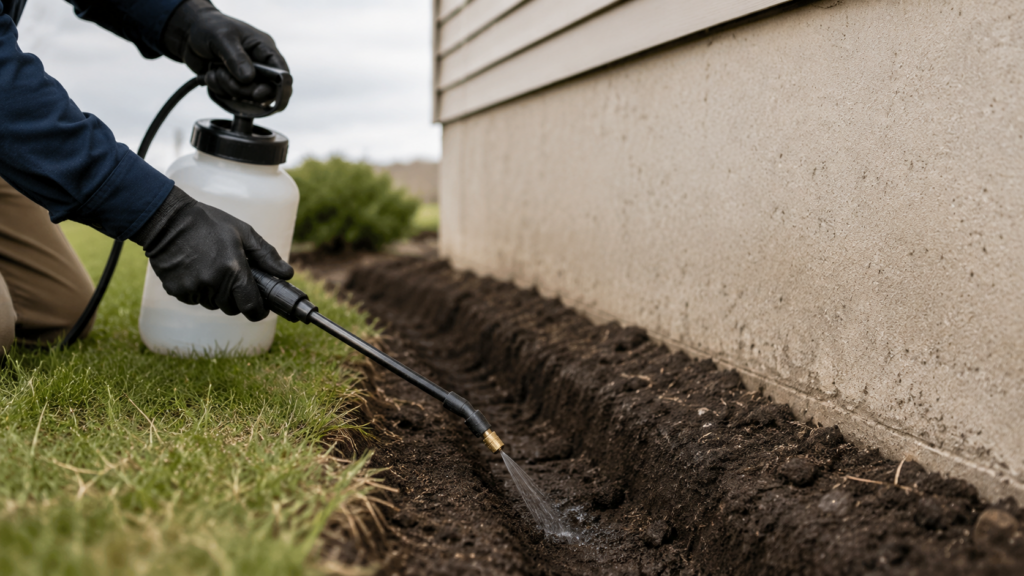
If subterranean termites are moving through the soil toward your home, a liquid termiticide applied around the foundation is one of the strongest treatment options. Unlike a small spot spray, soil treatment is designed to create a treated zone in the ground where termites travel between the colony and the structure. The two soil termiticides US homeowners most often compare are Termidor® SC and Taurus® SC. Both use fipronil 9.1%, both are non-repellent, and both require careful trenching and label-following. The best choice depends on your budget, bottle size, state restrictions, and whether DIY soil treatment is realistic for your foundation.
Affiliate and referral disclosure: PestsGuide may earn a commission from qualifying purchases or referrals through links in this article. This does not change your price or our editorial recommendations.
Quick Answer
- Best value pick for larger perimeters: Taurus® SC, especially if the 78 oz size is available for your state.
- Established brand comparison point: Termidor® SC is the better-known brand, but Taurus® SC is usually the stronger value pick for DIY soil treatment.
- Same active ingredient: both are fipronil 9.1% suspension concentrates.
- Best use case: subterranean termites and accessible soil around the foundation.
- Not ideal for: drywood termites, fully concrete-wrapped foundations, severe structural damage, or states where the product is restricted.
DIY soil-treatment option
Start with Taurus SC if value matters
Taurus SC uses the same fipronil 9.1% active ingredient as Termidor SC and is often the more practical pick when you need to treat a larger accessible perimeter. It still requires careful label-following, trenching, PPE, and state availability checks.
Before ordering, use the product page to review the current label, state restrictions, bottle size, and application directions so you know whether this treatment fits your foundation.
If you are still deciding whether soil treatment is worth doing yourself, read our guide on whether DIY termite treatment is worth it. If termites are already inside wood, also compare termite spot treatment foams and borate wood treatment.
Termidor SC vs Taurus SC: Quick Comparison
| Feature | Termidor SC | Taurus SC |
|---|---|---|
| Active ingredient | Fipronil 9.1% | Fipronil 9.1% |
| Type | Non-repellent soil termiticide | Non-repellent soil termiticide |
| Best reason to choose it | Established brand, widely associated with professional termite treatment | Often lower cost per ounce, larger bottle option |
| Common homeowner bottle size | 20 oz | 20 oz and 78 oz options through many retailers |
| Typical trench rate | 4 gallons of finished solution per 10 linear feet | 4 gallons of finished solution per 10 linear feet |
| Main limitation | Higher brand-name cost and state restrictions | Lower brand recognition and state-specific limits |
When Soil Treatment Makes Sense
A soil-applied termiticide is most useful when the termite problem is connected to the ground. That usually means subterranean termites, mud tubes, foundation activity, or a home in a high-pressure termite region.
Good fit signals: soil treatment is most relevant when you see termite mud tubes, signs of subterranean termites, or termite activity that appears to connect from soil to wood. If you only see dry pellets or frass, compare termite droppings first before choosing a soil product.
- you are dealing with subterranean termites;
- you have found mud tubes, swarmers, or damaged wood near the foundation;
- you want a long-lasting treated zone around the structure;
- the soil around your foundation is accessible;
- you can trench the full perimeter or hire help for the digging;
- you are comfortable reading and following the pesticide label exactly.
Soil treatment can be a strong DIY value when the foundation is accessible and the termite type fits the method. If your home has a full concrete wrap, patios on every side, or hardscape that cannot be drilled or trenched, soil treatment becomes much harder to do correctly.
When Soil Treatment Is Not Enough
Soil termiticides are powerful, but they are not the right answer for every termite problem. They are usually not enough when the termites are not traveling through the soil or when the infestation is already widespread inside the structure.
- you are dealing with drywood termites living inside wood members;
- termites are active inside walls, trim, flooring, or furniture away from the foundation zone;
- the foundation is fully covered by concrete or hardscape that cannot be trenched;
- the product you need is restricted in your state;
- there is visible structural damage or activity in multiple rooms;
- you are not physically able to dig, mix, and apply many gallons of finished solution.
For drywood termites or hidden wall-void activity, compare termite spot treatment foams. For widespread drywood activity, read about termite fumigation. If you are unsure whether DIY makes financial sense, see when to treat termites yourself and when to call a professional.
The Two Soil Termiticides Homeowners Actually Buy
Termidor® SC
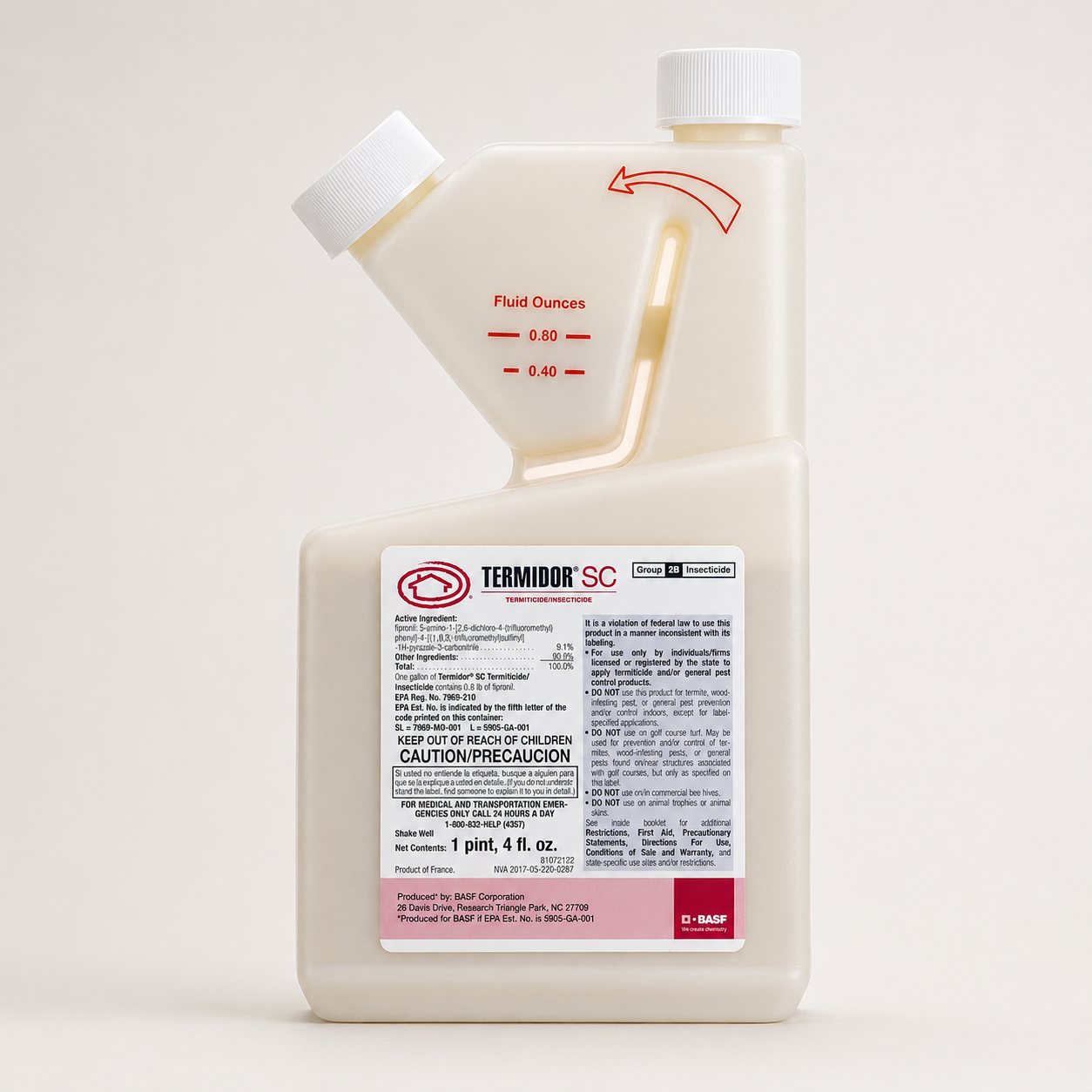

Comparison note: Termidor SC is included as the established brand benchmark. For most DIY full-perimeter soil treatments, compare it closely against the Taurus SC value option below.
Termidor® SC is the established brand most homeowners recognize when researching professional-grade soil termite treatment. Its active ingredient is fipronil 9.1%, a non-repellent compound termites do not detect as they move through treated soil.
Because termites continue walking through the treated zone, they can pick up the active ingredient and transfer it to other colony members through normal contact, grooming, and feeding. That transfer effect is why fipronil soil treatments can work beyond the exact strip of soil you apply.
Best for: homeowners who want the established brand, a 20 oz bottle, and a professional-style soil treatment around an accessible foundation.
Worth noting: Termidor is commonly more expensive per ounce than generic fipronil alternatives, and current retailer restrictions may block sale in some states or limit purchase to licensed applicators.
Pros
- Industry-standard fipronil chemistry
- Non-repellent treatment zone
- Transfer effect through normal termite contact
- Long residual when applied correctly
- Strong brand recognition
Cons
- Higher per-bottle cost than generic alternatives
- Commonly sold to homeowners in 20 oz size
- State restrictions may apply
- Requires trenching and backfill treatment
- Not a casual indoor spot treatment product
Taurus® SC
Value pick
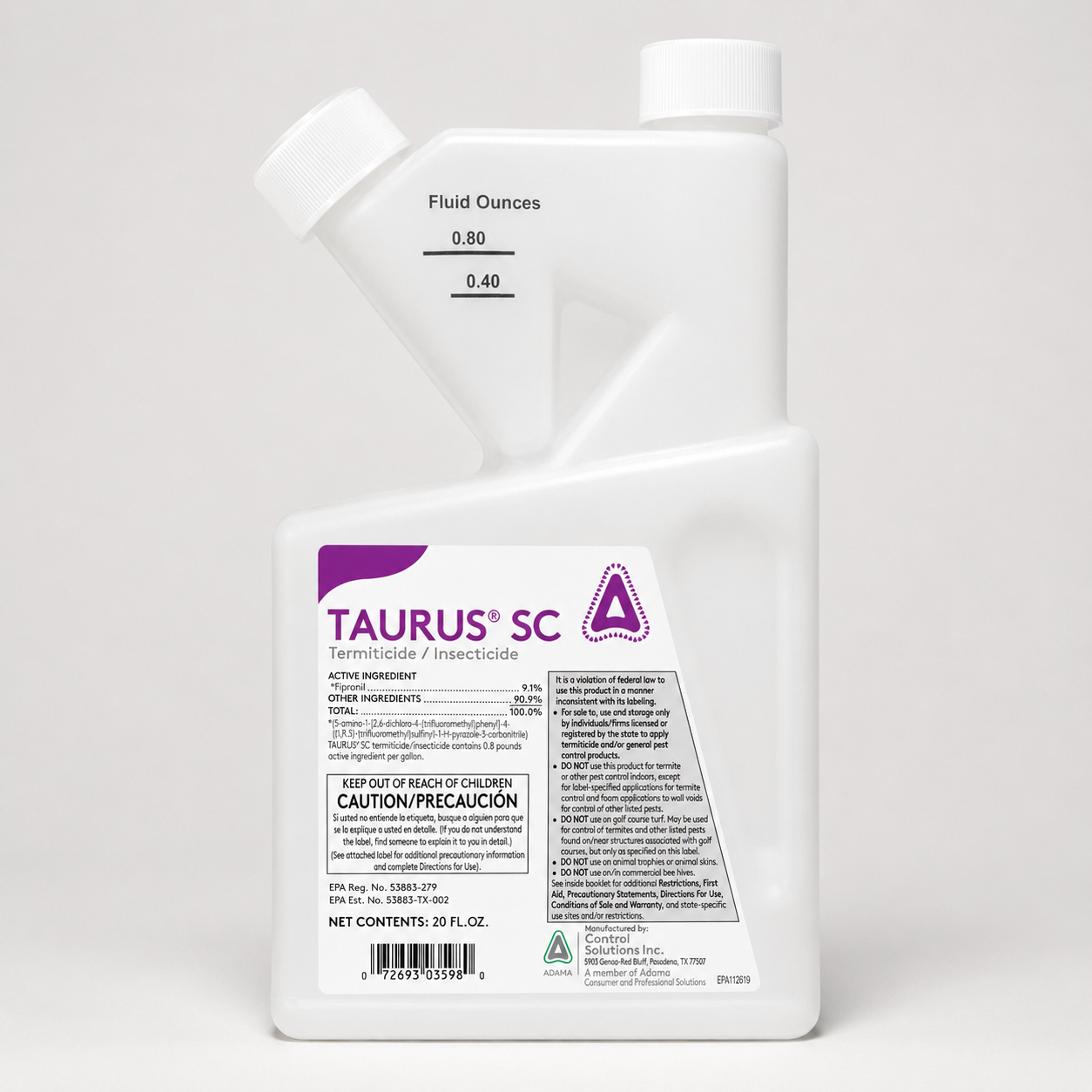
Taurus® SC is a generic fipronil soil termiticide with the same active ingredient concentration as Termidor: fipronil 9.1%. It uses the same basic non-repellent soil-treatment logic and is often the more practical choice for larger perimeters.
The main advantage is value. Taurus is commonly available in both 20 oz and 78 oz sizes through many retailers, so homeowners treating a full perimeter may be able to buy fewer bottles and reduce the per-ounce cost.
Best for: homeowners who want fipronil soil treatment at a lower per-ounce cost, especially when a larger bottle is available and legal in their state.
Worth noting: Taurus has its own state and label restrictions. For example, some post-construction uses may be restricted in certain states, so verify the current retailer page and label before ordering.
Pros
- Same active ingredient concentration as Termidor
- Often lower cost per ounce
- 20 oz and 78 oz options through many retailers
- Non-repellent transfer effect
- Strong value for full-perimeter treatment
Cons
- Lower consumer brand recognition than Termidor
- State restrictions can differ from Termidor
- Still requires trenching and careful application
- Not a shortcut for inaccessible soil or hardscape
- Label must be followed exactly
Which One Should You Choose?
If you want the most familiar brand name and only need a smaller bottle, Termidor® SC is the conservative comparison point.
If you are treating a larger perimeter and want the same fipronil chemistry with a larger bottle option, Taurus® SC is often the better value.
The active ingredient is not the real deciding factor because both products use fipronil 9.1%. The bigger questions are:
- Which product can you legally buy in your state?
- How many linear feet do you need to treat?
- Is a 20 oz bottle enough, or does a larger bottle make more sense?
- Can you trench and treat the full perimeter correctly?
- Would inspection be a better first step before buying product?
State Restrictions and Product Availability
Soil termiticides are regulated, and retailer availability can change. Before you order, check the current product page, current label, and your state pesticide rules.
| State / Situation | What to Check | Practical DIY Meaning |
|---|---|---|
| MA, MN, NY | Some retailers list Termidor SC as not for sale | Confirm availability before planning DIY soil treatment |
| CT, IN, SC, VT | Some Termidor sales may be restricted to licensed applicators | You may need Taurus, bait stations, borate, or a licensed pro |
| CA | Seasonal, dilution, label, and retailer restrictions | Check current rules before buying or applying either product |
| LA | Taurus post-construction limitations may apply | Verify label and retailer details before choosing Taurus |
| Fully hardscaped foundation | Whether trenching or drilling is realistic | DIY soil treatment may not be practical |
This table is a practical summary, not legal advice. Always read the current product label and check your state’s pesticide regulations before purchase or application.
How Soil Termiticide Treatment Works
Subterranean termites travel through soil. They build mud tubes between the underground colony and wood in or around the structure. Soil treatment puts a treated zone in that travel path.
Non-repellent termiticides do not push termites away. Older repellent treatments could cause termites to avoid treated soil and search for gaps. Fipronil products work differently. Termites do not detect the treated zone, so they continue moving through it.
The transfer effect is the value. Termites groom each other and share food. A worker that contacts fipronil in treated soil can carry it back to other termites. Results are not instant; colony decline can take weeks or months.
The treated zone must be continuous. A gap behind a shrub, under a deck, or near a pipe can let termites bypass the treatment. Full-perimeter coverage matters.
Backfill matters. When you dig a trench and pour solution into it, the removed soil also needs to be treated before it goes back. Untreated backfill can create a route over the treated layer.
How Much Product Do You Need?
The standard trench application is commonly 4 gallons of finished solution per 10 linear feet, but the label is the final authority for your exact situation.
As a rough planning example, a home with a 200-foot perimeter may require around 80 gallons of finished solution. A 20 oz bottle that makes about 25 gallons of finished solution may cover about 60 linear feet of trench at the standard rate. That means many full-home treatments need multiple bottles.
Cost warning: do not buy based only on bottle price. Calculate linear feet, finished gallons, state availability, and whether you can treat the full perimeter. A cheaper product that cannot be applied correctly is not a good value.
Tips for Better DIY Results
- Treat the full perimeter. Soil treatment is weakest where you skip a section.
- Measure the foundation. Estimate linear feet before ordering product.
- Use the label rate. Do not weaken the mix to stretch product.
- Use the 5-gallon bucket method. Many DIY users mix smaller batches instead of trying to manage one large tank.
- Treat the backfill. The soil removed from the trench should be treated before it goes back.
- Avoid saturated or frozen soil. Follow label directions for weather and site conditions.
- Wear PPE. Use chemical-resistant gloves, eye protection, long sleeves, long pants, and closed shoes.
- Keep people and pets away. Restrict access until the treated area is safe according to the label.
- Document the application. Save the product name, date, amount used, and treated areas.
- Keep monitoring. Pair soil treatment with foundation checks and, where useful, termite bait stations.
Common Mistakes Homeowners Make
- Treating only the visible mud tube. Subterranean termites may be active around more than one side of the home.
- Skipping hard-to-reach areas. A gap in the treated zone can reduce protection.
- Ignoring backfill. Untreated backfill can sit above the treated soil.
- Using soil termiticide for drywood termites. Drywood termites live inside wood and do not require soil contact.
- Applying before heavy rain. Do not apply to water-saturated soil or before conditions that conflict with the label.
- Buying before checking state restrictions. Availability and legal use can vary by state and product.
- Delaying inspection when damage is visible. If structural wood is damaged, read our guide to termite damage repair before covering anything up.
Not sure DIY soil treatment is realistic?
If your foundation is hard to trench, termites may already be inside the structure, or the products are restricted in your state, pause before buying more pesticide. Start with the DIY-vs-pro decision guide and inspection-cost guide so you do not spend money on the wrong treatment path.
DIY vs Pro Termite Treatment Guide Termite Inspection Cost Guide
FAQ
What is the best termite killer for soil treatment?
Termidor® SC and Taurus® SC are the two soil termiticides homeowners most often compare. Both use fipronil 9.1%. Termidor is the established brand; Taurus often offers better value for larger perimeters.
Is Taurus SC the same as Termidor SC?
They are not the same brand, but they use the same active ingredient concentration: fipronil 9.1%. The main differences are manufacturer, bottle sizes, pricing, brand recognition, and state restrictions.
How long does fipronil soil treatment last?
A correctly applied fipronil soil treatment can provide long residual protection, often described as up to 10 years for in-ground termite barriers. Actual performance depends on application quality, soil conditions, label directions, and whether the treated zone is continuous.
How much Termidor SC do I need for a house?
Plan by linear feet, not by square footage alone. The common trench rate is 4 gallons of finished solution per 10 linear feet. A 20 oz bottle can make about 25 gallons of finished solution, which is roughly 60 linear feet at that rate. Always follow the current label.
Can I use soil termiticide for drywood termites?
No. Soil termiticide is mainly for subterranean termites that travel between soil and wood. Drywood termites live inside wood and usually need a different treatment path, such as spot treatment, heat, or fumigation depending on scope.
What if my foundation is surrounded by concrete?
If you cannot trench the soil around the foundation, DIY soil treatment may not be realistic. A professional may drill through concrete and inject termiticide, or you may need bait stations, borate on accessible wood, or another treatment path.
Is fipronil safe around pets and children?
These products are used around homes when applied according to the label, but they are not casual household sprays. Keep people and pets away from treated areas until the label allows re-entry, and never apply to food, play surfaces, pets, or indoor living areas unless the label specifically allows it.
How soon will I see results after soil treatment?
Fipronil is designed to work through contact and transfer, not instant visible results. Colony decline can take weeks or months. Watch for new mud tubes, swarmers, or fresh damage over time.
Should I use bait stations instead of soil treatment?
Bait stations may be more realistic if you cannot trench the foundation, if product restrictions apply, or if you want monitoring instead of a liquid perimeter treatment. For some homes, bait stations and soil treatment can also be part of the same overall termite plan.
Final Thoughts
For DIY soil termite treatment, the choice is usually between established-brand Termidor SC and value-focused Taurus SC. Both use fipronil 9.1%, both require careful trenching, and both depend on a continuous treated zone around the foundation.
Choose Termidor® SC if you want the familiar professional-grade brand and the product is available for your state. Choose Taurus® SC if you want the same active ingredient with a larger bottle option and a lower per-ounce cost.
If the soil is accessible, the termite type is subterranean, and you can follow the label carefully, DIY soil treatment can be worth considering. If the infestation is hidden, severe, restricted by state rules, or hard to access, inspection is usually the better first investment.
Related Reading
- Is DIY Termite Treatment Worth It?
- Can I Treat Termites Myself or Do I Need a Professional?
- Best Termite Sprays for Spot Treatment
- 3 Best Termite Bait Stations for Home Protection
- Best Borate Wood Treatments for Termites
- Termite Inspection Cost: What Homeowners Should Expect
- Termite Damage Repair: Cost, DIY Fixes, and When to Hire a Pro
- Termite Fumigation: Preparation, Side Effects and Cost