


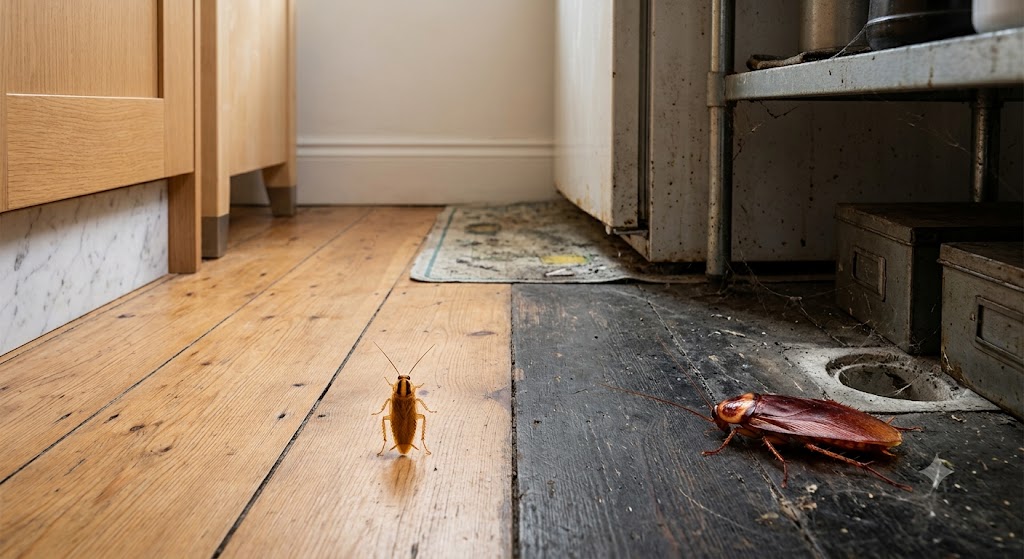
German cockroach vs American cockroach — these are the two species you’re most likely to find in a US home, and they need completely different treatment strategies. Get the ID wrong and you’ll waste weeks on the wrong product. This guide walks through how to tell them apart from what you see, where you see it, and what they leave behind, plus what changes about your treatment plan depending on the answer.
German Cockroach vs American Cockroach: The Short Answer
If it’s small (about ½ inch), light tan or brown, and you found it in your kitchen or bathroom — it’s almost certainly a German cockroach. Indoor breeder, fast reproduction, treated with gel bait plus an insect growth regulator (IGR) inside the home.
If it’s large (1¼ to 2 inches), reddish-brown, and appeared near a drain, garage, basement, or came in from outside — it’s an American cockroach. Outdoor-origin, slower reproduction, treated with a combination of exterior perimeter work and interior gel bait.
That’s usually enough to point you in the right direction. If you want to be sure — read on.
German Cockroach vs American Cockroach: Side-by-Side Comparison
| Feature | German Cockroach | American Cockroach |
|---|---|---|
| Adult size | ½ to ⅝ inch | 1¼ to 2 inches |
| Color | Light tan to medium brown | Reddish-brown, sometimes mahogany |
| Key marking | Two dark parallel stripes running down the pronotum (the shield behind the head) | Yellow figure-8 or halo marking around the edge of the pronotum |
| Wings | Present but rarely used for flight | Full wings; can glide short distances, especially in warm weather |
| Where they live | Indoor only — kitchens, bathrooms, near warm appliances | Outdoor origin — sewers, drains, mulch beds, crawlspaces; enters homes seeking food or moisture |
| Breeding speed | Egg case incubates ~28 days; each case holds 30–40 eggs; a female produces 4–8 cases and over 300 offspring in her lifetime (Univ. of Florida) | Slower — egg case hatches in 6–8 weeks; ~16 nymphs per case; fewer generations per year |
| Nymph appearance | Very dark, almost black, with a lighter stripe down the back | Grayish-brown, becoming reddish as they mature |
| Droppings | Look like ground coffee or black pepper; small, scattered | Larger, capsule-shaped, roughly the size of a rice grain with visible ridges |
| Primary treatment | Indoor gel bait + IGR; sanitation; sealing indoor voids | Exterior perimeter treatment + indoor gel bait at entry points; sealing plumbing penetrations and drains |
| Speed to eliminate | 2–4 weeks with correct treatment; longer if population is established | Faster if the outdoor colony is treated correctly; if only the interior is treated, they keep coming back indefinitely |
German Cockroach: Deep Dive
The German cockroach (Blattella germanica) is the species pest control professionals dread the most. It’s small, hard to see, breeds faster than any other roach in a US home, and has developed genetic bait aversion in some strains — meaning older bait formulas simply don’t work on all populations anymore.
How to identify one
- Size: adults are about ½ inch — roughly the length of a paperclip end-to-end. Nymphs are smaller and darker, often mistaken for beetles or bed bugs.
- Color: uniform light tan to medium brown across the body.
- Key marking: two thin, dark parallel stripes running down the pronotum. If you can see those two stripes, that alone is diagnostic — no other cockroach species has them.
- Behavior: stays hidden by day. If you’re seeing one in daylight, the population is already substantial.
Where they hide
German cockroaches live where it’s warm, humid, and close to food. Every one of those conditions is met in a kitchen. Their favorite harborage spots:
- Inside and behind the refrigerator motor housing (warm and dark)
- Under the sink, particularly in the corners where cabinet walls meet
- Behind and inside the dishwasher
- Inside microwaves that haven’t been cleaned in a while
- Cracks along the wall-cabinet joint
- Inside cardboard packaging (cereal boxes, pasta boxes)
- Behind and under the stove
They rarely stray far from a food and water source, so if you see one in the bathroom, that bathroom has moisture the roach is using — usually a small pipe leak, condensation on the toilet tank, or a slow drip somewhere.
Why they’re hard to eliminate
Three reasons German cockroaches are the toughest to remove:
- Reproduction rate. A female carries her egg case (called an ootheca) until just before it hatches. That means she’s protecting the next generation from any surface spray or trap. A new generation reaches breeding age in roughly 6 weeks.
- Bait aversion. Some populations have developed genetic resistance to glucose-based baits after decades of commercial use. Modern non-repellent baits like Advion (indoxacarb-based) or Vendetta (fipronil + IGR) were developed specifically to work around this.
- Indoor-only life cycle. Unlike the American species, there’s no “outdoor colony” to treat. Every roach you’re dealing with is inside your walls, appliances, or cabinets. Miss any hiding spot and the population rebuilds.
The proven approach: non-repellent gel bait in cracks and crevices (never on open surfaces where roaches won’t feed), combined with an insect growth regulator to break the reproductive cycle. Advion Cockroach Gel Bait is the current industry standard for German roaches — available on Amazon for fast shipping, or from DoMyOwn if you want it from a pest-control specialist retailer with pro-grade documentation.
American Cockroach: Deep Dive
The American cockroach (Periplaneta americana) is the giant one — the “palmetto bug” or “waterbug” many US homeowners see in warm climates. Despite the name, it’s not native to the Americas; it likely arrived on trade ships from Africa centuries ago. Today it’s found across the southern and coastal US, and turns up in northern homes wherever moisture and warmth combine (basements, boiler rooms, hospitals, restaurants).
How to identify one
- Size: 1¼ to 2 inches long, sometimes larger. Substantially bigger than a German cockroach — if you saw a “big roach,” this is almost always the one.
- Color: reddish-brown to mahogany, with a distinct yellowish figure-8 or halo pattern around the edge of the pronotum.
- Wings: full, functional wings. American roaches can glide from surface to surface, especially in warm humid weather. They rarely fly indoors but the capability is there.
- Speed: notoriously fast runners — clocked at about 50 body lengths per second (Journal of Experimental Biology, 1991), among the fastest running insects, though not the outright record-holder.
Where they come from
This is the crucial difference from German cockroaches: American cockroaches live outdoors by preference. They only come inside for food, moisture, or shelter from weather. The colonies you actually need to treat are in:
- Sewers and municipal drain systems
- Storm drains and outdoor drain covers
- Mulch beds around foundations
- Wood piles
- Compost heaps
- Crawlspaces and basements (especially damp ones)
- Sub-slab voids under concrete slabs
- Palm tree bases and dense outdoor vegetation (in southern climates)
They enter your home through drain traps that have dried out, gaps around plumbing penetrations, cracks in foundations, garage door bottoms, and unscreened dryer vents. If you’re finding American cockroaches indoors regularly, the problem isn’t inside your house — it’s the outdoor population, and interior spray treatment alone won’t fix it.
Why interior-only treatment fails against American cockroaches
This is one of the most common mistakes homeowners make. You see a big roach in the kitchen at night, you buy a bait or a spray, you treat inside — and the roaches keep appearing every few weeks. That’s because the actual colony is outside, feeding and breeding somewhere you’re not treating, and sending scouts through the same entry points each time.
Effective treatment for American cockroaches has two prongs:
- Exterior perimeter work — granular bait around the foundation, especially near mulch beds; sealing plumbing and utility penetrations; keeping mulch pulled back from siding; running water down rarely-used floor drains monthly to keep the trap seal intact.
- Interior gel bait at entry points — where roaches actually cross into the home. Baseboards near drains, gaps under sinks, garage door thresholds.
Because American cockroaches breed more slowly than Germans, once you cut off the entry route and treat the outdoor source, the interior activity usually drops off within 2–3 weeks. But cut off just the interior and they’ll come back forever.
Brief Notes on the Other Species You Might Encounter
German and American cover roughly 90% of US household cockroach encounters, but a few other species turn up regularly enough to mention:
Oriental cockroach (Blatta orientalis)
Medium-sized (about 1 inch), very dark — nearly black — with a distinctive greasy sheen. Prefers cool, damp environments: basements, drains, crawlspaces, under porches. Slower and less agile than the other species. Often the first cockroach spotted in older homes with humidity issues. Treatment approach is similar to American cockroach (exterior + entry point), with special attention to moisture control.
Brown-banded cockroach (Supella longipalpa)
Small (about ½ inch), light brown with two distinctive pale bands running horizontally across the wings and abdomen. Unlike the German cockroach, it prefers dry, warm environments and often turns up in unexpected places — behind picture frames, inside electronics, in upper cabinets, in bedroom furniture. This is the species that gets misidentified as German most often. Treatment is similar (indoor gel bait + IGR), but bait placement needs to cover the entire home, not just kitchen and bathroom.
Smokybrown cockroach (Periplaneta fuliginosa)
Common in the southeastern US. Slightly smaller than American cockroach (~1¼ inches), uniformly dark mahogany with no yellow banding. Lives outdoors in tree canopies and can enter attics through soffit gaps. Treatment is similar to American cockroach, with attention to eaves and roofline entry points.
Which Treatment Approach for Which Roach
The species you’re dealing with dictates where you focus your treatment. Here’s the summary:
- German or Brown-banded → indoor-focused treatment. Gel bait (Advion or equivalent) in cracks and crevices throughout the home. Insect growth regulator (Gentrol Point Source or similar) to break the breeding cycle. Sanitation, moisture control, and sealing indoor voids.
- American, Oriental, or Smokybrown → exterior-focused treatment. Granular bait around the foundation. Seal plumbing and utility penetrations. Interior gel bait only at entry points, not throughout the home.
- Not sure which species → set monitoring traps (sticky glue boards) along baseboards and behind appliances for 3–5 nights. The size and appearance of what you catch tells you.
Once you’ve settled the German cockroach vs American cockroach question, the next question is how established the population actually is. Our guide to the signs of a cockroach infestation walks through what to look for. For the full picture of DIY cockroach control — where to start, what order to do things in, and when to call a professional — start with our cockroach control hub.
Frequently Asked Questions
Can I have German and American cockroaches at the same time?
Yes, and it’s more common than people realize, especially in older homes and multi-unit buildings. The two species occupy different niches — Germans in kitchens and bathrooms, Americans in basements, drains, and crawlspaces — so they don’t compete directly. If you have both, you need both treatment strategies running in parallel, not a single approach.
Are baby cockroaches always German cockroaches?
No. Every roach species goes through nymph stages, and juvenile American, Oriental, and Brown-banded roaches can look superficially similar to adult Germans in size and color. Two clues help: German nymphs are almost black with a lighter stripe down the back; American nymphs are grayish-brown and shaped more like miniature adults. If you’re finding small dark roaches in a basement, they’re much more likely American nymphs than adult Germans.
Do “waterbugs” and “palmetto bugs” mean American cockroaches?
Usually yes. Both are informal regional names — “waterbug” is common in the northeast and midwest, “palmetto bug” in the southeast — and both almost always refer to the American cockroach. Technically there’s a true waterbug (family Belostomatidae, an aquatic insect), but if someone says they saw a “waterbug” in their basement or kitchen, they mean an American cockroach.
If I see one in daylight, does that automatically mean a bad infestation?
For German cockroaches, almost always yes — they’re strongly nocturnal, and daytime sightings usually mean the hiding population has outgrown available shelter. For American cockroaches, not necessarily — they’re nocturnal but larger and slower, and one can wander into a room during the day if disturbed or if it entered recently from outside. Context matters: a large roach in the basement at 2 pm might be a lone scout; a small tan roach on the kitchen counter at 2 pm signals a real problem.
Do the same products work on both species?
The same gel baits (Advion, Combat, Maxforce) work on both sides of the German cockroach vs American cockroach question — the active ingredients kill any cockroach species that consumes them. What differs is where you apply them and what you combine them with. For German cockroaches, indoor gel bait placement throughout the home plus an IGR. For American cockroaches, exterior perimeter treatment matters more than indoor bait, and interior bait is targeted at entry points rather than everywhere.
PestsGuide gives independent DIY pest control guidance for US homeowners and renters. When you buy through links on this page we may earn a commission, at no extra cost to you.